contact@synergytop.com
 +1 619-349-4911






Key Takeaways
- Renewable energy capacity is expanding faster than operators can manage manually, making software essential for monitoring, forecasting, optimization, and asset management.
- The right renewable energy software connects operational data, devices, people, and business workflows instead of creating another isolated dashboard.
- Core capabilities include real-time monitoring, asset management, analytics, reporting, alerts, forecasting, integrations, security, and role-based access.
- AI, IoT, cloud computing, and advanced data analytics are making renewable energy software more predictive, automated, and useful for day-to-day decisions.
- Custom development makes more sense when your operations, assets, workflows, or integrations do not fit neatly into an off-the-shelf platform.
Renewable Energy Software Development Is Becoming an Operational Necessity
In 2024, the world added 585 GW of renewable power capacity, a record annual increase that represented 92.5% of total power capacity expansion globally. IRENA also reported that renewable capacity reached 4,448 GW by the end of 2024.
But adding renewable capacity is only one part of the problem.
Solar farms, wind turbines, battery systems, distributed energy resources, grid connections, maintenance teams, energy traders, and customers all generate data. Someone has to collect it, interpret it, and act on it.
That is where renewable energy software comes in.
Software has moved from being a supporting tool to becoming part of the operating infrastructure of renewable energy businesses. The IEA’s 2026 analysis of modern electricity grids points to AI, monitoring systems, forecasting, optimization, and other digital technologies as increasingly important for making better use of existing energy infrastructure.
At SynergyTop, we have spent 12+ years building renewable energy software around complex business workflows, integrations, data, and automation. That experience leads to one straightforward view: renewable energy software should be designed around the operation first and the technology second.
In this blog below, we explain what that means, what a renewable energy software should include, how development typically works, and what it can cost.
What Is Renewable Energy Software Development?
Renewable energy software development is the process of designing and building digital applications that help renewable energy companies monitor, manage, analyze, forecast, and optimize energy generation and related business operations.
The software can support solar, wind, hydro, geothermal, battery storage, distributed energy resources, or multiple energy sources at once. Depending on the business, it may include asset monitoring, energy forecasting, maintenance management, customer portals, project management, billing, reporting, grid integrations, IoT connectivity, and AI-powered analytics.
The important point is that renewable energy software is not one specific product. It is a category of systems built around a particular energy operation.
Benefits of Renewable Energy Software Development
The business case is straightforward. Renewable energy operations produce large volumes of constantly changing information. Software turns that information into something teams can actually use.
Better Visibility Into Energy Assets
A centralized system gives operators a single view of generation, equipment health, performance, alarms, maintenance activity, and historical data. That makes it easier to identify problems before they become expensive operational issues.
Faster Operational Decisions
Instead of waiting for spreadsheets, emails, or separate monitoring systems, teams can access current information from one platform. This shortens the distance between detecting a problem and deciding what to do about it.
Lower Maintenance Costs
Software can track equipment history, maintenance schedules, service requests, and performance anomalies. With enough historical data, teams can move from purely reactive maintenance toward condition-based FAQsand predictive maintenance.
More Accurate Energy Forecasting
Generation from solar and wind changes with weather and operating conditions. Forecasting software combines historical production, weather information, asset data, and other inputs to improve estimates of expected generation.
Stronger Regulatory And Business Reporting
Renewable energy businesses often need detailed production, operational, financial, and compliance reports. Automated reporting reduces manual data collection and gives management a consistent source of information.
These benefits reinforce each other. Better data improves forecasting. Better forecasting improves planning. Better planning improves asset utilization. The software becomes useful because the pieces are connected, not because it has a long feature list.
Types of Renewable Energy Software Solutions
There is no single renewable energy application that fits every company. The right system depends on what the business owns, operates, sells, or manages.
Renewable Energy Monitoring Software
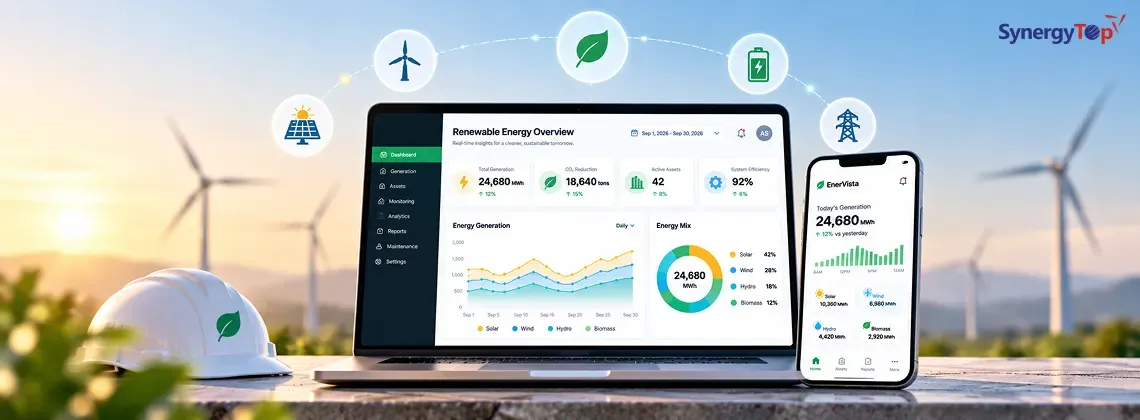
Monitoring platforms collect information from renewable assets and present it through dashboards. Operators can track generation, equipment status, performance, alerts, and other operational metrics in near real time.
Solar Energy Management Software
Solar platforms can manage photovoltaic assets, generation data, inverter information, performance ratios, maintenance activities, forecasting, and reporting across individual installations or large portfolios.
Wind Energy Management Software
Wind software focuses on turbine performance, production data, equipment condition, maintenance, weather inputs, alerts, and operational analytics. Larger platforms can manage data across multiple wind farms.
Renewable Asset Management Software
Asset management platforms provide a broader operational view. They can combine equipment records, maintenance schedules, work orders, warranties, inspections, performance information, and financial data in one system.
Energy Trading And Forecasting Software
These systems help energy companies forecast generation and demand, analyze market information, manage schedules, and support trading or energy procurement decisions.
Renewable Energy Customer Platforms
For businesses selling energy services directly to customers, software can provide consumption information, billing, energy production data, service requests, notifications, and customer self-service capabilities.
The categories often overlap. A mature renewable energy business may need several of these capabilities inside one connected platform rather than maintaining separate applications for each function.
Must-Have Renewable Energy Software Features
The exact feature set depends on the use case, but a reliable renewable energy platform needs a strong operational foundation before advanced technology is added. The must-have features include:
- Real-time energy production monitoring
- Asset and equipment management
- Performance dashboards
- Alerts and notifications
- Maintenance scheduling
- Work order management
- Historical data storage
- Energy generation forecasting
- Weather data integration
- User and role management
- Reporting and analytics
- API integrations
- Mobile or responsive access
- Data security and audit logs
- Cloud-based infrastructure
- Backup and disaster recovery
These are the basic features which are necessary, but no longer enough for many larger or more data-intensive operations. Beyond these, here are some of the must-have advanced features that a renewable energy software must have:
AI-Powered Forecasting And Optimization
AI can analyze historical production, weather, asset behavior, and operational data to improve forecasts and identify patterns that are difficult to spot manually. The IEA identifies forecasting, anomaly detection, diagnosis, simulation, and optimization as important AI applications for modern power systems.
IoT-Based Asset Monitoring
IoT devices can continuously capture information from inverters, turbines, batteries, sensors, meters, and other equipment. That data can feed directly into the software, creating a much clearer picture of asset health and performance.
Cloud-Based Data And Analytics
Cloud infrastructure makes it easier to bring data from multiple locations into one system and scale storage and computing as the renewable portfolio grows. It also supports remote access, centralized analytics, integrations, and faster software updates.
The technology should serve the operation rather than becoming the project. AI, IoT, and cloud capabilities are valuable when they improve a measurable business process.
The Process of Getting Renewable Energy Software Developed
A renewable energy software project should start with the most pressing operational problem that you are facing, not a technology stack. A sensible development process usually looks like this.
Step 1. Business And Technical Discovery — 1–2 Weeks
The development team maps users, assets, workflows, data sources, integrations, reporting requirements, security needs, and business goals. This is where unnecessary features should be removed before they become development costs.
Step 2. Product And UX Design — 2–4 Weeks
The team turns requirements into user journeys, information architecture, wireframes, and interface designs. Dashboards need particular attention because energy software can expose large amounts of information without making it useful.
Step 3. Architecture And MVP Development — 8–16 Weeks
Developers build the core application, database, APIs, authentication, dashboards, and primary workflows. For a focused product, this stage produces the first usable version that real users can test.
Step 4. Device And Third-Party Integrations — 3–8 Weeks
Integrations connect the platform with meters, IoT devices, weather services, ERP systems, CRM platforms, payment systems, energy marketplaces, or other required data sources. The exact timeline depends heavily on API quality and hardware compatibility.
Step 5. AI, Analytics And Automation — 4–10 Weeks
Once enough reliable data is available, advanced analytics, forecasting, anomaly detection, predictive maintenance, or optimization can be introduced. Building these capabilities before the data foundation is ready usually creates problems later.
Step 6. Testing, Security And Deployment — 3–6 Weeks
The system goes through functional, performance, integration, security, and user acceptance testing. Deployment also includes monitoring, backups, access controls, documentation, and production readiness.
For a focused renewable energy application, an MVP can commonly take around 3–5 months. A larger platform with multiple integrations, IoT connectivity, advanced analytics, and complex workflows can take 6–12 months or longer.
The timeline should be driven by scope and integration complexity, not by an arbitrary launch date.
The Cost of Getting Renewable Energy Software Developed
There is no meaningful single price for renewable energy software. A monitoring dashboard and a multi-site energy management platform are completely different engineering projects.
As a practical planning range, custom development can look like this:
| Solution type | Typical development range |
| Basic monitoring/dashboard platform | 50,000 |
| Solar or wind management platform | 90,000 |
| Asset and maintenance management platform | 100,000 |
| Energy forecasting and analytics platform | 120,000+ |
| IoT-enabled renewable energy platform | 150,000+ |
| Large multi-module energy management platform | 250,000+ |
These are planning ranges for custom software, not fixed market prices. The actual estimate should come from the workflows, integrations, data architecture, and technical requirements.
- Number and type of renewable energy assets
- Number of users and locations
- IoT hardware and device protocols
- Third-party APIs and integrations
- Real-time data requirements
- AI and machine learning requirements
- Mobile application requirements
- Dashboard and reporting complexity
- Security and compliance requirements
- Cloud infrastructure and data volume
- Existing systems that need to be connected
- Ongoing support and maintenance requirements
One of the biggest cost mistakes is treating integrations as a small add-on. Connecting to a clean modern API is one thing. Connecting to multiple hardware vendors, legacy systems, inconsistent data formats, and unreliable endpoints is another.
That difference should be discovered during technical planning, not after development begins.
Building the Renewable Energy Software of the Future
Renewable energy is scaling quickly, but scale creates an operational problem of its own. More assets mean more devices, more data, more variability, more maintenance decisions, and more systems that need to communicate with each other. The next generation of renewable energy software will not simply display more information. It will help teams decide what information matters, predict what is likely to happen next, and automate the actions that do not need human intervention. That means the strongest platforms will combine dependable software fundamentals with AI, IoT, cloud infrastructure, and well-designed data architecture.
At SynergyTop, we bring 12+ years of software development experience to complex business applications, integrations, automation, cloud solutions, and data-driven products. If you are planning a renewable energy platform or replacing disconnected systems with one unified solution, schedule a consultation with SynergyTop’s experts to discuss your requirements, technical approach, timeline, and development estimate.
FAQs
Should I get custom renewable energy software developed or use an off-the-shelf solution?
Choose off-the-shelf software when your workflows are standard and the platform already supports your assets, integrations, reporting, and users. Choose custom development when your operations are specialized, you need proprietary workflows, or multiple systems must work together.
What are the challenges of getting renewable energy software developed?
The biggest challenges are usually data quality, hardware and API integrations, real-time processing, cybersecurity, scalability, and translating complex energy workflows into simple interfaces. AI also requires reliable historical data, so advanced analytics should not be treated as a starting point.
How do I find a renewable energy software development company?
Look for a team with experience in complex integrations, cloud systems, data platforms, IoT, analytics, and enterprise workflows rather than only general web development. Ask for relevant case studies, technical architecture examples, development timelines, security practices, and a clear approach to post-launch support.