contact@synergytop.com
 +1 619-349-4911




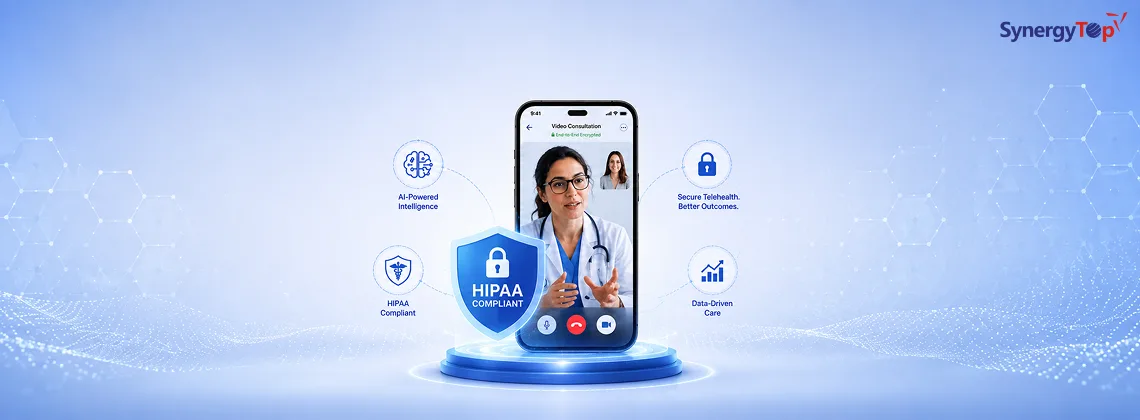


The development of contemporary telehealth is no longer a time-consuming and complicated process. By developing AI-based telemedicine apps, teams are able to develop secure and scalable systems in a more expeditious and understandable manner. This will make the compliance process easier, enhance workflow, and maintain the focus on the delivery of a reliable HIPAA-compliant telehealth app that can be relied upon by patients and providers.
A Fast Start: Why AI Changes Everything
In the past, developing a HIPAA-compliant telehealth app was a tedious and complicated task. In 2026, that completely changes with AI in creating telehealth applications. AI can plan, write the code, test security and even write compliance documents. It can also help the teams to work faster without forgetting their purpose of patient privacy or product quality.
AI eradicates most of the friction in case you desire to create a telehealth app. Automation of the heavy lifting has now been achieved but still human observation is required. This means that teams will not have to spend as much time on duplicative work and concentrate more on strategy and patient experience.
What This Shift Means in Practice
It is not just a matter of speed. It is regarding smarter implementation and better workflows. AI introduces order to all steps of developing telehealth apps services.
- Reduced delays and shorter development cycles
- Enhanced security testing without overloading
- Effective compliance guidance at the start
- Less effort in operations between teams
- Better emphasis on user experience and results
AI simplifies issues where it was previously not achievable. It establishes a harmonious solution in which both human judgments and automation collaborate with each other. This renders the process more trustworthy, expandable and manageable to contemporary healthcare applications.
The HIPAA Rules That Do Matter
Encryption is not the sole feature of a HIPAA-compliant healthcare application. It is concerning the way your application manages the protected health information (PHI) across systems. The workflow should be biased towards privacy, access control, and accountability.
In order to develop a telehealth app, you will need to ensure:
- Information is safeguarded
- Access is controlled
- The vendors are HIPAA compliant.
- Audit logs are kept
- Patient confidentiality is ensured.
- What AI Is Capable of in this case.
What AI Can Handle Here
- Visualize PHI flow
- Generate compliance checklists
- Suggest HIPAA-ready workflows
- Flag risky integrations
- Draft policy documents
This makes it easier to develop healthcare apps with the help of AI. It also gives the teams more appropriate guidance towards compliance at an earlier point.
Bringing Compliance to Life
Rules are not the only thing with compliance. It is concerned with regular implementation in systems. AI assists teams to remain focused without complicating them.
- Clarity of data movement
- Timely identification of non-compliance
- Formatted records without time wastage
- Improved coordination amongst development teams
AI makes decisions that are usually unclear clear. It lowers the level of guesswork and aids planning. This brings about predictability and manageability of the process in the real world healthcare application development service environment.
Step 1: Let AI Map the Risks
Every HIPAA-compliant app development process starts with a risk assessment. AI can scan your entire system and identify the location where PHI is disclosed. It helps the teams to detect the problems early instead of realizing the problem after the launch. This clarity at an early stage saves stress and unnecessary expenses in the future.
It creates:
- Risk reports
- Threat models
- Vulnerability lists
- Compliance documentation
AI simplifies the initial step and makes it less intimidating. It provides direction to the teams prior to the commencement of development. This will minimize confusion and enhance confidence in decision-making.
Use AI to Do the Boring Part
Risk analysis is rather tedious and time consuming. When done manually, it can be a drag. AI takes away that work load and enables teams to operate more quickly and more accurately.
AI can quickly:
- Following of application data flow
- Identify areas of weak authentication
- Highlight storage risks
- Rank threats in order of severity
- Suggest fixes automatically
This is where AI-based healthcare solutions can save time to save lives. It also makes the entire compliance process easy to control and audit.
Step 2: Design a Secure-by-Default System
Security cannot be an afterthought when you develop a telemedicine app. AI will help to create a system where compliance is architected. It can even propose safer patterns before development. This will eliminate confusion and instill trust initially. It makes sure that later decisions are not taken in a hurry. It establishes a robust and firm base of success in the long run.
It suggests the enhanced design of:
- Secure APIs
- Role-based access
- Data encryption layers
- Microservices separation
- Audit logging
AI introduces sanity to system design. It assists teams to escape superfluous complexity. It ensures that everything is on track with compliance at the outset.
Keep the Architecture Lean
Complex systems tend to pose a higher risk and confusion. They are more difficult to control and more difficult to get. A lean structure simplifies everything to be controlled and enhanced.
The best approach to the development of a telehealth app would be to:
- Minimal data collection
- Controlled access levels
- Isolated sensitive services
- Transparent audit trails
- Easy third-party review
AI will help you keep everything clean and orderly. It simplifies the app to be easier to secure, scale and maintain overtime.
Step 3: Build the Features Patients Will Use
This is accompanied by the actual telehealth app development services layer. AI is quick and efficient in creating majority of the product features. It helps in transforming a complex concept into an application that can be more easily applied than the traditional ways. This phase is more tangible and patient-involved. It transforms concepts into experiences that can be applied by individuals. It introduces value that is visible to the users.
The Best AI-Assisted Build Order
Without structure, feature development can be confusing. It can cause delays and irregular experiences. AI provides an evident direction that makes everything focused and simple to track.
The optimal AI-based build order:
- Safe log-in and patient registration
- Appointment scheduling system
- Video consultation and chat
- E-prescriptions and notifications
- Admin dashboard and analytics
AI can write code, develop user interface, and even optimize processes. This hastens the creation of AI healthcare applications in the past. It also helps in ensuring that patients and providers go through easier transitions.
Step 4: Pick a Stack AI Can Support Well
In the development of a healthcare app, the selection of the suitable stack is extremely important. The AI will be in a position to propose scalable, safe, and easily maintainable technologies. It can also compare options based on performance and flexibility and compliance requirements.
This choice will determine your future application. It affects stability, speed and long-term growth. It also determines the ease at which your system can change over time.
A Realistic AI-Friendly Stack
The decisions to make regarding technology can be daunting. Options and trade-offs are too many. This is simplified by AI providing intuitive and real-world suggestions.
The appearance of a realistic AI-friendly stack is as follows:
- Modern frontend framework
- Secure backend APIs
- HIPAA-ready cloud storage
- Strong authentication systems
- Watching and recording devices
AI is used to maintain a consistent and optimized telemedicine app development stack. It minimizes confusion in the development process and enhances the overall balance of the system. This will reduce the amount of technical debt and subsequent updates will be much easier to manage.
Step 5: Test, Monitor and Keep Improving
There will never be a HIPAA-compliant telehealth application. It must be regularly observed. This is completely automated by AI. It also keeps an eye on threats, errors and non-conformance even after launch. This phase maintains your system in operation and security. It makes sure that your app does not lag behind novel risks. It establishes long-term patient and provider trust.
AI operates in the background. It continues to examine what can be missed by humans. It establishes a protective barrier that will not fail.
Let AI Watch the App After Launch
Most systems are vulnerable in post-launch. Minor problems may escalate when left unattended. Constant surveillance maintains everything in check and order.
AI helps with:
- Automated security testing
- Real-time monitoring
- Log analysis
- Threat detection
- Compliance reporting
This is where AI in healthcare software development comes in. It keeps your app secure without coding. It also helps your team to respond faster to a change.
The Mistakes That Break Compliance
Even the most qualified teams make mistakes when developing telehealth apps. The difference is that they are getting them at an early age. AI will give you a better chance to find out those mistakes before it becomes a big issue. These errors are usually minor yet can be very disastrous. They are able to affect trust, security and stability in the long run. It is better to avoid them at an early stage and the whole trip will be easier and less chaotic.
Possible Fallacies to Be Careful of
Errors do not necessarily present themselves at first sight. They tend to conceal themselves within the quick development cycles. AI assists in bringing those unseen risks into the limelight.
- Skipping risk assessments
- Using non-compliant vendors
- Over-collecting patient data
- Ignoring software updates
- Poor access controls
AI can identify these issues at the initial phase of your healthcare application development service. It will mean that there will be fewer surprises and a much higher chance that there will be no compliance problems in the future.
Why Little Things Matter a Lot
Minor loopholes may easily develop into significant failures. They have the ability to violate compliance without prior notice. Everything is kept in check by early detection.
- Fewer legal and security risks
- Better system reliability
- Stronger compliance confidence
AI serves as an early warning mechanism. It assists teams to remain vigilant and ready. It enables the development process to be more secure and easier to control.
The Final Shift: Smarter, Faster, and More Confident Development.
In 2026, building a HIPAA-compliant telehealth app is no longer overwhelming. The majority of the work will be quicker, smarter, and more organized with the development of AI-powered telemedicine apps. It provides teams with a realistic method of developing rather than trial and error. This transition is more natural and less stressful. It eliminates uncertainty in the process. It provides teams with a better sense of direction.
What is really effective in this shift:
- Reduced manual work and repetitive work
- More rapid decision making and clarity
- Enhanced attention to patient experience
- Greater conformance alignment early on
- More controlled and planned flow of development
The way it transforms the development mindset:
- From misunderstanding to understanding
- Delays to speed of execution
- Guesswork to sure planning
- Complexity to simplicity
AI addresses the complexity. You are focused on patient experience and development. The real merit is that. This is where AI in healthcare software development really comes in handy. It does not overburden teams. It is a mere transformation that changes the whole process of development.
FAQs
1. Is AI capable of creating a HIPAA-compliant telehealth app?
Yes, the majority of the development, testing and documentation is doable with AI. Nonetheless, human judgment remains to be applied in compliance choices. It makes sure that the decisions made are accurate and responsible. It also provides an element of trust to the final product.
2. What is the price of building a telehealth application?
Features can affect the price, but AI in telehealth application development can significantly reduce the time and costs of development. It minimizes the needless operational expenses. It also assists in improved budget planning.
3. What is the time span of developing telehealth apps?
With the help of AI, a simple one can be created in a significantly shorter period of time than the conventional one in weeks, not months. It accelerates all the developmental stages. It also enhances delivery schedules.
4. What does a telemedicine application need?
A telemedicine app should include video consultation for real-time care and secure messaging for safe communication. It also needs appointment booking to manage schedules efficiently. In addition, features like e-prescriptions and patient records are essential to ensure smooth treatment and better continuity of care.
5. What is the importance of HIPAA compliance in healthcare apps?
It offers a very high degree of protection of patient information, legal safety and trust, especially sensitive health information. It fosters a relationship between patients and providers. It also minimizes the possibility of legal problems.