contact@synergytop.com
 +1 619-349-4911




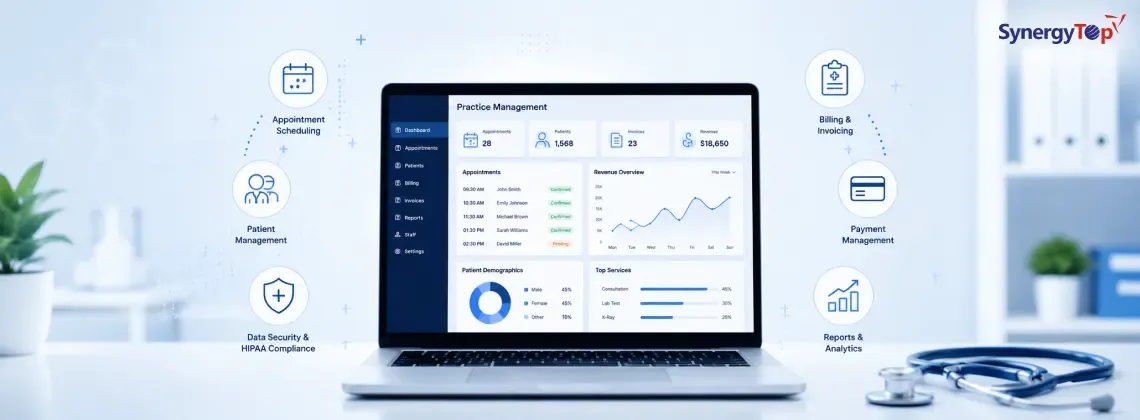


In healthcare environment, there is a growing pressure for healthcare providers to provide high-quality patient service while operating efficiently. Administrative tasks are becoming more complex – from patient scheduling and registration to medical billing and claims processing. These processes are often error-prone, inefficient, and can result in lost revenue and appointments if managed manually.
In the healthcare sector, which is continuously looking for methods to enhance patient satisfaction and operational efficiency, technology has emerged as a key element in healthcare operations. healthcare practice management software comes into a big picture here. The automation of administrative and financial processes can help healthcare organizations to streamline their daily operations, minimize manual workload, and increase productivity.
Healthcare practice management software pms is increasingly being embraced by modern healthcare facilities to ease operations, improve patient engagement and bolster revenue cycle management.
Is Your Clinic Losing Money Because of Inefficient Practice Management?
Many healthcare providers don’t realize how much revenue is lost through manual scheduling, billing errors, missed appointments, duplicate administrative work, and disconnected systems. These operational inefficiencies increase staff workload, delay patient care, and reduce profitability.
The right healthcare practice management software helps automate routine processes, improve operational visibility, reduce administrative costs, and allow healthcare teams to spend more time focusing on patient care instead of paperwork.
What Is Healthcare Practice Management Software?
Healthcare practice management software is an online system designed to handle the administrative and financial aspects of healthcare practices, from appointment scheduling and patient registration to billing, claims handling, insurance verification, reporting and patient communication.
This software is tailored for healthcare organizations, consolidating all operational aspects onto a single platform to streamline management and enhance efficiency and accuracy. Healthcare providers can focus their efforts on patient care rather than administrative tasks by having routine tasks automated and performance of the practice visible in real-time.
Practice Management Software Definition
The definition of practice management software definition is simple: it’s a technology solution to help manage the business and administrative aspects of healthcare operations. Clinical systems are used more for clinical documentation of patient care, whereas practice management systems are used more for scheduling and billing processes, communication, and revenue management.
The idea of PMS – Practice Management Software has undergone a lot of changes over the years. Today’s systems include automation, cloud access, analytics, and AI to enhance efficiency.
Healthcare organizations choose to use PMS solutions due to the fact that they can help them not only decrease administrative burden, but also enhance the efficiency of their workflows and ensure sustainable business development.
What Is Practice Management Software in Healthcare?
Many healthcare professionals ask, what is practice management software in healthcare and how it differs from other healthcare technologies.
In healthcare settings, practice management software is the backbone of a medical practice. It is responsible for managing patient scheduling, registration, verifying insurance information, billing, claims processing, and reporting, and supports the efficient workflow of healthcare providers.
Most of the software applications usually contain the following elements:
- The appointment schedule and patient management system
- The signing up and intake process
- Insurance verification
- Medical billing and coding
- Revenue cycle management
- Reporting and analytics
It is crucial to grasp the concept of practice management software pms in healthcare, as it directly affects patient satisfaction, efficiency, and financial results.
Healthcare organizations can enhance patient experience and ensure a streamlined billing and reimbursement process by streamlining administrative complexity.
What Functions Does Practice Management Software Perform?
Many healthcare providers are asking themselves what functions does practice management software perform in a healthcare organization? The modern practice management systems are created to optimize administrative, financial and patient facing work for healthcare facilities, to make things more efficient, decrease mistakes and improve patient experience. They streamline repetitive tasks, freeing up time for providers and staff to dedicate to quality patient care.
Appointment Scheduling and Calendar Management
One of the key aspects of a practice management software is scheduling. With modern solutions, you can have online appointment booking, provider calendar management, room and resource management, a waitlist, and automated reminders. These features can help ease the scheduling hassle, reduce patient appointments being missed, and enhance patient access to healthcare. Efficient scheduling also helps providers to make the most out of the time they have and keep their workflows productive.
Patient Registration and Intake
Digital patient registration streamlines the registration process by enabling patients to fill forms online prior to visiting. This saves paperwork, increases data accuracy, speeds up check-in and streamlines the patient’s experience from the first time they interact with your clinic.
Insurance Verification
Another essential role is the verification of insurance. With automated eligibility verification, healthcare providers can verify patient coverage and benefits before they provide any care. This will minimize the risk of billing problems, claim denials and increase the likelihood of being reimbursed.
Medical Billing and Claims Management
One of the key responses to the question what does practice management software do is dealing with money. Automates billing processes, claim creation, claim posting, payment tracking, payment reimbursement and denial management. These attributes help to ensure accurate billing, faster revenue collection and a healthier revenue cycle.
Patient Communication and Reporting
Practice management software also helps with patient communication via follow-up messages, appointment reminders, and digital notifications. Moreover, complex reporting and analytics features offer financial performance data, operational efficiency analytics, provider productivity, and patient patterns, helping healthcare organizations make informed business decisions and continually boost performance.
What Functions Are Performed in Practice Management Software?
Healthcare administrators frequently inquire about the functions of practice management software that go beyond just scheduling and billing.
This answer encompasses a wide variety of administrative, financial and compliance-related processes that enable effective healthcare operations.
Administrative Functions
Administrative capabilities include appointment scheduling, workflow automation, staff coordination, calendar management, and resource allocation. These functions assist healthcare organizations in streamlining their everyday operations and minimizing manual work.
Financial Functions
One of the fundamental aspects of any health care practice management software solution is financial management. Features include billing, payment processing, claims tracking, reimbursement management and revenue cycle optimization.
Patient Management Functions
Patient related functions comprise patient registration, management of communication, coordination of appointments, updating of patient’s demographics, and management of patient information. All of these attributes help to enhance the patient experience along the care path.
Compliance Functions
Healthcare organizations need to adhere to the industry regulations and data security. Another major response to the question of what functions are performed in practice management software. Today’s systems offer security, access controls, and audit trails to help meet regulatory requirements.
Essential Medical Practice Management Software Features
Healthcare organizations need to be mindful of the key medical practice management software features offered by modern platforms when assessing solutions.
By using smart scheduling, providers can optimize their calendars, minimize overbooking and no-show problems, and proceed with the work. Automated billing and coding reduces the chances of manual mistakes and speeds up the reimbursement process.
The insurance eligibility verification tools ease the coverage verification process and lessen the risk of claims being rejected. Claims management capability enhances reimbursement processes by monitoring claims in the revenue cycle.
One of the most desired functionalities in medical practice management software is access to a patient portal, which enables patients to book appointments, fill out forms, check information, and even communicate with the healthcare provider online.
Other features that are often found in modern systems are:
- Revenue cycle management
- Reporting and Analytics dashboards
- Workflow automation
- Multi-location practice support
- Cloud-based accessibility
- Security and compliance controls
These are the features that aid in enhancing the efficiency of healthcare organisations without compromising the patient experience.
How Much Is Manual Practice Management Costing Your Organization?
Administrative inefficiencies often remain hidden until they begin affecting revenue, patient satisfaction, and staff productivity. Every manually scheduled appointment, billing correction, duplicate patient record, or delayed insurance claim increases operational costs.
Healthcare organizations that automate scheduling, billing, patient communication, and reporting often reduce administrative overhead while improving staff efficiency and patient experience.
Still relying on spreadsheets or disconnected systems?
Let our healthcare technology experts identify where automation can save your organization time and operational costs.
Book a Free Software Consultation
Top 10 Healthcare Practice Management Software Development Companies
Digital transformation is rapidly becoming a top priority for healthcare organizations due to the need to enhance operational efficiency, patient engagement, and revenue cycle management. Collaborating with a seasoned healthcare software development firm can enable healthcare providers to create scalable and secure practice management solutions that simplify healthcare operations.
1. SynergyTop
SynergyTop is a provider of custom practice management software for healthcare organizations, designed to enhance efficiency and patient experiences.
Key Services
- Practice Management Software Development
- Patient Scheduling Solutions
- Billing & Claims Management Systems
- Healthcare Workflow Automation
- How to integrate PMS with EHRs?How do you integrate PMS into a EHR?
- Cloud-Based Healthcare Platforms
2. Athenahealth
Delivers cloud-based healthcare solutions for practice management, billing, patient engagement and revenue optimization.
3. NextGen Healthcare
Provides healthcare technology solutions that include practice management, EHR integration and workflow solutions.
4. eClinicalWorks
Provides practice management and healthcare automation solutions to enhance patient and practice experience.
5. CareCloud
Delivers contemporary healthcare software solutions to support scheduling, billing, patient management and revenue cycle enhancement.
6. Kareo
Provides practice management software that runs on the cloud for independent healthcare providers and clinics.
7. AdvancedMD
Creates healthcare management solutions that optimize the scheduling, billing, reporting and communication with patients.
8. Greenway Health
Delivers technology solutions for the healthcare industry that emphasize operational efficiency, interoperability and practice development.
9. DrChrono
Provides adaptive healthcare administration software equipped with scheduling, billing, healthcare record and tele-health functionality.
10. Oracle Health
Provides enterprise healthcare technology solutions for clinical, financial and administrative operations.
Build Custom Software or Buy an Existing Platform?
Every healthcare organization has different operational requirements. While off-the-shelf practice management software may work for standard workflows, organizations with complex scheduling, multiple locations, specialized billing processes, or integration requirements often benefit from custom healthcare software.
Evaluating your long-term business goals before selecting a solution helps avoid unnecessary software limitations and future migration costs.
Benefits of Healthcare Practice Management Software
Implementing healthcare practice management software can be extremely beneficial in many facets, including operation, finance, and patient management. In the era where healthcare organizations are constantly challenged to deliver efficiency, adherence to regulations, and patient satisfaction, modern practice management solutions supply the means to simplify everyday procedures and promote sustained expansion.
Improved Operational Efficiency
The greatest benefit of healthcare practice management software is that it makes day-to-day operations more efficient. Healthcare organizations can automate routine tasks like appointment scheduling, patient registration, insurance verification, and billing, which helps to reduce manual workloads and eliminate human errors. This helps staff to focus on patient care and other high value activities.
Faster Billing and Reimbursements
Automated billing and claims management workflows help boost claim accuracy and minimize claims processing delays. Fewer mistakes in billing and quicker claims processing means healthcare providers might get paid quicker and keep their finances in better shape, which in turn boosts financial results.
Reduced Administrative Costs
Administrative processes can be time consuming and resource intensive. By automating workflows, automating repetitive tasks and minimizing paperwork, practice management software can help businesses save money and increase overall productivity.
Better Patient Experience
Patients enjoy easier appointment scheduling, quicker patient registration, automated message reminders, and better communication. These improvements help to streamline and simplify the healthcare journey, resulting in increased patient satisfaction and retention rates.
Increased Revenue Collection and Compliance
Efficient claim processing, revenue cycle management and automatic payment monitoring minimize claim denials and maximize revenue collection rates. New systems also offer enhanced security measures, audit trails, and compliance capabilities, enabling healthcare providers to safeguard patient data and adhere to regulations with confidence.
AI-Powered Innovations in Healthcare Practice Management Software
AI is revolutionizing the capabilities of today’s practice management software solutions in healthcare.
AI-enabled scheduling solutions can integrate and minimize scheduling issues. Intelligent claims processing systems can minimize denials and speed up reimbursements by identifying potential claims processing errors before they are submitted.
AI-powered billing solutions enhance the accuracy of coding and streamline repetitive financial operations. Intelligent automation helps to better communicate with patients through reminders, notifications, and follow-up messages.
Another innovation that’s emerging is predictive analytics. AI can leverage patterns in past data to predict revenue trends, pinpoint operational bottlenecks, and aid in informed business decisions.
With the ongoing advancement of technology, AI is expected to further influence the administration and operational efficiency of healthcare, with the potential for even greater impact in the future.
How to Choose the Right Healthcare Practice Management Software
Choosing the correct healthcare practice management software demands careful analysis of organizational requirements and plans.
The first step for healthcare providers is to assess their business issues and determine where the greatest value can be gained from automating. Another important factor to consider is integration capabilities, as practice management software must interoperate with EHR systems, billing software, and other healthcare technologies.
Security should be kept a priority. Organizations need to make sure that any solution complies with the industry standards and provides robust data protection features.
Scalability is another factor that needs to be taken into account. Technology solutions need to be able to accommodate more users, sites and business needs as healthcare organizations expand.
In conclusion, organisations need to consider vendor support, implementation services, training support and innovation roadmaps of the product before choosing.
Case Study: Building a Custom Healthcare Practice Management Solution
Challenge
The healthcare provider had to deal with several issues related to poor scheduling efficiency, delayed billing, disjointed patient information, and manual administrative procedures at numerous locations.
Solution
SynergyTop designed a unified healthcare practice management solution that combines appointment scheduling, patient registration, billing processes, reporting capabilities and automated communication.
Business Impact
- Improved scheduling efficiency
- Reduced administrative workload
- Faster billing processes
- Better patient communication
- Enhanced operational visibility
Why Healthcare Organizations Choose SynergyTop for Practice Management Software Development
In current healthcare establishments, intelligent platforms are needed that ease administrative, financial and patient management processes. SynergyTop builds tailor-made healthcare practice management software, blending scheduling, billing, claims handling, reporting, workflow automation, and patient communication functionality for optimal efficiency and patient satisfaction.
Free Healthcare Software Consultation
From healthcare practice management software to patient scheduling systems, billing platforms, workflow automation, to healthcare analytics solutions, an expert consultation can assist organizations in deciding on the suitable technology approach.
Conclusion
healthcare practice management software simplifies the scheduling, billing, claims processing, patient communication and administrative workflows in healthcare organizations. Healthcare automation, analytics, and intelligent workflow management can help providers boost efficiency, deliver better patient experiences, streamline revenue cycles, and promote growth.
Frequently Asked Questions
Healthcare practice management software is an electronic tool that enables healthcare practitioners to schedule, bill, process claims, register patients, communicate with them, and handle administrative tasks.
It is a health-centric system used for administrative and financial processes, and to boost the efficiency and revenue management of healthcare organizations.
It facilitates appointment scheduling, patient registration, insurance verification, billing, claims management, communication, reporting, and workflow automation.
Practice management software aids in the administration, financial, patient management and compliance-related activities that enable healthcare organizations to function efficiently.
Some of the most important features are appointment scheduling, billing automation, claims management, insurance verification, reporting, patient portals, workflow automation, and cloud access.
Yes. Practice management software concentrates on administration and finance aspects whereas EHR software takes care of the clinical records and health information of patients.
Yes. AI can help streamline scheduling, claims processing, billing accuracy, patient communication, predictive analytics, and revenue forecasting.
The costs depend on features, deployment model, size of practice, requirement for customization and pricing of vendors. Small practices can have monthly subscription fees, larger practices may need enterprise level implementations.