contact@synergytop.com
 +1 619-349-4911




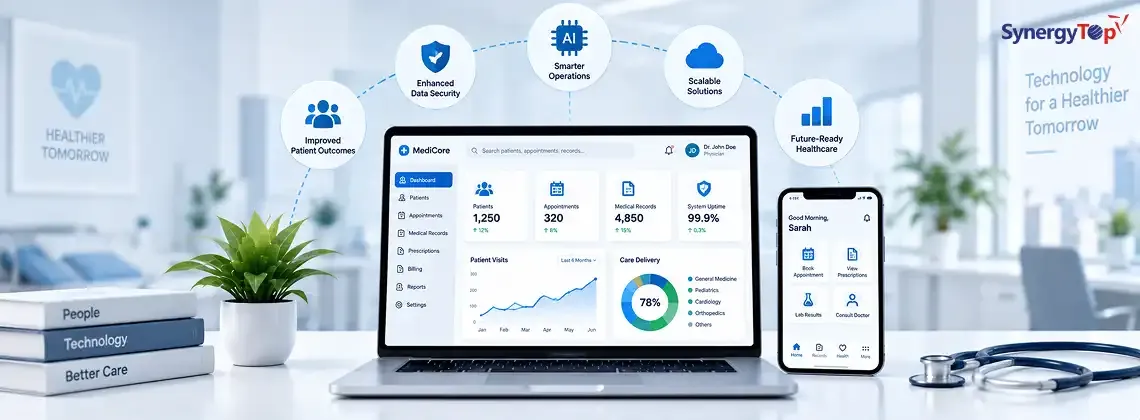


The amount of data flowing from various sources into managed service organization healthcare is greater than ever before, with patient records, imaging files, lab results, billing data, and data from devices coming at them from multiple angles simultaneously. With that increase in volume, there is also an increase in complexity, and many IT teams are discovering that the systems they created 10 years ago aren’t able to cope with the volume today.
Fragmentation is one of the issues. A hospital may have one system for its EHR, another system for lab results, another system for billing and another system for patient scheduling, all with different logins, update schedules, and different quirks. These systems can only be made to communicate with one another, and even to function in harmony simultaneously, with the effort of careful coordination.
In addition, there have been changes in expectations. Clinicians don’t want to be waiting for patient data or needing a workaround to get to it at the point of care. Patients also want the same responsiveness from their bank app or their store’s website. As more and more of healthcare transitions to a digital-first approach, virtual visits, remote monitoring, and online scheduling, the strain on the IT infrastructure only increases. This demands more than just quick fixes; it demands a new and different way of doing business when it comes to healthcare it services.
The Role of Managed IT Services in Modern Healthcare
That’s where managed it services for healthcare have come into their own. Healthcare cloud managed services move the model from reacting to problems as they occur to preventing them from becoming outages and making systems run efficiently.
This trend, from IT support to IT management, alters the clinical and administrative experience daily. Problems are often solved before they are even noticed, instead of reporting a problem and waiting for a ticket to be submitted. All of this occurs behind the scenes and is usually handled by a healthcare managed service provider, one that handles the patching of software, manages updates, monitors network performance and addresses the routine maintenance that can divert internal resources from the more valuable tasks.
The crux of this is the continuous monitoring. Systems are monitored around-the-clock, not just during business hours. Systems are monitored outside of business hours, which is critical because a system outage at 2 a.m. can impact patient care the same way a system outage at 2 p.m. does. Managed service organization healthcare can only rely on their systems to be available when they are needed because of that constant oversight.
Building a Connected Healthcare Ecosystem
The largest opportunity currently in healthcare IT is the linkage of historically disparate systems. EHRs, lab systems, billing platforms and patient portals may all be separate silos with a piece of the patient story but not always easily sharing it with the other systems.
Healthcare IT managed services can be a catalyst in breaking those silos, ensuring systems are integrated together so that data added to one system can be accessed in another, without anyone having to re-enter the data. This type of integration enables meaningful interoperability, two or more systems, often from different vendors, to share data in real-time and accurately.
Payoffs are felt in day-to-day processes. Care teams can work faster and with greater confidence in the data they are analysing when they’re not waiting for faxed records or manually re-keyed information. It also decreases administrative mistakes based on using out-of-date or incomplete data, a factor that is significant for administrative accuracy as well as for clinical decision-making.
Security, Compliance, and Risk Management in Healthcare IT
Healthcare remains one of the most heavily targeted industries for cyberattacks, patient records are valuable, systems are interconnected, and a breach can disrupt actual patient care, not just back-office operations.
Why healthcare is a prime target:
- Patient data holds high value on the black market
- Interconnected systems let one weak point expose multiple departments
- Legacy systems and medical devices often lag on security updates
What healthcare managed security services cover:
- Encryption and access control for data at rest and in transit
- Multi-factor authentication and role-based permissions
- 24/7 threat monitoring and rapid incident response
How HIPAA managed services support compliance:
- Maintaining audit-ready documentation and controls
- Ongoing risk assessments instead of once-a-year scrambles
- Staff training so compliance stays part of daily practice
Done well, security and compliance are built into everyday operations, not separate checkboxes.
Cloud-Driven Healthcare IT Transformation
The adoption of the cloud has revolutionized the possibilities of healthcare IT infrastructure, and for organizations without the in-house expertise needed to manage it independently, cloud managed healthcare services have made it much easier. Cloud benefits are obvious: systems can scale up and down as necessary, infrastructure resources become more flexible, and personnel can access the resources they need as they move around, not stuck to a single physical location.
A healthcare it msp usually does the bulk of the legwork on this transition, including the migration of legacy systems, setting up the cloud environment to adhere to the security standards of the healthcare industry and maintaining the cloud infrastructure on behalf of the internal team.
This sort of modernization has additionally been a big enabler for telehealth and distance care. From virtual visits to remote patient monitoring to distributed care teams, the infrastructure is essential to manage fluctuations in demand and ensure secure connections with providers outside a hospital’s network. With the right cloud management in place, it’s far easier to achieve that sort of flexibility than ever previously would’ve been possible with on-premises infrastructure.
Operational Efficiency Through Managed IT Services
Downtime in a healthcare environment goes beyond just an inconvenience; it can impact patient care, cause delays, and cause backlogs that can take days to deplete. Downtime and consistent system performance are among the most obvious, measurable advantages that managed it services for healthcare offer.
Fewer bottlenecks in daily work are a consequence of streamlining IT operations and healthcare managed it services. Proactively managing routine maintenance, updates and monitoring reduces the time spent by clinical and administration staff dealing with IT issues and allows them to focus on the task at hand, which is most important to the patient and to the organization’s bottom line.
Automation also features prominently in this place. Healthcare managed it support services providers and in-house IT personnel can benefit from automating seemingly mundane functions such as software updates, verifying backups, routine troubleshooting, and more, which allows them to concentrate on more difficult problems. This proactive approach and automation will eventually give rise to a more fluid operating environment, with reduced surprises and firefighting.
Supporting Multi-Location Healthcare Organizations
Having to manage IT for a single clinic is hard enough, but doing so for multiple clinics, urgent care centers, and hospitals is quite another thing. There can be differences in equipment, staff, and even the history of IT decisions made at each site (which can lead to an overall lack of consistency throughout the organization).
This can be overcome with centralized dashboards and a unified monitoring platform, as this provides IT teams with a single window of insight into the health of systems from one of their many locations, as opposed to checking on each location individually. That visibility can make it much easier to notice patterns, early problems and the performance of the system in a distributed system, whether it’s a large hospital or a small satellite clinic.
Healthcare managed service providers are especially well suited to the kind of scale this supports, as they typically have been tasked to manage multiple environments anyway. This sort of centralized, scalable solution becomes more of a must as organizations expand, either through adding new locations or through acquisitions.
IT Strategy as a Growth Enabler in Healthcare
In some cases, IT is used merely as an operational issue, but in today’s world, there is no doubt that the overall business strategy of an organization should directly correlate with its IT strategy. Whether it’s a plan to expand, acquire a new company, or embark on a digital transformation project, IT infrastructure has to be there to support it and organisations that view IT as a back-up option struggle to implement what they wanted to achieve.
Managed healthcare IT services are scalable in this way to provide long-term value. A well-managed IT environment can adapt without experiencing a complete overhaul every time, where decisions are made individually, one department at a time.
There’s a patient-facing aspect of it too. Reliable systems result in faster wait times, less mis-scheduling and a smoother experience on the whole — all things customers notice, even if they don’t see the infrastructure that makes it possible. From that point of view, a robust IT strategy is not a back-office issue, but rather intimately linked to the patient care experience.
Choosing the Right Healthcare IT Service Partner
Given how much rides on IT performance, choosing the right partner deserves real consideration rather than a decision based on price alone. A few things worth checking:
- Healthcare-specific experience: a track record with EHRs, lab systems, and HIPAA compliance, not just general IT
- Scalability: the ability to support your organization’s current size and grow with you
- Security and compliance capabilities: strong monitoring, threat detection, and transparent reporting
- Customization: healthcare managed it services built around your existing systems and workflows, not a one-size-fits-all package
Conclusion: Enabling Future-Ready Healthcare with Managed IT Services
In every component of this report, from operational efficiency to clinical workflows and security to compliance, there’s a recurring theme: those organizations that have robust, well-managed IT infrastructure are simply more equipped to provide quality care. No outages, more connected systems, better security, and scalable infrastructure are the sum it’s all that can make a difference for patients and staff, even though they may not be thinking about the IT behind it.
None of this is done as a single project, however. The ones that benefit the most from managed IT think of it the same way they would think of a business partner instead of a vendor; someone who understands them and grows with their company. In this sense, managed it support for healthcare is not merely a support service; it’s actually a key building block that enables innovation, expansion, and consistently great patient care to begin with.
Strengthen Your Healthcare IT Infrastructure
When you are encountering fragmented systems, increasing security issues or an IT environment that can’t keep up with the demands of patients, it might be time for a partner that is designed for healthcare’s specific needs. SynergyTop collaborates with healthcare organizations to develop custom-managed IT solutions that align with their current systems and processes, grow with them and stem from healthcare industry experience, not a generic IT playbook.
Whether you’re planning for infrastructure modernization, greater compliance readiness, or a multi-location expansion, a savvy partner can help you make the journey a lot smoother.
Discuss it with our experts now, or get a consultation to understand how a custom IT solution can be applied to your situation.
Frequently Asked Questions About Healthcare IT Services
1. What are healthcare IT services?
Healthcare IT services include the management, integration, security, modernization, and ongoing support of technology used by healthcare organizations. This can include EHR systems, cloud infrastructure, patient portals, billing platforms, telehealth systems, cybersecurity, data integration, and IT monitoring.
2. What are managed IT services for healthcare?
Managed IT services for healthcare allow hospitals, clinics, medical practices, and other healthcare organizations to outsource some or all of their IT operations to a specialized provider. Services can include system monitoring, software updates, infrastructure management, security monitoring, backups, troubleshooting, and technical support.
3. Why are healthcare IT managed services important?
Healthcare IT managed services help organizations improve system reliability, reduce downtime, strengthen security, and manage increasingly complex technology environments. They also allow internal healthcare teams to spend less time resolving routine IT issues and more time supporting clinical and operational priorities.
4. How do healthcare IT services support HIPAA compliance?
Healthcare IT services can support HIPAA compliance by implementing access controls, encryption, audit logging, authentication, security monitoring, backup procedures, risk assessments, and other technical and administrative safeguards. Compliance ultimately depends on the organization’s complete policies, processes, technology, and responsibilities.
5. What is a healthcare IT MSP?
A healthcare IT MSP, or Managed Service Provider, is a technology partner that manages and supports IT infrastructure specifically for healthcare organizations. A healthcare-focused MSP typically understands areas such as EHR environments, interoperability, healthcare cybersecurity, cloud infrastructure, patient data protection, and regulatory requirements.