contact@synergytop.com
 +1 619-349-4911




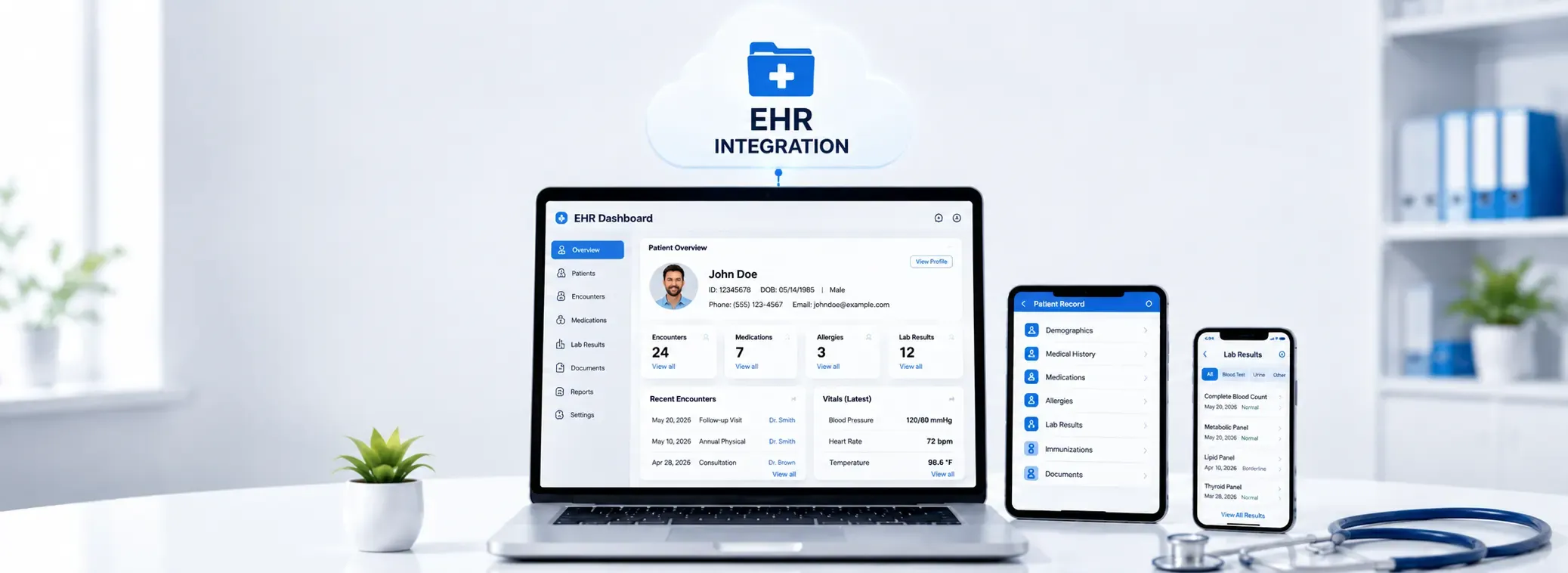


EHR integration remains one of healthcare’s most persistent operational challenges. Organizations spend significant resources on integration projects, yet many still operate with disconnected systems where clinical data, billing information, and administrative records exist in separate silos. The problem isn’t new, but the stakes keep rising as regulatory requirements tighten and patient expectations for seamless care coordination increase.
This guide addresses what EHR integration actually entails, why organizations struggle with it, and what approach produces sustainable results.
The Business Case for EHR Integration
The numbers matter here because they define whether integration is a nice-to-have or an operational necessity.
Healthcare workers spend approximately 25–30% of their time on data entry and documentation. That’s not inefficiency at the margins. That’s a quarter of clinical capacity devoted to moving information between systems rather than treating patients.
The financial impact compounds quickly. When patient data lives across multiple systems (like the EHR, practice management platform, lab system, and insurance billing tool) someone manually reconciles between them. This creates three problems: labor cost, error rate, and opportunity cost.
A typical mid-sized health system (200–400 clinicians) manages somewhere between 500,000 and 2 million discrete patient records. Without integration, administrative staff spend hours daily on data reconciliation. The billing department re-enters clinical data into claims systems. The lab reports results that clinicians must manually transfer into the EHR. Insurance denials come back as paper notifications that someone has to track down and resolve manually.
The operational math is straightforward: every percentage point reduction in manual data entry translates directly to staff capacity for higher-value work. Conversely, every percentage point increase in claims rejection rates (often caused by data inconsistencies across systems) directly reduces revenue.
From a patient safety perspective, the risk is equally clear. Duplicate patient records lead to fragmented care histories. Data entry errors introduce medication interaction risks. Delayed information flow between systems means clinicians make decisions with incomplete information. These aren’t theoretical problems. They are practical problems that show up in adverse event reports and near-miss documentation in organizations nationwide.
Why EHR Integration Fails: The Real Barriers
Most organizations frame EHR integration as a technology problem. The actual barriers are more complex.
Data Quality Issues
Most EHR systems have accumulated years of messy data. Patient identifiers might not be consistent across records. Names might be spelled multiple ways. Historical data might have been entered during periods when validation rules were looser. Address information might be outdated. Insurance coverage fields might contain notes instead of structured data.
Integrating these systems without addressing underlying data quality doesn’t solve the problem, it spreads it across more systems. Organizations that attempt integration without a preceding data remediation phase typically discover this 3–4 months into implementation, when validation testing reveals that 15–25% of records have issues that prevent clean data flow. At that point, choices become difficult: delay the project to fix data, or proceed with known data quality issues.
Organizations that succeed allocate 2–4 months for data assessment and remediation before technical integration work begins. This isn’t glamorous work. It doesn’t produce visible deliverables in month one. But it determines whether the integration actually works.
Organizational Fragmentation
Your billing department, clinical staff, IT team, and administration each operate with different priorities and different definitions of what “correct” looks like. The billing team wants real-time data flow to reduce claims rejection rates. Clinicians want data they can trust without manual verification. IT wants stability and wants to avoid disrupting existing infrastructure. Administration wants completion without budget overruns or patient care disruption.
These goals aren’t automatically compatible. Someone has to make trade-off decisions. Organizations where those decisions happen at the departmental level (IT decides, then tells billing what they get) typically fail at integration because the solution doesn’t actually serve the needs that drove the project in the first place.
Organizations that succeed establish clear authority for integration decisions. This often means creating or empowering a Chief Medical Information Officer, establishing a steering committee with genuine decision-making power, or assigning a program director with enough organizational credibility to negotiate between departments and make choices stick.
Technical Debt and Vendor Architecture
Healthcare data standards have evolved significantly. Older EHR systems (10+ years old) typically run on HL7, the healthcare industry standard from the 1980s. HL7 requires substantial custom configuration and interpretation. Different vendors implement it differently, which means integrating two HL7 systems often requires custom middleware.
Newer EHR systems increasingly support FHIR (Fast Healthcare Interoperability Resources), a modern standard built on RESTful APIs and JSON. FHIR is substantially easier to implement and standardizes how different vendors interpret data exchange. The gap between integrating an older HL7-based system and a modern FHIR-based system is typically 3–6 months and 50,000-150,000 in professional services.
This matters for your roadmap. If you’re evaluating EHR systems, native FHIR support should rank high in your evaluation criteria. If you’re locked into a legacy system, that’s not a reason to abandon integration. Instead, it’s your clue to be realistic about timeline and cost.
The CMS interoperability rules (effective 2024) now mandate that EHR vendors support modern standards like FHIR. This is shifting vendor behavior meaningfully. Vendors are finally building API-first architecture because regulatory requirements now demand it.
What Successful EHR Integration Actually Requires
EHR integration typically connects the primary EHR system to one or more of these: practice management systems (billing and scheduling), laboratory information systems, radiology platforms, pharmacy systems, or external health information exchanges. Each connection has different data flows, validation requirements, and error-handling needs.
A basic integration workflow looks like this: patient data exports from the EHR at scheduled intervals (typically nightly), flows into the practice management system, enables billing staff to generate claims from current clinical information, and flags rejected claims back into the EHR for clinician review.
This description sounds straightforward. Implementation requires several components working together:
- Data mapping — determining which fields in the source system need to flow to the destination system, how they translate between different data formats, and what validation rules apply.
- Error handling — building systems so that when exports fail (which they will, eventually), someone gets notified and has clear procedures for investigation and recovery.
- Audit trails — logging every data transfer so you can trace where information came from and what happened to it. This is critical for compliance and for troubleshooting when data looks wrong.
- Testing protocols — validating the integration across realistic scenarios: new patients, returning patients, patients with complex insurance situations, providers with credential changes, date-of-service corrections. These aren’t edge cases in healthcare, they’re normal operational conditions.
- Rollback procedures — having documented processes to revert to the previous state quickly if a deployed integration causes unexpected problems.
Organizations that build these systematically into their integration infrastructure end up with connections that run reliably for years. Organizations that skip these elements to accelerate timelines typically end up calling their vendor support multiple times weekly for problems that could have been prevented.
HL7 vs. FHIR: Why the Standard Matters for Proper EHR Integrations
Healthcare data standards have fragmented historically, which creates real technical complexity. Understanding this distinction matters for your implementation timeline.
- HL7 (Health Level 7) versions 2.x have been the healthcare industry standard since the 1980s. They’re text-based or XML-based formats that encode patient information into pipe-delimited fields. Most legacy EHR systems use HL7v2. The standard is comprehensive, but it’s also complex — different vendors interpret the same standard differently, which means HL7 integration often requires custom configuration and testing to ensure both systems send and receive the same information in compatible ways.
- FHIR (Fast Healthcare Interoperability Resources), released in 2014 and finalized in 2017, represents a different architectural approach. It’s built on REST APIs and JSON, uses modern web technology standards, and is designed specifically to make interoperability easier. FHIR defines how different data elements should be structured and transmitted, reducing interpretation differences between vendors.
The practical difference: HL7 integration typically requires middleware, custom development, and integration specialists who understand both the HL7 format and the specific systems involved. FHIR integration is typically faster because vendors implement FHIR in more standardized ways.
CMS Office of the National Coordinator (ONC) Interoperability Regulations (2024) now require vendors to support FHIR. This regulatory mandate is accelerating vendor adoption. Most modern EHR systems now support FHIR natively.
For organizations evaluating systems: ask whether FHIR support is native or added later. Ask whether APIs are documented publicly. These answers determine whether your integration timeline is measured in months or quarters.
Successful EHR Integration Patterns
Organizations approach EHR integration using different strategies, and each has trade-offs.
Phased Integration
Phased integration starts with the highest-impact connection first, typically practice management (billing and scheduling). This connection delivers immediate financial and operational impact. Once that integration stabilizes (usually 2–3 months), you integrate the next system. This approach takes longer overall but distributes risk and focuses organizational attention on making one thing work well before moving to the next.
Big Bang Integration
Big Bang integration attempts to connect multiple systems simultaneously. This is rarer than people think because it requires the most resources and carries the highest risk. It’s typically chosen only when replacing an entire EHR system where downtime is unavoidable anyway.
Hybrid Integration
Hybrid integration is what actually happens in most organizations: you integrate critical paths immediately (billing, core clinical workflows) and build out less critical integrations over time (reporting, quality dashboards, population health systems).
The success factor isn’t which approach you choose. It’s whether you staff and resource the approach adequately and build in sufficient time for the inevitable problems that emerge during implementation.
Most organizations underestimate integration timelines by 30–40%. A realistic estimate for integrating your primary EHR to a practice management system typically runs 4–6 months from project start to stable production operation. This includes data assessment (4–6 weeks), design and configuration (4–6 weeks), testing (4–8 weeks), and initial stabilization (2–4 weeks).
If someone quotes you less time, they’re either integrating highly compatible systems or they’re not accounting for real-world complexity.
Data Stewardship: The Governance Piece of EHR Integrations
EHR integration completes when data flows reliably. But it succeeds when data remains correct over time.
This requires explicit data stewardship. “IT manages it” or “the EHR vendor supports it” isn’t sufficient because neither group has visibility into whether the data being integrated is correct in the first place.
Organizations that sustain integration over years assign specific stewardship responsibilities:
- A clinical data analyst or informatics role monitors whether data looks correct from a clinical perspective. They spot anomalies, verify assumptions about data quality, and flag when integrations are drifting.
- IT staff monitor the technical infrastructure, whether processes are running on schedule, whether error rates are increasing, whether system performance is degrading.
- Business stakeholders (practice managers, billing directors, department heads) track business outcomes. Are claims getting processed faster? Is staff spending less time on manual reconciliation? Are denials declining? These metrics tell you whether the integration is actually delivering value.
Assigning data stewardship to multiple roles feels bureaucratic until you consider the alternative: an integration that silently degrades over time, and nobody notices until patient care is affected or revenue is declining.
EHR Integration Implementation Roadmap
If you’re planning EHR integration for your organization:
Assess your Current State
Audit which systems hold patient data, how much is duplicated across systems, and how consistent data is across them. Until you understand the baseline, you can’t estimate integration scope accurately.
Define your Integration Sequence
Which system connection would have the highest impact on staff efficiency, patient safety, or financial performance? Start there. Typically this is practice management integration, but that depends on your organization’s specific pain points.
Evaluate your Technical Foundation
What does your EHR vendor support? Is it FHIR or HL7? Do published APIs exist? Are there known integration partners who’ve built connectors? These answers determine whether you’re building something standardized or something custom.
Establish Governance Before Technical Work
Define who owns data quality, who owns technical infrastructure, and who owns business outcomes. Build this into your charter before you write code.
Budget for Data Remediation
Plan to spend 2–4 months cleaning existing data before integration work begins. This determines whether your integration spreads clean data or contaminated data across multiple systems.
Build Realistic Timelines
Plan for 4–6 months from project start to stable operation for the first integration. Add 3–4 months for each additional system.
Invest in Visibility
Build logging, monitoring, and alerting into your integration infrastructure from the beginning. This is cheaper to add upfront than to retrofit later.
The fundamental truth about modern EHR integration development is that it’s technically feasible with contemporary systems. Most modern EHRs have the API capability and standards compliance to connect effectively. What determines success or failure is organizational discipline: commitment to data quality, clear accountability for outcomes, realistic timelines, and adequate staffing.
These factors matter more than the technology you choose.
Start Your EHR Integration Right With SynergyTop
EHR integration complexity varies wildly depending on your current systems, data quality, and organizational structure. What works for one health system might not work for another.
At SynergyTop, we work with healthcare organizations to assess their integration baseline, map out realistic timelines, and build governance structures that stick. We’ve worked through HL7 legacy systems, FHIR-native implementations, and everything in between. More importantly, we know where organizations typically underestimate scope and we build those realities into planning from day one.
If your organization is considering EHR integration, reach out to discuss your specific situation by scheduling consultation here. We’ll give you honest feedback about what’s actually feasible, what timeline is realistic, and what you should prioritize first.
FAQs
What is EHR integration?
EHR integration is the process of connecting an Electronic Health Record system with other healthcare platforms such as practice management, billing, laboratory, pharmacy, radiology, and health information exchange systems. The goal is to allow clinical, administrative, and financial data to move securely between systems without repeated manual data entry.
Why is EHR integration important for healthcare organizations?
EHR integration helps reduce manual data entry, duplicate records, billing errors, and fragmented patient information. It can improve staff efficiency, support better care coordination, reduce claims-related issues, and give clinicians access to more complete patient information when making treatment decisions.
What is the difference between HL7 and FHIR in EHR integration?
HL7 is a long-established healthcare data exchange standard commonly used by legacy EHR systems and often requires custom configuration or middleware. FHIR is a newer standard built around REST APIs and JSON, making healthcare data exchange more standardized and generally easier to implement with modern systems.
How long does an EHR integration project take?
A typical integration between a primary EHR and a practice management system can take around 4–6 months from initial assessment to stable production. The timeline usually includes data assessment, design and configuration, testing, deployment, and stabilization. Additional system integrations may require several more months.
What are the biggest challenges in EHR integration?
Common challenges include poor data quality, inconsistent patient records, legacy technology, different vendor implementations, organizational fragmentation, and unclear ownership of integration decisions. Addressing data quality and governance before development begins can significantly reduce integration problems later.
Which healthcare systems can be integrated with an EHR?
EHR systems can be integrated with practice management and billing platforms, laboratory information systems, radiology platforms, pharmacy systems, scheduling tools, and external health information exchanges. The exact integration architecture depends on the data flows and operational requirements of the healthcare organization.