contact@synergytop.com
 +1 619-349-4911




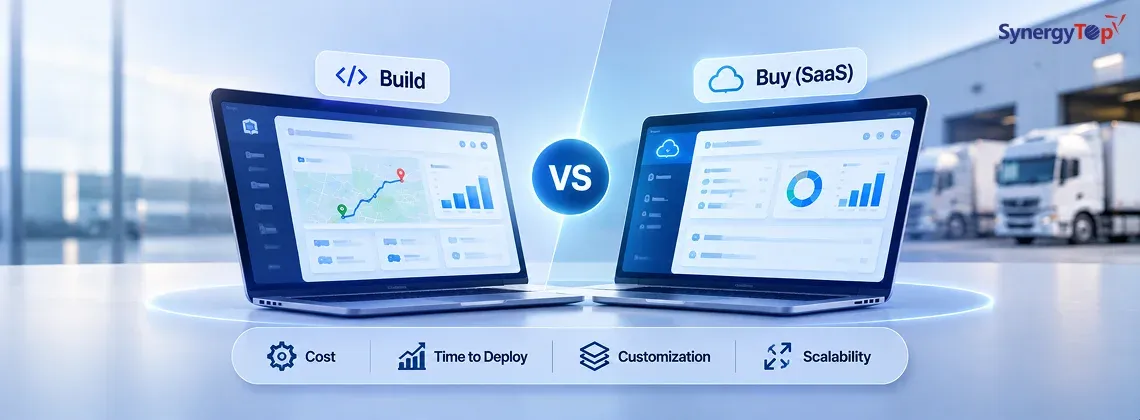


A Transportation Management System can reduce freight costs, improve dispatch, automate carrier selection, track shipments, and give operations teams much better visibility. But before investing, logistics businesses usually face a difficult question: Should we buy an existing TMS or build software around our own operation?
Buying looks safer. The software already exists, implementation can be faster, and the vendor handles much of the maintenance. Building gives you more control, but requires a larger upfront investment and a long-term ownership commitment.
The real problem is that the decision is rarely this simple.
A logistics company may buy a TMS and still use Excel for rate calculations, WhatsApp for driver communication, separate tools for tracking, email for approvals, and manual exports for customer reporting. Another business may spend heavily building custom software only to discover that an off-the-shelf product already handled 80% of what it needed.
The right decision depends on how unique your logistics operation is, how much your current process costs, and whether software is simply supporting your business or is actually part of your competitive advantage.
When Buying a TMS Usually Makes More Sense
Buying an existing TMS is usually the better option when your transportation operation is relatively standard. If you mainly need shipment planning, carrier selection, basic routing, tracking, freight audit, and reporting, mature TMS products may already cover most of the requirement.
The financial advantage is straightforward. Instead of paying for months of software design and development, you pay an implementation fee and recurring subscription or transaction cost. Your team can usually start using the system much faster.
Industry research also suggests that mature SaaS TMS platforms are often the practical choice for standard transportation requirements. Supply Chain Research notes that businesses should evaluate not only subscription cost but also implementation, integrations, commercial models, and the five-year total cost of ownership when choosing a TMS.
If your business can configure an existing product without significantly changing the way it operates, buying is often more economical.
The Problem Starts When Your Team Works Around the TMS
This is the strongest warning sign.
Your company may officially use a TMS, but dispatchers still maintain a spreadsheet because the system cannot handle one customer’s special rules. Finance exports data into another workbook to calculate charges. Operations uses WhatsApp because the TMS driver workflow is too rigid. Customer service checks another system for delivery status.
At this point, the business is paying for the TMS and paying employees to compensate for what it cannot do.
Imagine a logistics company spends $8,000 per month on software licenses, integrations, and related tools. That equals $96,000 per year.
Now assume six employees spend five hours each week manually reconciling data, correcting rates, updating customer reports, or moving information between systems.
That is:
6 × 5 × 52 = 1,560 hours every year
At an average loaded cost of $45 per hour, that creates another $70,200 in operational cost.
The software environment that appeared to cost $96,000 per year is now creating roughly $166,000 in annual cost before you count errors, delayed billing, missed deliveries, or customer dissatisfaction.
This is where custom software becomes worth evaluating.
Build When Your Transportation Workflow Is How You Compete
A standard TMS works best when your operation is standard.
Custom development becomes more attractive when your transportation model contains rules that differentiate your business.
For example, a 3PL may have customer-specific rates, unusual tendering rules, unique carrier allocation logic, multiple service levels, specialized freight requirements, or complex exception handling.
If those workflows are central to how you win customers, forcing them into a generic TMS can create more inefficiency than automation.
Recent industry guidance makes the same distinction. Noseberry’s 2026 TMS build-vs-buy analysis recommends buying when transportation workflows are standard and building or extending when lanes, rate structures, dispatch logic, or integrations are strategically important to the business.
In this situation, software is not just an operational tool. It becomes part of the company’s business model.
Integration Complexity Can Be the Real Reason to Build
Sometimes the TMS itself is not the problem.
The issue is everything around it.
Your transportation operation may depend on:
- ERP
- WMS
- CRM
- accounting
- fuel systems
- telematics
- GPS tracking
- carrier APIs
- EDI
- customer portals
- billing platforms
If employees are manually moving information between those systems, buying another large platform may not solve the underlying problem.
A custom operational layer can connect them.
For example:
Customer Order → ERP → TMS → Carrier/Driver → GPS Tracking → Proof of Delivery → Billing
The TMS may remain in place, while custom software manages the workflows and data exchanges that standard products do not support.
This hybrid approach is becoming increasingly common in logistics. Recent logistics integration guidance notes that businesses often end up combining native connectors, purchased platforms, APIs, EDI, and custom logic rather than choosing a pure build-or-buy architecture.
SynergyTop’s Custom Software Development Services are relevant in this type of situation because you do not necessarily need to rebuild the entire logistics technology stack. You may only need to build the missing operational layer.
What Does Buying a TMS Really Cost?
The recurring subscription is only one part of the cost.
TMS vendors may charge using:
- per-user pricing
- per-shipment fees
- percentage of freight spend
- transaction fees
- enterprise licenses
Then there may be additional implementation, integration, support, training, and customization costs.
Supply Chain Research reports that SaaS TMS pricing may range from roughly 50–500 per user per month or 1–5 per shipment, while five-year total cost of ownership for larger implementations can reach hundreds of thousands of dollars or more depending on the platform and implementation.
This does not mean buying is expensive or a bad decision.
It means you should evaluate the total cost at the scale you expect to reach, not just at your current shipment volume.
A TMS that is affordable at 5,000 shipments per month may create a very different cost profile at 50,000.
What Does Building Custom Transportation Software Cost?
Custom development has the opposite financial pattern.
The upfront cost is higher, but there are no standard per-user or per-shipment SaaS fees unless you choose third-party services that charge that way.
A focused transportation platform may begin around 50,000–100,000, while a broader custom TMS with carrier management, route planning, dispatch, tracking, driver applications, billing, integrations, and analytics may require 100,000–250,000+.
Large multi-region or enterprise platforms can cost considerably more.
That cost should include not only initial development but also cloud infrastructure, support, security, monitoring, future enhancements, and ongoing maintenance.
This is why the comparison should be made across three to five years, not year one.
If an existing TMS and surrounding tools cost $180,000 every year, a $200,000 custom project can deserve serious analysis. If your current TMS costs $25,000 annually and works well, custom development may make no financial sense.
A Hybrid Model Is Often the Best Decision
Many logistics companies do not need to choose between buying everything and building everything.
They can buy standardized capabilities and build only what is unique.
For example, a company could keep an existing TMS for standard carrier rating and tendering while building a custom customer portal, dispatch workflow, tracking dashboard, analytics layer, or integration service.
Or a company may keep ERP and WMS systems while building a custom transportation application between them.
This can reduce project risk and development cost while giving the business control over the workflows that actually matter.
If your operation already has a working system but struggles with integration or outdated workflows, SynergyTop’s Application Management Services can help determine whether modernization, integration, or selective custom development is more practical than a complete replacement.
What About Real-Time Fleet Tracking?
For fleet operators, this question often becomes part of the TMS decision.
You may need real-time vehicle tracking, driver apps, geofencing, ETA, route deviation alerts, and proof of delivery.
Some TMS platforms provide these capabilities directly. Others depend on third-party telematics tools.
If the tracking workflow is important to your operation, evaluate how well the TMS connects to your fleet data before committing.
SynergyTop’s guide on building a real-time vehicle tracking and fleet monitoring platform explains the architecture behind GPS tracking, geofencing, dispatcher dashboards, driver apps, and fleet integrations.
This is especially important if transportation management and fleet management need to operate as one workflow rather than two separate systems.
A Simple Build-vs-Buy Decision Test
Before choosing, answer five questions.
First, how much of your workflow is standard? If an existing TMS covers 80–90% of your operation with minimal customization, buying is usually the safer choice.
Second, how much manual work remains after using the TMS? If employees still depend heavily on spreadsheets, email, and disconnected tools, you may need custom development or a hybrid architecture.
Third, how complex are your integrations? A logistics operation that depends on several ERP, WMS, carrier, tracking, and customer systems may benefit from custom integration.
Fourth, does the workflow create competitive advantage? If your dispatch, pricing, service model, or carrier logic is how you differentiate, owning that software may have strategic value.
Finally, what will each option cost over five years? Compare subscriptions, implementation, integrations, support, internal administration, and workarounds against development, maintenance, hosting, and future enhancement.
That calculation usually makes the decision much clearer.
FAQs
Is it cheaper to buy or build transportation management software?
Buying is usually cheaper upfront. Custom development can become financially attractive over several years when licensing, transaction fees, integrations, and operational workarounds create a high total cost.
When should a logistics company build its own TMS?
Custom development is worth evaluating when transportation workflows are unique, integrations are complex, standard software forces employees into workarounds, or the platform itself creates competitive advantage.
Can we customize an existing TMS instead of replacing it?
Yes. In many cases, extending or integrating an existing TMS is more practical than rebuilding the entire system.
How much does a custom TMS cost?
A focused system may start around 50,000–100,000, while broader platforms with dispatch, carrier management, tracking, driver apps, billing, and enterprise integrations may cost 100,000–250,000+.
How long does a custom TMS take to build?
A focused first version may take several months. Larger platforms are usually developed in phases, with core planning, dispatch, tracking, and integrations prioritized first.
Should a small logistics company build a TMS?
Usually not if standard SaaS tools already cover the workflow. Custom development becomes more relevant as operational complexity, shipment volume, integration requirements, and unique business rules increase.
Find Out Whether Your Logistics Business Should Build or Buy
You do not need to decide that custom software is the better option before contacting a development company.
The first step should be understanding the actual cost and limitations of your current process.
Share with SynergyTop:
Your current TMS or logistics software, monthly shipment volume, number of users, carrier network, ERP/WMS integrations, manual workarounds, and the workflow that creates the most operational pain.
SynergyTop can help determine whether your logistics business should:
keep the existing TMS → extend it → integrate it → replace selected workflows → or build a custom transportation platform.
Get a Transportation Software Assessment
If your team is paying for a TMS but still depends on spreadsheets, manual dispatch, disconnected tracking tools, or expensive integrations, share your current setup with SynergyTop and request a project-specific recommendation, architecture approach, estimated timeline, and development quotation.