contact@synergytop.com
 +1 619-349-4911






Your energy bill is one of the few operating costs that grows quietly. Nobody approves it line by line, and by the time finance flags it, the money is already spent.
The scale of the problem is not small. According to the U.S. EPA’s ENERGY STAR program, commercial buildings and industrial plants account for about half of U.S. energy use, and often 30% or more of that energy is lost to inefficiencies. ENERGY STAR certified buildings, by contrast, use around 35% less energy than their peers.
The gap between those two numbers is visibility. Companies that see their energy use in real time can act on it. Companies that rely on monthly utility bills and spreadsheets cannot.
That is exactly what an energy management system solves. But here is what most guides will not tell you: the ready-made EMS platforms on the market are built for the average facility. If your operations involve legacy machines, multiple sites, solar or battery assets, or reporting rules specific to your business, an off-the-shelf tool will cover part of the job and leave the rest to manual work.
This guide is for decision-makers who are past the “what is EMS” stage. We cover when a custom energy management system makes sense, which features matter, how one is built, and what it typically costs.
Planning an energy management system for your business? Book a free consultation with SynergyTop’s energy software team and get a clear scope before you commit budget.
What Is an Energy Management System?
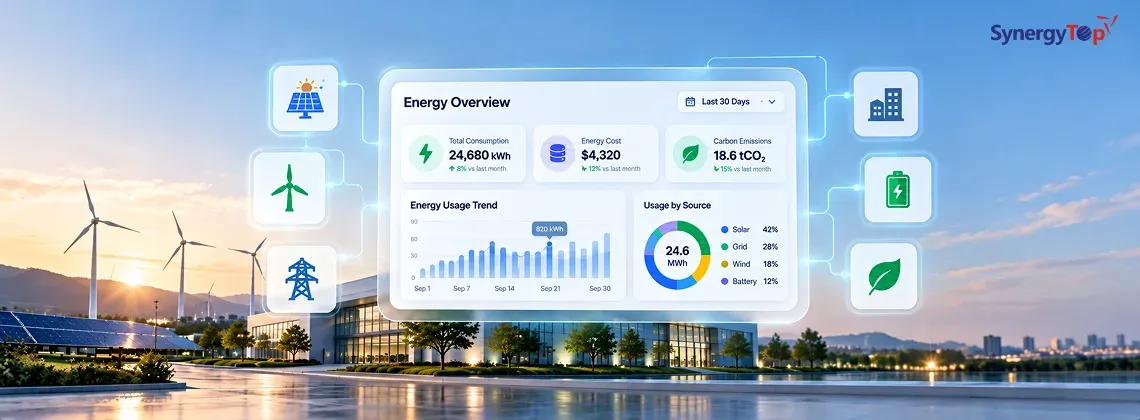
An energy management system (EMS) is software that collects energy data from meters, sensors, and equipment, then turns it into dashboards, alerts, and actions that reduce consumption and cost.
The term also refers to the management framework defined by ISO 50001, the international standard for energy management. The U.S. Department of Energy describes ISO 50001 as a voluntary standard for industrial, commercial, and institutional facilities, and its analysis shows that savings from a structured EnMS persist over time because energy management becomes part of daily operations.
In practice, the software is what makes that framework workable. Without it, energy reviews, baselines, and performance tracking live in spreadsheets that nobody updates.
Off-the-Shelf vs. Custom Energy Management System
Off-the-shelf EMS platforms are faster to start. Custom systems fit the way your facilities actually run. The right choice depends on how standard your operations are.
| Factor | Off-the-shelf EMS | Custom EMS |
| Setup time | Days to weeks | 3 to 9 months, depending on scope |
| Upfront cost | Low, but recurring per-site or per-meter licenses | Higher upfront, no per-seat licensing |
| Equipment integration | Supported device list only | Any meter, PLC, SCADA, BMS, inverter, or API |
| Reporting | Fixed templates | Reports built around your KPIs, tariffs, and compliance needs |
| Multi-site and multi-source | Often limited or priced as add-ons | Designed around your portfolio from day one |
| Data ownership | Stored on vendor’s cloud | You own the data and the code |
| Scaling | Costs rise with each site added | Marginal cost per new site stays low |
| Product potential | None | Can be sold to your own customers as SaaS |
A useful rule: if a ready-made platform covers 80% or more of your needs, start there. If you find your team exporting data into spreadsheets to fill the gaps, the hidden labor cost usually justifies building your own. Our custom vs. off-the-shelf LMS guide applies the same decision logic to another category, and the reasoning carries over.
7 Signs Your Business Needs a Custom Energy Management System
If three or more of these sound familiar, a custom build is worth scoping.
- Your energy data lives in too many places. Utility portals, inverter apps, BMS screens, and spreadsheets each hold part of the picture, and nobody sees all of it at once.
- Your equipment is not on the vendor’s list. Older machines, custom PLCs, or regional meter brands are not supported by the platform you tried.
- You manage multiple sites or assets. Comparing plants, stores, or solar sites side by side takes manual work every month.
- Reporting eats your team’s time. ESG, sustainability, or ISO 50001 reports are compiled by hand from exports.
- You pay license fees that keep rising. Per-meter or per-site pricing grows faster than the value you get.
- You need automation, not just dashboards. You want the system to shift loads, trigger alerts, or schedule equipment based on tariffs and demand.
- You want to sell energy software, not just use it. You are a solar, storage, or energy services company that wants its own branded platform for customers.
Recognized your business here? Talk to our team about a custom energy management system.
Key Features of a Custom Energy Management System
The best energy management software does more than display numbers. These are the features that turn data into savings.
- Real-time energy monitoring. Live consumption by site, building, floor, line, or machine, pulled from smart meters, IoT sensors, and sub-meters.
- Multi-source integration. Grid, solar, wind, generators, and battery storage managed from one platform instead of separate vendor apps.
- AI-based demand forecasting. Machine learning models predict consumption and generation, so you can plan loads and purchases ahead of time.
- Peak demand and tariff alerts. Notifications before you cross demand thresholds that trigger expensive charges.
- Automated load control. Rules that shift or shed non-critical loads during peak pricing windows.
- Anomaly detection and predictive maintenance. Early warnings when equipment starts drawing more power than normal, often a sign of a fault.
- Benchmarking across sites. Compare energy intensity per square foot, per unit produced, or per store.
- Compliance and ESG reporting. Automated reports for ISO 50001, carbon accounting, and sustainability disclosures, plus benchmarking through tools like ENERGY STAR Portfolio Manager.
- Role-based dashboards and mobile apps. Executives see costs and trends; technicians see alerts and asset status on their phones.
See how we apply these capabilities in our AI-based renewable energy software solutions.
Tech Stack and Architecture of an EMS
A custom energy management system is built in five layers. Each one can be scaled or replaced without rebuilding the whole platform.
| Layer | What it does | Common technologies |
| Device and edge | Reads data from meters, sensors, inverters, PLCs, and BMS | Modbus, BACnet, MQTT, OPC UA, edge gateways |
| Data ingestion | Moves readings to the cloud reliably, even with patchy connectivity | Kafka, AWS IoT Core, Azure IoT Hub |
| Storage | Holds high-frequency time-series data and business records | TimescaleDB, InfluxDB, PostgreSQL, DynamoDB |
| Analytics and AI | Forecasting, anomaly detection, cost calculations, rules engine | Python, Pandas, scikit-learn, TensorFlow |
| Application | Dashboards, reports, alerts, mobile apps, APIs | React.js, Node.js, .NET, Flutter or React Native |
Security runs across every layer: encrypted data in transit, role-based access, and OAuth2 or SSO login.
SynergyTop’s teams work across this stack, including Python, React.js, Node.js, and .NET.
How We Build a Custom Energy Management System
A phased approach keeps risk low. You see working software early and fund the next phase only after the previous one proves its value.
- Discovery and energy audit (2 to 4 weeks). We map your sites, equipment, data sources, tariffs, and reporting needs, then define the KPIs the system must move.
- Architecture and UI/UX design (2 to 3 weeks). We choose integration protocols and cloud setup, and design dashboards around the people who will use them. See our UI/UX design services.
- MVP development (8 to 12 weeks). Monitoring, core dashboards, and alerts for one pilot site, so savings can be measured quickly.
- Integration and pilot rollout (3 to 6 weeks). Connect meters, SCADA, BMS, ERP, or billing systems, then validate data accuracy on site.
- Scale and automate. Add sites, AI forecasting, load control, and compliance reports in later phases.
- Support and optimization. Ongoing monitoring, updates, and new features through our application management services.
If you plan to sell your EMS as a product, our product engineering services cover multi-tenant SaaS architecture, billing, and white-labeling.
How Much Does a Custom Energy Management System Cost?
Most custom EMS projects fall between $40,000 and $250,000+, depending on the number of integrations, sites, and AI features. The ranges below are indicative for planning.
| Scope | What’s included | Typical timeline | Indicative cost (USD) |
| MVP / single site | Monitoring, dashboards, alerts, 1 to 3 data sources | 3 to 4 months | $40,000 to $80,000 |
| Mid-size / multi-site | Multiple sites, benchmarking, reports, mobile app, ERP or billing integration | 5 to 7 months | $80,000 to $150,000 |
| Enterprise or SaaS product | AI forecasting, load automation, multi-tenant SaaS, compliance modules | 8 to 12 months | $150,000 to $250,000+ |
The biggest cost drivers are:
- Number and age of devices. Legacy equipment often needs gateways or custom drivers.
- Data frequency. Second-level readings need more storage and processing than 15-minute intervals.
- AI and automation depth. Forecasting and load control add data science and testing effort.
- Compliance requirements. Audit trails and certified reporting add development time.
The return usually comes from three places: lower energy bills, fewer hours spent compiling reports, and license fees you no longer pay. ENERGY STAR estimates that a 10% cut in energy use can lift a building’s net operating income by about 1.5%.
Want a precise number for your project? Get a detailed EMS cost estimate from SynergyTop. We’ll review your sites and equipment and send a scoped proposal.
Editor note: confirm these cost ranges with SynergyTop’s sales team before publishing.
Energy Management System Use Cases by Industry
Every industry wastes energy in a different place. A custom EMS is built around where your waste actually happens.
| Industry | Main problem | What a custom EMS does |
| Manufacturing | Machines running idle, peak demand charges | Machine-level monitoring, shift-wise energy per unit, load scheduling |
| Commercial real estate | HVAC and lighting waste across many buildings | Portfolio benchmarking, BMS integration, tenant-level billing |
| Retail and restaurant chains | HCustom-Energy-Management-System-Development_-Features-Cost-Processundreds of small sites, no central view | Store-by-store comparison, refrigeration alerts, remote control |
| Solar and renewable energy | Variable generation, many assets and inverters | Generation forecasting, performance ratio tracking, customer portals |
| Healthcare and campuses | 24/7 loads, strict uptime needs | Critical load monitoring, backup power tracking, compliance reports |
| EV charging and storage | Balancing charging demand with grid limits | Smart charging schedules, battery dispatch, tariff optimization |
For healthcare facilities, energy data can also connect with the systems we build for hospital management.
Case Studies: How SynergyTop Builds Energy and Data Platforms
The building blocks of an energy management system are data integration, secure dashboards, automated reporting, and multi-platform access. Here is how we have delivered them for clients.
Case Study 1: Reporting platform for a solar energy marketplace
Client: A San Francisco-based marketplace that connects commercial building owners with pre-qualified solar developers, installers, and financing partners.
Challenge: Project data sat across multiple third-party databases. The platform struggled to fetch the right data on request, and confidential information needed strong protection.
What we built: A Python-powered web application for project reporting, with third-party data stored in DynamoDB, secure OAuth2 login, an AngularJS admin dashboard, and CSV/Excel exports.
Results:
- Project milestones, daily and weekly reports, documents, and contacts available in a single click
- User base grew by 10% within the first six months
- Website ranked on the first page for 100+ keywords with ongoing technical SEO
Read the full solar energy platform case study
Case Study 2: SaaS and mobile platform for multi-project operations
Client: A U.S.-based construction company managing many projects for its customers on an outdated desktop application.
Challenge: Manual, error-prone reports, no mobile access, weak database scalability, and security gaps.
What we built: A new SaaS, web, Android, and iOS platform on React and Node.js, with automated sales, profit, bidding, and scheduling reports, role-based access, and Auth0, Twilio, and Stripe integrations. Delivered in 6 to 7 months.
Results: Centralized multi-project management, automated real-time reporting in place of manual work, and secure access from any device. The same architecture pattern powers a multi-site EMS: many assets, role-based users, automated reports, and field teams on mobile.
Read the full construction SaaS case study
What energy clients say
Lindsey Salters, Director of Digital Business at 5 Digital Energy, chose SynergyTop because its proposal cost far less than competing bids, and her team was very pleased with the end result. Read more client testimonials or browse our full portfolio.
Editor note: if SynergyTop has an IoT, energy dashboard, or 5 Digital Energy case study, add it here as Case Study 1. A direct EMS project converts better than adjacent ones.
Why Choose SynergyTop for Energy Management System Development
SynergyTop has built custom software for U.S. businesses for 12+ years, with a dedicated renewable and solar energy practice.
- Energy domain experience. We have delivered platforms for solar marketplaces and energy companies, so we understand assets, generation data, and how energy buyers make decisions.
- Full-stack delivery. Web, mobile apps, cloud, AI, and ERP integration under one team.
- You own everything. Source code, data, and IP belong to you, with no per-meter licenses.
- Proven client satisfaction. 50+ five-star reviews and a 4.9 rating on Clutch.
- U.S. presence, global team. Offices in San Diego, Los Angeles, and Los Altos, backed by engineering centers in India for cost-efficient delivery.
Frequently Asked Questions
What is the difference between an energy management system and a building management system?
A building management system (BMS) controls equipment such as HVAC, lighting, and access. An energy management system analyzes energy use across equipment, buildings, and sites to find savings. A custom EMS usually reads data from your BMS rather than replacing it.
How long does it take to build a custom energy management system?
An MVP for one site typically takes 3 to 4 months. A multi-site platform with AI forecasting and automation takes 6 to 12 months, delivered in phases.
Can a custom EMS integrate with our existing meters and equipment?
Yes. Custom systems connect through standard protocols like Modbus, BACnet, MQTT, and OPC UA, or through vendor APIs. Older equipment can be connected with IoT gateways.
Does an energy management system help with ISO 50001 certification?
Yes. ISO 50001 requires energy baselines, performance indicators, and ongoing monitoring. An EMS automates the data collection and reporting behind those requirements. The DOE’s 50001 Ready program shares case studies of facilities that followed this path.
What ROI can we expect from an energy management system?
Savings depend on your starting point. Facilities with little monitoring today usually see the fastest returns from fixing idle loads, peak demand charges, and equipment faults. We estimate expected savings during discovery, before you commit to development.
Can we sell our energy management system to other businesses?
Yes. If you are a solar, storage, or energy services company, we can build the platform as a multi-tenant SaaS product with subscriptions, white-labeling, and customer portals.
Ready to Stop Paying for Wasted Energy?
Every month without visibility is another month of paying for energy you never used productively. A custom energy management system gives you that visibility on your terms, built around your equipment, sites, and goals.
SynergyTop will help you scope the right system, from a single-site MVP to a full SaaS platform, with clear costs and timelines up front.
Book a free 30-minute EMS consultation. We’ll review your energy setup, identify quick wins, and give you a cost and timeline estimate. Schedule your consultation