contact@synergytop.com
 +1 619-349-4911




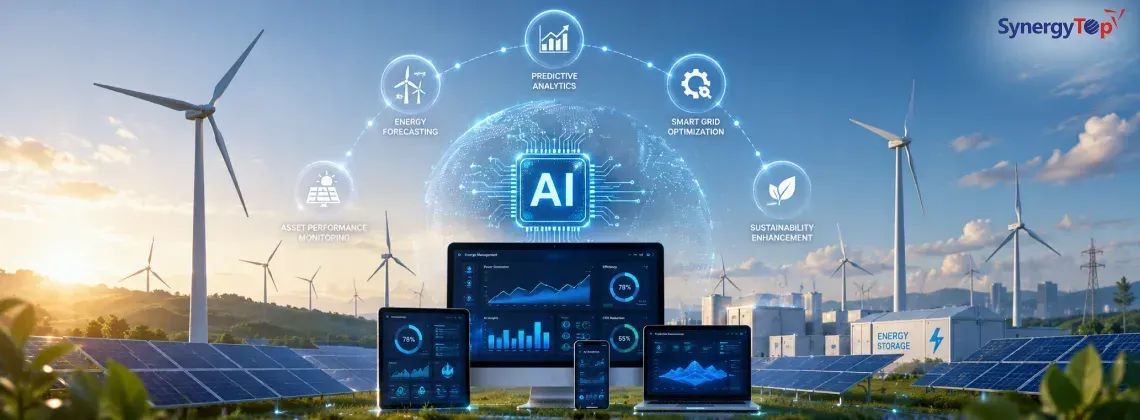


The global demand for clean energy continues to rise as governments pursue decarbonization goals, companies work toward net-zero targets, and consumers increasingly adopt cleaner technologies such as electric vehicles and solar-powered infrastructure.
The scale of this transition is already significant. The International Renewable Energy Agency reported that 585 GW of renewable power capacity was added globally in 2024, accounting for 92.5% of total power-capacity expansion that year.
But renewable energy is harder to control than conventional generation. Cloud movement affects solar output. Wind conditions change turbine generation. Batteries degrade when charging and discharging are poorly managed. Grid operators also have to balance changing generation against changing electricity demand.
That is where AI in renewable energy is becoming increasingly valuable.
Artificial intelligence can analyze large volumes of weather, sensor, equipment, demand, and grid data to identify patterns that would be difficult to detect manually. It can help forecast generation, identify equipment problems earlier, optimize battery usage, and support real-time energy decisions.
For renewable-energy organizations, successful AI implementation also requires software capable of connecting analytics with real operational systems. SynergyTop’s renewable energy software solutions focus on integrating monitoring, analytics, forecasting, automation, and energy-management capabilities into connected digital platforms.
What Is AI in Renewable Energy?
AI in renewable energy is the application of technologies such as machine learning, predictive analytics, computer vision, intelligent automation, and optimization algorithms to improve the production, storage, distribution, and consumption of renewable energy.
Instead of relying only on predefined rules and manual monitoring, AI systems can analyze historical and real-time information to predict what is likely to happen next.
For example, AI can help determine:
- How much solar energy may be generated tomorrow.
- Whether a wind turbine is developing a fault.
- When a battery should charge or discharge.
- Whether electricity demand is likely to spike.
- Where energy losses or operational inefficiencies are occurring.
This represents a broader shift from reactive energy operations toward predictive and increasingly intelligent energy management.
Why Renewable Energy Needs AI
Solar and wind energy are naturally variable.
Solar generation depends on cloud cover, irradiance, temperature, season, and location. Wind generation changes according to wind speed, direction, atmospheric conditions, and turbine characteristics.
At the same time, modern energy systems include distributed solar, battery storage, EV charging, microgrids, smart meters, and other connected energy resources.
This creates several challenges:
- Sudden changes in renewable generation.
- Changing electricity demand throughout the day.
- Difficulty balancing supply and demand.
- Undetected equipment degradation.
- Battery charging and lifecycle optimization.
- Increasing amounts of operational data.
AI helps turn this complexity into actionable information.
Applications of AI in Renewable Energy
AI-Powered Energy Forecasting
Forecasting is one of the most established applications of artificial intelligence in the renewable energy sector.
AI models can combine historical generation with weather information such as solar irradiance, cloud movement, temperature, wind speed, and wind direction to estimate future renewable output.
The National Renewable Energy Laboratory’s solar and wind forecasting research highlights machine learning and data analytics as useful capabilities for generating short-term renewable-energy forecasts and integrating those forecasts into power-system operations.
How It Works
- Historical and real-time weather data is analyzed.
- Solar irradiance is used to estimate future photovoltaic output.
- Wind conditions are analyzed to forecast turbine generation.
- Previous production patterns help improve future predictions.
Benefits
- Better generation planning.
- Improved grid scheduling.
- More efficient battery management.
- Reduced energy imbalance.
- Better preparation for supply changes.
Predictive Maintenance for Renewable Energy Assets
Renewable-energy assets generate large amounts of operating data.
AI can analyze vibration, temperature, voltage, output, acoustic signals, and historical maintenance information to identify abnormal behavior before equipment fails.
For solar installations, this can help identify panel degradation, hotspots, inverter faults, or unexpected output losses.
For wind farms, predictive models can help detect abnormal behavior associated with blades, bearings, gearboxes, and generators.
Battery systems can also be monitored for temperature changes, state-of-health deterioration, and unusual charging behavior.
Benefits
- Reduced unplanned downtime.
- Earlier fault identification.
- Better maintenance scheduling.
- Lower risk of major equipment failures.
- Longer asset operating life.
The important distinction is that predictive maintenance does not simply tell operators that equipment has failed. It aims to provide enough warning to act before the failure significantly affects operations.
Smart Grid Optimization
As more renewable resources connect to electricity networks, grid operations become increasingly complex.
AI-supported smart grids can continuously analyze generation, demand, storage, voltage, power flow, and network conditions.
AI can support:
- Real-time grid monitoring.
- Load forecasting.
- Supply-demand balancing.
- Fault detection.
- Distributed-energy coordination.
- Power-flow optimization.
The U.S. Department of Energy describes renewable energy integration as a systems challenge involving generation, storage, demand response, transmission, distribution, and distributed-energy resources.
The potential impact of intelligent optimization can be significant. According to the IEA, widespread AI adoption could help unlock up to 175 GW of additional transmission capacity from existing power lines by improving how electricity networks are operated.
Energy Storage Optimization
Battery storage helps address one of renewable energy’s biggest challenges: energy is not always generated when it is needed.
AI can analyze:
- Battery state of charge.
- Battery health.
- Renewable-generation forecasts.
- Electricity demand.
- Grid conditions.
- Electricity prices.
- Temperature.
- Historical cycling.
The system can then help determine when energy should be stored and when it should be released.
Benefits
- Smarter charging and discharging.
- Improved battery utilization.
- Reduced unnecessary battery cycling.
- Better peak-demand management.
- Increased use of available renewable electricity.
Demand Response Management
AI can also help electricity providers anticipate changes in consumption.
Machine-learning models can analyze historical energy usage, weather, time of day, business activity, and other variables to predict demand.
Energy loads can then be managed across systems such as:
- EV chargers.
- HVAC.
- Industrial equipment.
- Battery storage.
- Commercial buildings.
This helps balance supply and demand without relying exclusively on additional generation.
AI in Energy Management
AI for energy management uses machine learning and analytics to monitor, analyze, predict, and optimize how electricity is consumed.
The objective is not necessarily to generate more energy. It is often to use available energy more efficiently.
Organizations that need deeper operational visibility can use energy management software to connect smart meters, IoT devices, building systems, analytics, dashboards, and automated alerts.
Key AI Energy Management Functions
| Function | What It Does |
| Energy Consumption Monitoring | Tracks usage patterns across facilities |
| Load Forecasting | Predicts future electricity demand |
| Real-Time Optimization | Identifies opportunities to reduce waste |
| Demand Prediction | Anticipates consumption spikes |
| Anomaly Detection | Identifies unusual energy behavior |
| Carbon Monitoring | Supports sustainability measurement |
| Cost Optimization | Helps optimize energy usage patterns |
AI Energy Solutions Transforming Renewable Energy Operations
AI is increasingly being incorporated into complete software platforms rather than operating as an isolated algorithm.
Common AI energy solutions include:
- Intelligent Asset Monitoring: Continuous monitoring of turbines, panels, storage, and other equipment.
- Renewable Energy Analytics: Dashboards that convert sensor data into operational insights.
- Automated Energy Dispatch: Systems that help determine when and where electricity should be distributed.
- Sustainability Reporting: Automated collection and analysis of energy and emissions information.
- Smart Building Management: Optimization of HVAC, lighting, and building energy consumption.
- Grid Stability Management: Systems that help maintain reliable electricity supply.
Practical Experience: From Fragmented Energy Data to One Platform
E-E-A-T is stronger when a technology discussion includes practical implementation experience rather than theory alone.
SynergyTop has published an energy-management case study involving an organization with multiple facilities whose energy information was fragmented across different systems.
The solution integrated smart meters, IoT sensors, building-management systems, and connected equipment into a unified platform with real-time dashboards, automated reporting, consumption analysis, alerts, and performance benchmarking. The published case study reports improved energy monitoring, easier identification of energy losses, reduced operational inefficiencies, and stronger sustainability reporting.
This demonstrates an important implementation reality: the value of AI depends heavily on data integration and operational visibility.
AI in the Energy Sector: Industry-Wide Impact
Artificial intelligence is influencing multiple parts of the energy ecosystem:
Utilities and Power Generation: Load forecasting, grid optimization, and fault identification.
Solar Energy Companies: Generation forecasting, panel-performance monitoring, and intelligent inspections.
Wind Energy Operators: Turbine monitoring, wind forecasting, and predictive maintenance.
Energy Storage Providers: Battery-health monitoring and charge-cycle optimization.
Smart Cities: Coordinating energy consumption across transportation, buildings, and public infrastructure.
Industrial Facilities: Identifying energy waste and improving equipment efficiency.
When standard platforms cannot handle specialized workflows or legacy-system integration, custom software development can help connect energy systems, APIs, IoT devices, dashboards, and AI models around specific operational requirements.
Renewable Energy for AI: The Growing Relationship
The relationship between renewable energy and artificial intelligence works in both directions.
Renewable-energy companies can use AI to improve energy operations. At the same time, expanding AI infrastructure requires large amounts of electricity.
This increases the importance of efficient and lower-carbon power sources for data centers and computing infrastructure.
The relationship can be summarized simply:
AI helps renewable energy operate more intelligently, while renewable energy can help meet the growing electricity requirements of AI infrastructure.
Real-World Applications of AI in the Renewable Energy Sector
Some practical examples include:
- Solar Energy: Predicting output and identifying underperforming panels.
- Wind Energy: Monitoring turbine conditions and optimizing performance.
- Smart Grids: Forecasting load and supporting automatic power rerouting.
- Energy Trading: Analyzing demand, generation, storage, and price information.
- Battery Systems: Predicting battery degradation and optimizing charge cycles.
- Carbon Management: Identifying operational opportunities to reduce energy waste.
AI in Renewable Energy vs. Traditional Energy Management
| Feature | AI-Powered Energy Management | Traditional Energy Management |
| Forecasting | Predictive | Mainly historical |
| Predictive Maintenance | Yes | Limited |
| Real-Time Optimization | Advanced | Limited |
| Demand Response | Dynamic | Mostly manual |
| Fault Detection | Pattern-based | Reactive |
| Grid Intelligence | Advanced | Basic |
| Data Analysis | Continuous | Periodic |
AI does not necessarily replace human operators.
Its greater value lies in helping operators identify problems earlier and make better-informed decisions faster.
Benefits of AI in Renewable Energy
The major benefits include:
- Better energy-generation forecasting.
- Improved demand prediction.
- Reduced unplanned equipment downtime.
- More efficient maintenance.
- Better battery utilization.
- Improved power-grid coordination.
- Reduced energy waste.
- Better sustainability monitoring.
- Improved operational efficiency.
There is also a potential financial impact.
The IEA estimates that under its widespread-adoption scenario, AI applications in power-plant operations and maintenance could produce up to $110 billion in annual cost savings by 2035 through avoided fuel use and lower operating costs.
These figures should be viewed as sector-level potential rather than guaranteed savings for an individual company.
Challenges of Implementing AI in Renewable Energy
AI implementation also introduces practical challenges.
Data Quality and Availability
Machine-learning models depend on accurate information. Missing sensor readings, inconsistent formats, incorrect timestamps, and fragmented historical data can reduce model reliability.
Integration With Legacy Systems
Many energy assets operate for decades. New AI platforms therefore often need to communicate with older SCADA systems, databases, equipment, and APIs.
Cybersecurity
Connected energy infrastructure increases the digital attack surface. Strong access controls, encryption, logging, secure APIs, and network protection are essential.
Explainability
Operators need to understand why an AI system recommends an action, particularly where decisions affect infrastructure, maintenance, cost, or safety.
Implementation Cost
Sensors, cloud infrastructure, software development, cybersecurity, integration, and maintenance require investment.
This is why companies should begin with a measurable operational problem rather than implementing AI simply because the technology is popular.
SynergyTop’s artificial intelligence services can support organizations that need to introduce machine learning and AI capabilities into existing or newly developed software platforms.
AI in Renewable Energy: Statistics and Market Trends
The scale of renewable-energy deployment makes intelligent management increasingly important.
According to IRENA:
- Global renewable power capacity reached approximately 4,448 GW in 2024.
- Around 585 GW of new renewable capacity was added during the year.
- Renewables represented 92.5% of total global power-capacity additions.
- Solar and wind accounted for the overwhelming majority of renewable expansion.
These numbers demonstrate why forecasting, grid flexibility, battery storage, asset monitoring, and energy analytics are becoming increasingly important.
At the same time, the IEA notes that energy systems are becoming more electrified, connected, digitalized, and decentralized—conditions that expand the potential role of AI.
Future of AI in Renewable Energy
Several technologies are likely to shape the next generation of AI-powered energy systems.
Autonomous Energy Systems
Systems may increasingly analyze supply, demand, storage, and grid conditions and execute approved operational actions automatically.
Self-Healing Smart Grids
Future grids may automatically detect faults, isolate affected areas, and assist with faster service restoration.
AI-Powered Energy Trading
Algorithms can combine market prices, generation forecasts, demand, and battery availability to support faster trading and dispatch decisions.
Advanced Renewable Forecasting
Machine-learning models will continue to improve solar, wind, and demand forecasting as access to better-quality operational and weather data increases.
Digital Twins
Virtual representations of turbines, solar farms, batteries, and grid assets can allow companies to test scenarios without creating risk for physical infrastructure.
AI-Driven Carbon Management
AI can help organizations identify energy inefficiencies and improve carbon and sustainability reporting.
Organizations building these connected digital products may also require product engineering services covering architecture, development, integration, testing, deployment, and ongoing product evolution.
Expert Insight: Why AI Will Define the Future of Renewable Energy
The most important change AI brings to renewable energy is not automation alone.
It is the ability to move from reactive decision-making to predictive decision-making.
A conventional system may report that a turbine has lost performance.
An AI-enabled system may identify the abnormal vibration pattern that suggests why performance is declining and which component should be inspected.
A traditional dashboard may show yesterday’s solar generation.
A predictive system can estimate tomorrow’s generation and help operators plan battery usage before conditions change.
From a software-engineering perspective, this is also why AI projects should not begin with the question, “Which AI model should we use?”
Conclusion
AI in renewable energy is transforming how clean-energy systems are generated, monitored, maintained, stored, distributed, and managed.
Its applications now extend across energy forecasting, predictive maintenance, smart grids, battery optimization, demand response, energy analytics, and intelligent asset monitoring.
The opportunity is significant, but AI implementation requires more than algorithms. Organizations need reliable data, integration with existing infrastructure, cybersecurity, scalable software architecture, and clear operational goals.
As renewable-energy networks become larger and more distributed, AI is likely to become an increasingly important layer of modern energy management.
Organizations exploring AI-powered clean-energy platforms can learn more about SynergyTop’s AI-based renewable energy software solutions for building connected monitoring, analytics, automation, and optimization systems.
FAQs
What is AI in renewable energy?
AI in renewable energy refers to using technologies such as machine learning, predictive analytics, computer vision, and automation to improve renewable-energy generation, storage, distribution, monitoring, and consumption.
How is AI used in renewable energy?
AI is used for energy forecasting, predictive maintenance, smart-grid management, battery optimization, demand forecasting, equipment monitoring, and energy analytics.
What are the main applications of AI in renewable energy?
Major applications include solar and wind forecasting, predictive maintenance, smart-grid optimization, energy-storage management, demand response, and intelligent energy-management platforms.
How does AI improve energy management?
AI can continuously analyze energy consumption, predict demand, identify abnormal patterns, and recommend or automate actions that improve energy efficiency.