contact@synergytop.com
 +1 619-349-4911




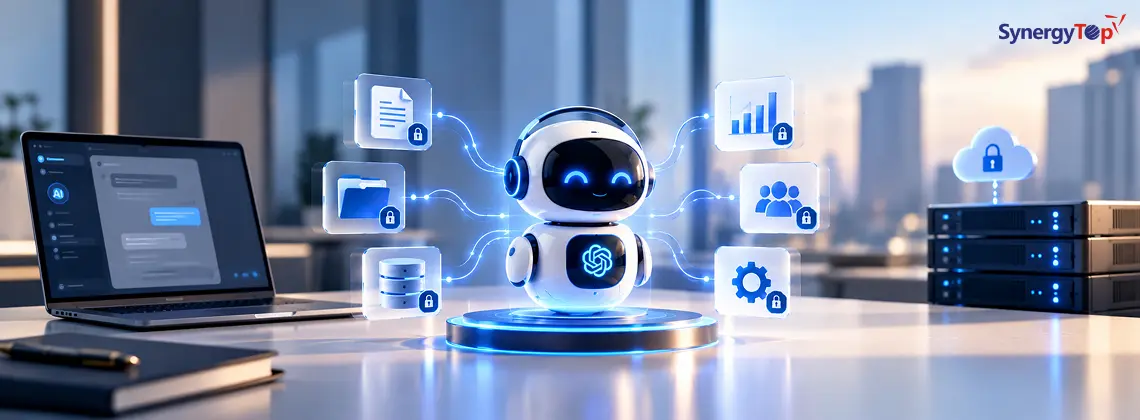


Your company may already have the knowledge your team needs—but it could be scattered across PDFs, SharePoint, Google Drive, CRM records, ERP systems, databases, emails, and internal applications.
A private AI assistant can make that information accessible through natural-language questions.
An employee could ask:
“Which customer contracts expire in the next 90 days?”
Or:
“Which orders are delayed, and what is causing the delay?”
But building a secure AI assistant around company data is very different from creating a basic chatbot. A private AI assistant can cost anywhere from around $10,000 for a focused proof of concept to $100,000+ for an enterprise system, depending on your data, integrations, security requirements, users, and what the AI needs to do.
Here’s what actually determines the cost.
How Much Does a Private AI Assistant Cost in 2026?
There is no single price because “AI assistant” can describe very different systems.
| Solution | Typical Requirement | Indicative Cost* |
| AI Proof of Concept | Validate one use case with limited company data | 10K–20K |
| Private RAG Assistant | Search documents and answer company-specific questions | 20K–40K |
| Business AI Assistant | Multiple data sources, authentication and permissions | 30K–60K |
| Integrated AI Assistant | CRM, ERP, database and API integrations | 60K–120K+ |
| Enterprise AI Agent | Multi-system analysis and approved business actions | 100K–150K+ |
These are planning ranges, not fixed quotations. Actual development cost depends on project requirements.
A typical estimate may include discovery, data preparation, AI/RAG development, application development, integrations, testing, and deployment. Enterprise requirements such as SSO, role-based access, audit logging, advanced evaluations, and complex workflows can increase the budget.
The important distinction is that the model itself is only one part of the cost. Most production AI projects also require software engineering, data integration, security, and infrastructure.
Not Sure Which Range Your Project Fits Into?
Get a preliminary estimate based on your use case, company data, integrations, and expected users.
Get My AI Assistant Estimate →
What Makes a Private AI Assistant More Expensive?
Instead of focusing only on whether you use GPT, Claude, Gemini, or another model, consider these five factors.
1. Where Your Company Data Lives
An assistant working with 3,000 organized PDFs is much easier to build than one that needs information from:
SharePoint + Salesforce + ERP + SQL databases + internal APIs + thousands of documents.
Data may need to be extracted, cleaned, structured, indexed, and continuously synchronized before the AI can use it effectively.
This is why an AI project often becomes a data integration project as well.
2. How Many Systems Need to Be Integrated
Suppose you want employees to ask:
“What is our enterprise refund policy?”
The answer may simply come from company documentation.
Now compare that with:
“Which customers haven’t ordered in the last 90 days?”
That could require CRM and database access.
Each additional business system introduces APIs, authentication, data structures, permissions, and synchronization requirements.
SynergyTop’s Artificial Intelligence services cover AI integration and custom AI solutions for businesses that need AI connected with existing applications and data.
3. What the AI Needs to Do: Ask, Analyze, or Act
This is one of the easiest ways to understand project complexity.
ASK
“What is our leave policy?”
AI retrieves information from company knowledge and answers the question.
ANALYZE
“Which customers haven’t ordered in 90 days?”
AI accesses business data, analyzes it, and returns an answer.
ACT
“Create follow-up tasks for those customers.”
AI interacts with another business system and changes data.
In simple terms:
Ask → Analyze → Act
usually means:
Lower Complexity → Higher Complexity → Highest Complexity
Once AI starts performing actions, the system may also need approvals, business rules, error handling, and audit logs.
4. Security and Permissions
A private AI assistant shouldn’t reveal information simply because that information exists somewhere in the company’s data.
HR documents shouldn’t automatically be visible to sales employees. Financial information may only be available to management.
Production systems may therefore require:
SSO, role-based access control, document permissions, encryption, audit logs, and approval workflows.
Organizations deploying AI can also use established AI risk management frameworks to assess governance, security, reliability, and other risks throughout the AI lifecycle.
OpenAI states that data submitted through its business offerings and API is not used to train its models by default.
However, model-provider policies are only one part of security. Businesses still need to design appropriate access controls, storage, logging, integrations, and data-handling policies around the AI application.
5. Number of Users
An internal assistant for 30 employees has different infrastructure requirements from a system serving 5,000 users.
Higher usage can increase model/API consumption, infrastructure requirements, database load, monitoring needs, and ongoing operating costs.
What Would Your AI Assistant Project Look Like?
Here are three examples that make the cost differences easier to understand.
Scenario 1: Private Knowledge Assistant
A 50-person company has:
- 5,000 internal documents
- SharePoint
- SOPs
- product documentation
- HR policies
Employees want to ask:
“What is our process for approving a new vendor?”
This is primarily a RAG-based knowledge assistant, where retrieval-augmented generation (RAG) helps ground AI responses in your organization’s proprietary content.
The system retrieves relevant information from approved company documents and provides a grounded answer, ideally with source references.
Scenario 2: AI Sales Assistant
A business has:
- CRM
- SQL database
- sales documents
- 200 users
A salesperson asks:
“Which customers haven’t purchased in 90 days, and what was our last interaction with them?”
Now the assistant needs to combine structured business data with company knowledge.
That means more integration, authentication, permissions, and business logic.
Scenario 3: Enterprise AI Agent
An operations team asks:
“Which customer orders are delayed, identify the likely reason, draft a response, and create a follow-up task.”
The required information exists across:
ERP + CRM + database + internal documents.
The workflow becomes:
Retrieve → Analyze → Recommend → Approve → Act
This is no longer just a chatbot. It is closer to an AI agent integrated into business operations.
If you’re exploring this type of system, SynergyTop’s guide to Agentic AI explains how AI systems can move from answering questions toward goal-oriented actions.
Build vs. Buy: Do You Really Need a Custom AI Assistant?
Not every company should build a custom solution.
If employees simply need help summarizing documents, writing content, brainstorming, or asking general questions, an existing AI product may already be sufficient.
Custom development becomes more relevant when AI needs to understand your proprietary data and business processes.
| Requirement | Existing AI Tool | Custom AI Assistant |
| General AI assistance | Good fit | Usually unnecessary |
| Basic document Q&A | Often sufficient | Sometimes |
| Multiple company data sources | Limited/varies | Strong fit |
| CRM/ERP integration | Varies | Strong fit |
| Complex user permissions | Varies | Strong fit |
| Custom business workflows | Limited | Strong fit |
| AI performing business actions | Varies | Strong fit |
Consider these two requests:
“Summarize this contract.”
versus:
“Review this customer’s contract, compare their pricing with our ERP, analyze their last three support tickets, and identify issues before renewal.”
The second request depends on your data, systems, permissions, and business rules.
That’s where a custom AI assistant can make more sense.
What Does a Private AI Assistant Cost After Launch?
Development isn’t the only cost to consider.
A production AI assistant can also have ongoing expenses for:
LLM/API usage, cloud infrastructure, vector databases, data synchronization, monitoring, AI evaluation, integration maintenance, and security updates.
For example, a knowledge assistant needs its data updated as company documents change. An assistant connected to CRM or ERP systems may require ongoing integration maintenance as APIs or business processes evolve.
So when comparing options, consider:
Development Cost + Operating Cost + Maintenance = Total Cost of Ownership
A cheap prototype isn’t necessarily the cheapest production solution.
Relevant SynergyTop Experience
Building a private AI assistant involves more than connecting an LLM to a chat window. It can require AI/ML engineering, backend development, data integration, APIs, authentication, cloud infrastructure, and custom application development.
SynergyTop works across AI development and custom software development, including AI integration, automation, custom applications, and data-driven platforms.
Our published portfolio also includes an AI-powered travel recommendation application and software involving Python development, third-party integrations, business data, secure applications, and custom workflows.
These aren’t presented as private RAG implementations. Instead, they demonstrate relevant engineering capabilities needed when AI must work alongside existing software and business data.
You can explore more examples in the SynergyTop portfolio.
What Would Your Private AI Assistant Cost?
If you’re considering a private AI assistant, you don’t need a complete technical specification before getting an initial estimate.
Start with four questions:
1. What should the AI assistant do?
Answer questions, analyze data, or perform actions?
2. Where does your data live?
Documents, SharePoint, CRM, ERP, databases, APIs—or several of them?
3. Which systems need to be integrated?
For example, Salesforce, HubSpot, SAP, Microsoft Dynamics, or your own software.
4. How many people will use it?
These answers can provide enough information for an initial assessment of architecture, complexity, timeline, and budget.
Get Your Private AI Assistant Cost Estimate
Tell us about your use case, company data, required integrations, and expected users.
SynergyTop can help you assess the likely:
Solution architecture • Development range • Integrations • Implementation approach • Timeline
Frequently Asked Questions
1. How much does it cost to build a private AI assistant?
Costs vary significantly. A focused proof of concept may start around the low five figures, while production RAG assistants and integrated business AI systems can require significantly larger budgets. Data, integrations, permissions, required actions, security, and scale are major cost drivers.
2. Can an AI assistant use our private company data?
Yes. An AI application can retrieve information from approved company sources such as documents, databases, CRM, ERP, and other business systems. The architecture should include appropriate authentication, permissions, encryption, logging, and data controls.
3. Do we need RAG?
RAG is particularly useful when the assistant needs to answer questions using current proprietary information from company documents or knowledge sources. It allows relevant information to be retrieved when a question is asked rather than relying solely on what the model learned during training.
4. How long does it take to build a private AI assistant?
A focused proof of concept may take a few weeks. A production knowledge assistant may take several weeks to a few months, while enterprise systems involving multiple integrations, complex permissions, and AI actions can require several months.