contact@synergytop.com
 +1 619-349-4911




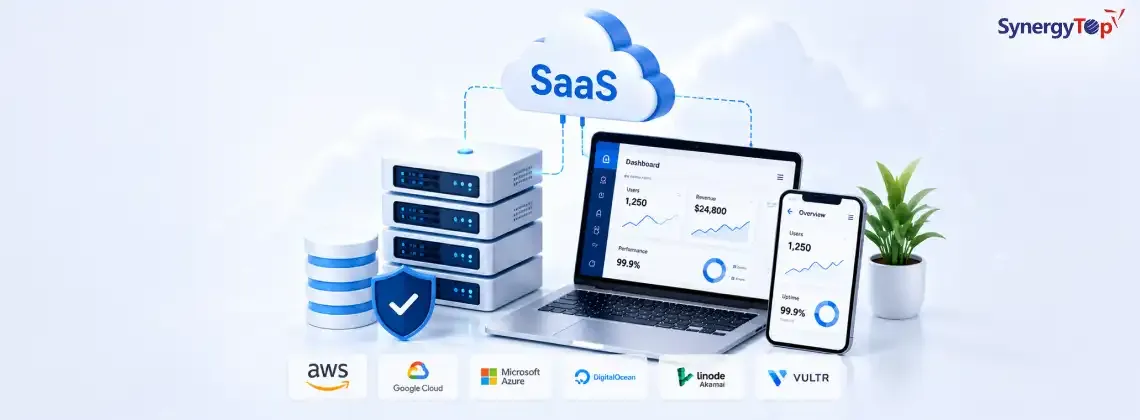


Launching your first SaaS product is exciting.
It also forces you to make dozens of decisions you’ve probably never had to think about before. Which framework should you use? Where should you host it? How much traffic should you expect? How much should you spend?
I’ve seen plenty of founders spend weeks debating features while treating hosting as an afterthought. Personally, I think that’s backwards.
Your hosting provider becomes the foundation your application runs on. If that foundation isn’t reliable, everything built on top of it becomes harder to maintain.
The good news is that choosing a hosting provider doesn’t have to be complicated. You simply need to understand what your application needs today while leaving room for tomorrow.
Start With Your Current Requirements
One mistake I see quite often is planning infrastructure for millions of users before the product even has ten customers.
That usually leads to unnecessary costs and infrastructure that’s far more complex than it needs to be.
Instead, I prefer asking a few simple questions.
- How many users do you realistically expect during the first year?
- Will customers upload files or large amounts of data?
- Does your application process information continuously?
- Will you need staging and testing environments?
- How quickly do you expect to grow?
The answers make choosing a hosting solution much easier.
Infrastructure should support your business, not become another project you have to manage.
Shared Hosting Has Its Place
Shared hosting often gets dismissed by developers, but I don’t think that’s entirely fair.
For simple websites, landing pages, documentation, or marketing sites, shared hosting can be perfectly adequate.
The limitation appears when your SaaS application starts relying on background jobs, databases, APIs, or custom server configurations.
Because resources are shared with other customers, performance can become unpredictable as your application grows.
For most SaaS platforms, shared hosting works best as a temporary solution rather than a long-term one.
VPS Hosting Offers a Great Balance
If someone asks me where most early-stage SaaS applications should begin, my answer is usually a Virtual Private Server.
A VPS provides dedicated resources without the cost of renting an entire physical server.
That means you have greater control over:
- Operating system configuration
- Security settings
- Server software
- Application deployment
- Performance tuning
It also allows you to grow gradually without completely rebuilding your infrastructure.
For many startups, that’s exactly the balance they’re looking for.
Cloud Platforms Make Scaling Easier
Cloud infrastructure has changed the way modern software is deployed.
Instead of guessing how much hardware you’ll need next year, cloud platforms allow you to increase resources as demand grows.
That flexibility becomes valuable when your SaaS application experiences rapid growth or unpredictable traffic.
Cloud services also simplify several operational tasks, including:
- Automated backups
- Managed databases
- Load balancing
- Monitoring
- Geographic redundancy
The trade-off is complexity.
Cloud environments often provide hundreds of services, and it’s surprisingly easy to build an infrastructure that’s larger than your application actually requires.
I’ve seen companies spend more time managing cloud resources than improving their product.
Sometimes a simpler architecture is simply the better choice.
Security Should Never Be Optional
Security isn’t something I like postponing until after launch.
The earlier it’s considered, the easier it becomes to build properly.
At a minimum, every SaaS application should include:
- HTTPS encryption
- Strong authentication
- Regular software updates
- Secure database access
- Automatic backups
- Monitoring and logging
Customers may never notice these features when everything works correctly.
They’ll certainly notice if they’re missing.
Trust is difficult to earn and remarkably easy to lose.
Backups Are Your Safety Net
Backups don’t usually receive much attention until they’re needed.
Unfortunately, by then it’s already too late. Hardware fails. Software bugs happen. People accidentally delete data.
Reliable backups mean those situations become inconveniences instead of disasters.
I always recommend testing backups regularly rather than simply assuming they’re working.
A backup that can’t be restored isn’t really a backup.
Look Beyond the Monthly Price
Price matters. It just shouldn’t be the only thing you compare.
Some hosting providers advertise extremely low introductory prices that increase substantially after the initial term.
Others include backups, security features, or support that would otherwise cost extra elsewhere.
If you’re comparing providers, don’t just look at introductory pricing. Before committing, it’s worth taking a few minutes to check these Hostinger coupons and compare the long-term cost against other providers.
Sometimes the cheapest plan ends up being the most expensive decision over the life of your project.
Think About Where You’ll Be in Two Years
One question I like asking founders is this:
“What happens if your application becomes successful?”
It’s a good problem to have, but it’s still a problem if your infrastructure can’t keep up.
Your hosting provider should make it easy to:
- Upgrade resources
- Add additional servers
- Improve redundancy
- Expand storage
- Handle increasing traffic
Migration is always possible, but it’s far easier when you’ve planned for growth from the beginning.
Scalability doesn’t mean paying for resources you don’t need today.
It means having a clear path forward when you do.
Final Thoughts
Choosing a hosting provider for your first SaaS project isn’t about finding the biggest server or the platform with the longest feature list.
It’s about finding infrastructure that matches where your business is today while giving you room to grow tomorrow.
Start simple.
Focus on reliability, security, backups, and predictable costs.
As your application evolves, your infrastructure can evolve with it.
In my experience, that’s a far more sustainable approach than trying to build an enterprise platform before you’ve acquired your first customers.