contact@synergytop.com
 +1 619-349-4911




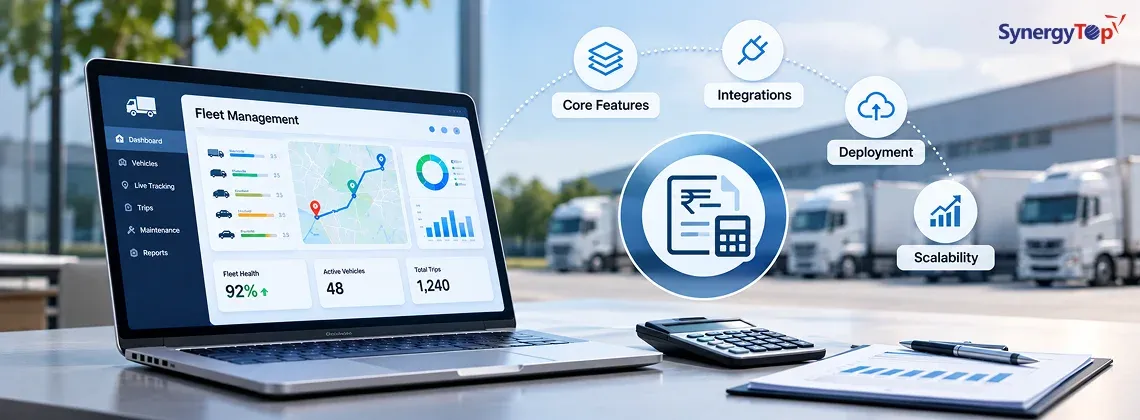


If your fleet still depends on phone calls, spreadsheets, WhatsApp updates, manual fuel logs, and separate GPS dashboards, the problem is probably not that you need “more software.”
The real problem is that your fleet data is scattered across too many places.
Dispatch knows where the vehicles should be. GPS tells you where they actually are. Drivers report issues separately. Maintenance records sit in another system. Fuel expenses arrive later. Management then tries to combine all of that information into one report.
That is usually the point where businesses start asking whether a custom fleet management system would solve the problem.
The next question is obvious:
How much does it cost to build one?
For a focused fleet management MVP, a realistic planning budget may start around 25,000–50,000. A more complete platform with GPS tracking, route management, driver apps, maintenance, fuel tracking, alerts, dashboards, and integrations can move into the 60,000–150,000 range. Large enterprise systems with telematics, advanced optimization, AI, multi-location operations, or hundreds of vehicles can exceed 150,000–300,000+.
Those are planning ranges, not fixed quotations. The final cost depends less on the number of screens and more on how much operational complexity the software needs to manage.
How Much Should You Budget for Fleet Management Software?
A useful starting point is to think about the system in stages.
| Fleet Management System | Typical Planning Budget |
| Basic Fleet MVP | 25,000–50,000 |
| GPS + Driver + Maintenance Platform | 50,000–90,000 |
| Integrated Fleet Operations System | 75,000–150,000 |
| Advanced Enterprise Fleet Platform | 150,000–300,000+ |
A basic system may include vehicle records, driver management, trip assignments, GPS tracking, and simple dashboards. A larger platform may also need fuel monitoring, preventive maintenance, route optimization, mobile applications, geofencing, real-time alerts, document management, ERP integration, and advanced reporting.
This is why two companies with the same number of vehicles can receive completely different development estimates.
A company with 50 vans operating within one city may need a much simpler platform than a logistics company managing 50 vehicles across multiple states, depots, clients, and delivery schedules.
The Biggest Cost Driver Is Usually Not GPS
Many businesses assume GPS tracking will be the most expensive part of the system.
It usually is not.
Displaying vehicle positions on a map is relatively straightforward. The real complexity begins when the business wants to use that location data to automate decisions.
For example, you may want the platform to automatically detect when a driver leaves a planned route, enters a geofenced customer location, spends too long at a stop, misses a delivery window, or needs to be reassigned to another job.
Now GPS is no longer just a dot on a map. It becomes part of your operational logic.
Mapping and routing also create ongoing API costs. Google Maps Platform, for example, uses usage-based pricing for services such as Routes, route matrices, geocoding, and fleet-routing capabilities. Google Maps Platform pricing
The important budgeting question is therefore not simply, “Do we need GPS?”
It is:
What decisions do we want the software to make using location data?
Route Optimization Can Change the Cost Quickly
There is a big difference between showing a driver where to go and automatically deciding the best route for 100 vehicles.
A simple application may display assigned stops and navigation.
An advanced fleet platform may need to consider vehicle capacity, delivery windows, traffic, driver shifts, customer priority, depots, vehicle type, and multiple possible routes before assigning work.
That kind of optimization adds complexity to both the backend and the business logic.
Google even separates standard route APIs from its dedicated fleet-routing optimization capability, which reflects how different these workloads can become.
If your fleet currently relies on dispatchers manually deciding which driver should take each job, this may be one of the areas where custom software can create the largest operational return.
Driver Mobile Apps Add More Than a Mobile Screen
Most modern fleet systems eventually need a driver application.
The app may allow drivers to view assigned trips, start and complete jobs, navigate to locations, upload proof of delivery, report vehicle issues, capture signatures, upload photos, or communicate with dispatch.
The development cost depends on how much the app needs to do offline, how frequently it sends location updates, whether it integrates with device hardware, and how much information needs to synchronize in real time.
For businesses that need a custom driver experience, SynergyTop’s Mobile Application Development Services support native and cross-platform applications that can integrate with existing systems and operational workflows.
The important thing is not to build an app simply because “drivers need an app.”
Build only the features that remove calls, paperwork, delays, and repeated data entry.
Maintenance Management Can Deliver Faster ROI Than Fancy Features
Vehicle downtime is expensive.
If maintenance is still managed using spreadsheets, paper records, or driver memory, the fleet may be reacting to breakdowns instead of preventing them.
A custom system can track mileage, engine hours, service dates, inspections, tire replacement, warranties, and maintenance history. It can automatically notify the operations team when a vehicle is approaching a service threshold.
The real value is not the maintenance screen.
It is reducing unplanned downtime and helping managers understand the actual operating cost of each vehicle.
For many companies, this is a higher-value feature than adding advanced AI in version one.
Fuel Tracking Becomes Valuable When It Connects With Other Data
Fuel management sounds simple until you try to identify why one vehicle is consistently more expensive to operate.
A good fleet system can compare fuel transactions with distance travelled, assigned route, driver, vehicle type, and historical consumption.
Now the business can start asking useful questions.
Why is Vehicle 27 consuming more fuel than similar vehicles? Is the route inefficient? Is there excessive idling? Is maintenance overdue? Does one driver consistently show higher consumption?
That is where custom fleet software becomes much more useful than a basic GPS tracker.
It connects information that would otherwise sit in separate systems.
What About Telematics and IoT?
If your fleet collects information directly from vehicles, the architecture becomes more advanced.
Telematics devices may continuously send GPS coordinates, ignition status, speed, sensor information, engine events, or other data to the cloud.
That means your platform must reliably receive, process, store, and analyze a large stream of device data.
Cloud IoT services are usually priced based on actual usage. AWS IoT Core, for example, charges separately for device connectivity, messaging, device state, registry operations, and rules-engine processing rather than charging one fixed platform fee. AWS IoT Core pricing
As your fleet grows, architecture becomes important because sending location and telemetry every few seconds from hundreds or thousands of vehicles can generate a very different workload than a fleet of 20 vehicles.
Integrations Often Decide Whether the System Actually Saves Time
The fleet application should not become another isolated platform.
If dispatch creates a delivery in the ERP and someone then manually enters the same information into the fleet system, you have simply created another data-entry task.
A better architecture connects the systems.
For example:
Customer Order → ERP → Fleet Platform → Driver App → Proof of Delivery → ERP / Billing
This can reduce manual coordination and ensure everyone works with the same information.
Common integrations may include CRM, ERP, warehouse software, accounting, fuel-card providers, telematics devices, payment systems, customer portals, and third-party APIs.
SynergyTop’s Custom Software Development Services are designed around these kinds of custom workflows and integrations rather than forcing businesses into a one-size-fits-all application.
Should You Build Custom Fleet Software or Buy SaaS?
If you operate 20 vehicles and mainly need GPS tracking, maintenance reminders, and basic reporting, an existing fleet SaaS product may be faster and more economical.
Building custom software starts making more sense when your workflow is different enough that employees constantly work around standard products.
For example, you may have unique dispatch logic, customer-specific delivery processes, multi-stage approvals, complex pricing, specialized vehicle categories, ERP integrations, or operational reporting that existing fleet platforms cannot handle cleanly.
At that point, you may be paying for SaaS while still managing critical processes in Excel, WhatsApp, email, or other applications.
That is exactly where a custom platform deserves financial evaluation.
What Would a Practical First Version Include?
The biggest mistake is trying to build every possible fleet feature in version one.
For many businesses, a useful first release could focus on vehicle management, driver management, trip assignments, live GPS, trip status, maintenance reminders, alerts, reporting, and a driver mobile app.
Once the system is being used daily, you can add route optimization, fuel analytics, telematics, predictive maintenance, customer tracking, advanced dashboards, or AI.
SynergyTop’s Product Engineering Services follow this type of scalable product-development approach, where features can be prioritized around business value and expanded as the product grows.
This is usually safer than spending heavily on advanced functionality before proving that the core workflow works.
Can AI Reduce Fleet Operating Costs?
Potentially, yes, but only when the business has enough reliable data.
AI can help identify maintenance patterns, flag unusual fuel usage, recommend routes, summarize driver performance, predict operational risks, or automatically surface vehicles that need attention.
But AI should not be the starting point if your vehicle, driver, maintenance, and trip data is still scattered across different spreadsheets and systems.
The better sequence is:
Centralize the workflow → collect clean operational data → automate repetitive work → add AI where it creates measurable value.
SynergyTop already works across AI development, custom software, integrations, and workflow-oriented applications, and its guide on AI agent development cost explains why production AI costs depend heavily on integrations, data, security, and workflow complexity.
FAQs
1. How much does it cost to build a fleet management system?
A focused fleet-management MVP may require approximately 25,000–50,000, while a more complete system with GPS, driver apps, maintenance, route management, and integrations may fall around 60,000–150,000. Advanced enterprise platforms can exceed $150,000 depending on scale and complexity.
2. What makes fleet management software expensive?
The biggest cost drivers are usually real-time GPS processing, route optimization, telematics, mobile applications, ERP integrations, reporting, data migration, security, and complex business rules.
3. How long does it take to build?
A focused MVP may take a few months. Larger integrated fleet platforms usually require phased development because GPS, mobile apps, integrations, testing, and operational rollout all need validation.
4. Can fleet software integrate with our existing ERP?
Yes, provided the ERP supports suitable APIs or integration methods. Orders, customers, vehicles, invoices, and delivery status can often be synchronized between systems.
5. Should we buy fleet SaaS instead?
If your requirements are standard, SaaS may be more economical. Custom development becomes more attractive when your operational workflow, integration requirements, or scale make standard tools inefficient.
6. Can we start with GPS and add other features later?
Yes. A phased approach is often preferable. Start with the workflow creating the most pain and expand after the system is proven in daily operations.
Get a Fleet Management System Cost Estimate
You do not need to prepare a complete technical specification before asking for a quote.
Start with your current operation.
Tell SynergyTop how many vehicles you manage, how dispatch works today, which information is still tracked manually, whether you already use GPS or telematics devices, which ERP or CRM systems need to connect, and what operational problem you most want to solve.
From there, the project can be scoped around what your business actually needs rather than a generic list of fleet-management features.