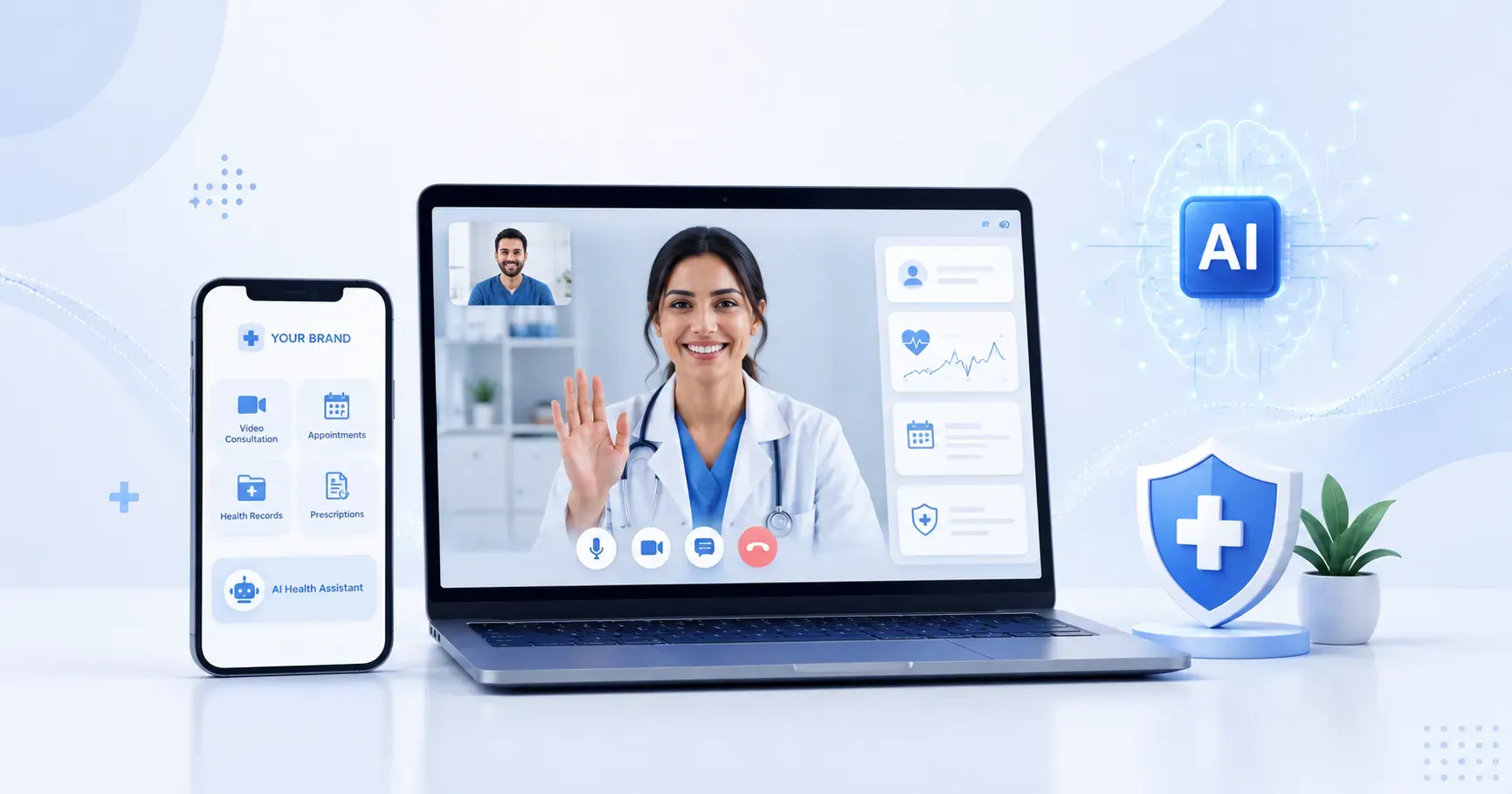

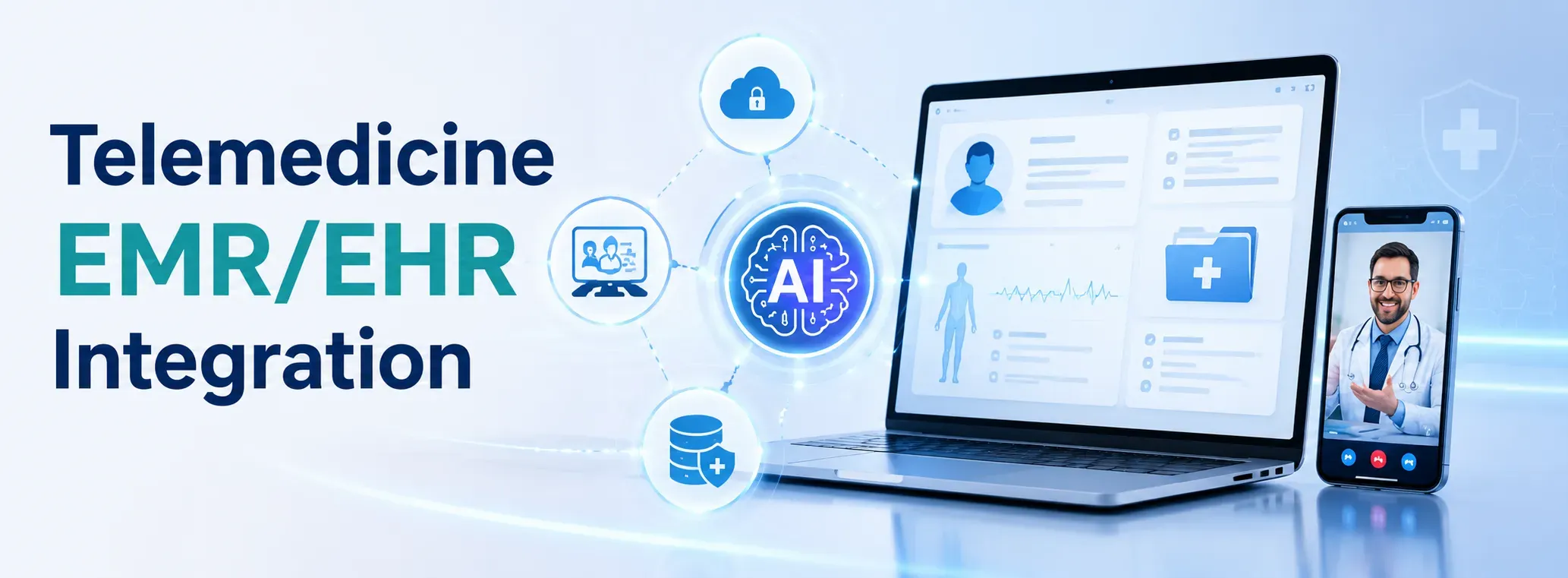
Manual processes and piles of paperwork in healthcare are a thing of the past. AI systems are revolutionizing patient data management in modern clinics, hospitals, and virtual care providers. Telemedicine EMR/EHR Integration now allows healthcare providers to automate appointments, patient records, billing, prescriptions, follow-ups, and even communication without constant human effort. With the help of AI-based systems, platforms can now be integrated live, eliminating delays, errors and administrative burden.
Why AI Is Driving Telehealth Integration With EHR Systems
AI is poised to be the backbone of the connected healthcare ecosystem. Today’s clinics need seamless patient data, prescriptions, appointments, and diagnostic information across platforms. This is why telehealth integration with EHR systems has become a major priority for healthcare providers worldwide.
In the virtual consultation, the AI algorithms can retrieve patient records in real time. No more manual searching of files or updating of records after each call for doctors. Smart automation features help providers focus more on treatment rather than data entry, eliminating repetitive tasks.
How AI Pulls Manual Work in Virtual Care
AI-driven systems can handle multiple healthcare processes simultaneously. This enhances the speed and decreases human dependence in routine procedures.
- Automatic updates of patient records
- AI-driven medical documentation
- Smart appointment reminders
- Real-time data synchronization
AI systems are now expected to silently operate in the background and process vast amounts of clinical data automatically, an expectation that is now being met by healthcare companies.
The Real Growth of EMR Telehealth
Traditional systems are slow and disjointed, making them ineffective, and that is why healthcare providers are turning to AI-first platforms. Today’s EMR telehealthsystems integrate patient records and virtual consultation features into a single ecosystem.
AI can now summarize consultations, prescribe treatments, and suggest treatment workflows in seconds. By automating repetitive administrative tasks, Clinics save time. This also helps patient satisfaction as wait times are shorter and communication is quicker.
AI Features Changing Digital Healthcare
The latest AI healthcare tools are becoming smarter every year. Nowadays, there are many organizations that are relying on automation for patient operations in large-scale.
- Healthcare AI voice transcription for consultations
- Predictive patient risk analysis
- Automated billing workflows
- Intelligent prescription management
These systems save on the operating expenses and enhance the efficiency of healthcare.
What Makes Telehealth EHR Integration So Powerful
AI-driven platforms ensure healthcare data flows between providers and patients in a seamless way, allowing doctors to access real-time medical records during online consultations, without the need for consistent switching between different platforms.
This integration also helps to minimize documentation errors. AI can identify missing data, duplicate records, and inconsistent patient records. Automatic organization of data enables quicker decision-making by healthcare teams.
AI Can Manage Entire Patient Journeys
Today’s AI solutions go beyond simple automation. These are now able to oversee patient workflows from end to end.
- AI-assisted symptom checking
- Automated consultation summaries
- Smart patient communication systems
- Predictive follow-up scheduling
This helps to alleviate the workload pressure for healthcare workers and enhances the uniformity in healthcare.
Smarter Clinics Need EMR for Telemedicine
Healthcare organizations are quickly transitioning to intelligent virtual care environments. AI-driven EMR for telemedicine solutions enable a streamlined process for organizations, allowing them to schedule appointments, record consultations, track patient information, and generate digital prescriptions without any hassles.
AI can also prioritize patient cases automatically. Rather than having to check appointments by hand, providers will be intelligently recommended with regard to signs and medical history. This can speed up the response time and the delay in treatment.
Automation Is Redefining Patient Experience
Today, patients demand speedy and customized patient care services. AI systems support the providers to provide a faster and more accurate virtual care experience.
- Quick access to medical records
- AI-driven chatbot assistance
- Automated prescription generation
- Intelligent patient notifications
These characteristics help to make virtual healthcare more efficient and easily managed.
The Rise of EHR with Telehealth
Healthcare providers are using AI to bridge the gap between disparate systems. AI is being used to join fragmented systems in healthcare. Today, with the integration of telehealth platforms, EHRs are a single AI-driven system that brings patient information, video visits, billing and communication together.
By integrating with healthcare systems, this functionality enhances access to healthcare for both patients and providers. The platform automates repetitive tasks throughout the day, minimizing the need for manual administrative work, further reducing dependency on manual staff.
AI Improves Healthcare Decision-Making
AI is not just about automation. It also ensures clinical accuracy with intelligent data analysis.
- The AI digs out patient anomalies.
- Smart systems are recommending treatment plans
- Automated alerts reduce medical errors
- Predictive analytics help make quicker decisions
AI adoption provides healthcare organizations with operational and clinical benefits.
Why Businesses Prefer Cloud-Based EHR Telehealth Support
As organizations expand, scalable healthcare systems are increasingly becoming a must-have feature, enabling healthcare providers to securely access patient records, consultations, and analytics from anywhere. Cloud-based EHR telehealth support helps providers to access records, consultations, and analytics securely from anywhere in a scalable manner.
AI and Cloud Technology Work Together
Cloud infrastructure becomes significantly more powerful when combined with AI-driven automation.
- Faster patient data access
- Real-time healthcare analytics
- Automated backup management
- Intelligent cybersecurity monitoring
This combination enhances efficiency and system reliability.
The Business Impact of Telemedicine EHR
Healthcare companies are facing a challenge to improve efficiency and cut expenses. Telemedicine EHR systems with AI capabilities can help organizations to automate many repetitive tasks that would otherwise be done by a large administrative team.
AI can accurately verify patient data, structure medical records, and streamline insurance processes. This cuts delays and helps to enhance the provision of health care, between departments. In today’s marketplace, many providers consider AI integration a “must” business upgrade and not an “optional.”
AI Eliminates Administrative Chaos
AI streamlines repetitive tasks in healthcare, optimizing operations.
- Automated patient onboarding
- Smart insurance verification
- AI-driven medical coding
- Automated reporting systems
They can be used to improve the efficiency of clinics and reduce manual workloads.
Choosing the Best EMR for Telemedicine
Systems that can automate rather than add complexity are desired by healthcare providers. The best EMR for telemedicine should include AI-powered scheduling, smart documentation, automated billing, and predictive analytics capabilities.
The key features to watch for in AI healthcare platforms
When choosing a healthcare system, it is crucial for businesses to consider a number of essential features.
- AI automation tools
- Real-time patient synchronization
- Intelligent reporting dashboards
- Secure cloud infrastructure
Seeking the best platform can have a direct impact on long-term operational efficiency.
AI Is Transforming Telemedicine EMR
With the advent of AI, modern healthcare platforms are undergoing significant transformations as AI can perform numerous functions that previously needed entire teams, such as patient management, prescription processing, virtual consultations, and documentation.
AI Creates Faster Healthcare Workflows
Automation improves speed across every healthcare process.
- Instant consultation summaries
- AI-generated treatment notes
- Automated patient reminders
- Smart referral management
Healthcare organizations save both time and operational costs through AI-driven optimization.
The Future of EHR With Telemedicine
AI is poised to further revolutionize digital health in the coming decade. As machine learning technology advances, EHR with telemedicine systems will be even more independent. Predictive diagnostics, treatment planning, patient monitoring, and healthcare analytics will be managed with less human involvement in the future with AI platforms.
AI Will Continue Expanding Healthcare Automation
Healthcare automation is still in a state of constant change. There are other systems that could be added in the future:
- AI-powered virtual healthcare assistants
- Predictive disease prevention systems
- Fully automated patient workflows
- Intelligent healthcare analytics engines
Healthcare organizations that don’t adopt AI may fall behind the curve of more AI-powered organizations.
How to Integrate an Appointment Management System with EHR has Become Easier with AI
In the past, healthcare organizations were required to have complex development procedures to join appointment systems to the clinical records. Now, AI makes it easier than ever to connect an appointment management system with EHR via automated APIs and intelligent sync tools.
Automated systems based on AI can keep current with schedules, patient history, reminders, and consultation information across connected systems. This simplifies the technical situation and limits man involvement in integration processes.
Simplifying System Connectivity is Easier with AI
Healthcare businesses can use modern tools that integrate AI to connect systems in no time.
- Automated appointment syncing
- Intelligent calendar management
- Real-time patient updates
- Smart workflow automation
This will make things more seamless for both providers and patients.
AI is Reshaping Healthcare App Ecosystems
Smart digital ecosystems are now a necessary part of the modern healthcare business. Advanced healthcare app platforms, patient management dashboard, EHR integration solutions help providers manage patient records, appointments, billing, and analytics from one centralized system.
AI streamlines healthcare data organization, providing greater operational visibility. The clinics and hospitals get real-time data on patient activities, performance and treatment efficiency. This helps to alleviate administrative overload and enhances health service management.
Why AI Matters in Medication and Billing Systems
Medication tracking and revenue management are crucial applications of AI in digital healthcare. Many providers today are employing the best telehealth medication management platforms integrated with EHR platforms to automate prescriptions, refill reminders and monitoring treatment.
To ensure accurate billing and faster payment cycles, healthcare organizations are also implementing best practices for integrating RCM software into telehealth apps. With AI handling the entire claims process, identifying billing mistakes, and streamlining the revenue cycle, there’s no need for constant manual supervision.
AI Is Strengthening Modern Healthcare Integration
Healthcare providers are improving efficiency with AI-powered systems and pharmacy systems with integrated telehealth communication capabilities. The healthcare sector is making strides in improving the efficiency of systems, while in the pharmaceutical industry, systems are being enhanced with added telehealth communication capabilities. They facilitate automated communication, secure notifications, prescription updates, and enhanced patient coordination within healthcare operations.
- The benefits of RHR and telemedicine integration include faster data access and reduced paperwork
- Businesses follow best practices for integrating EHR with telehealth platforms to improve scalability and cybersecurity
- AI-powered EHR telehealth solutions automate scheduling, billing, documentation, and analytics
- Intelligent automation helps healthcare organizations improve efficiency and reduce operational pressure
Conclusion
AI is rapidly reshaping healthcare unlike most companies would have thought. These days, modern systems can handle virtually any task in the healthcare space, from patient onboarding to billing automation, with little human effort. Organizations embracing intelligent healthcare ecosystems are reaping significant benefits in terms of faster speed, increased efficiency, scalability, and customer satisfaction.
The days of separate systems, especially in healthcare, are coming to an end and automated platforms are now the future, with Telemedicine, EMR, EHR, Analytics, Communication, and Patient Management all integrated into a single AI-powered platform. In this digital healthcare landscape, early adoption of advanced automation is a key to the success of healthcare providers.
FAQs
1. Telehealth EMR Integration is what?
The Telehealth EMR integration allows virtual health care systems to be integrated with EMR, enabling the automatic exchange of patient data during the consultation process.
2. Why is EHR and Telemedicine important?
By incorporating telemedicine into EHR, healthcare providers can make better-informed clinical decisions and better connect with patients during virtual visits.
3. What are the benefits of AI in telemedicine EMR systems?
Within telemedicine EMR systems, AI streamlines the scheduling process, documentation, prescription writing, billing, and patient communication.
4. What is the advantage of EMR telemedicine platforms?
AI automation streamlines administrative tasks and enhances operational efficiency on EMR telemedicine platforms.
5. What are the reasons providers require the best EHR for telemedicine solutions?
The ideal EHR solution for Telemedicine services support health care organizations to automate their processes, enhance patient experience, and expand services efficiently.