

Table of Contents:
- A Fast Start: Why AI Changes Everything
- The HIPAA Rules That Actually Matter
- Step 1: Let AI Map the Risks
- Step 2: Design a Secure-by-Default System
- Step 3: Build the Features Patients Will Use
- Step 4: Pick a Stack AI Can Support Well
- Step 5: Test, Monitor, and Keep Improving
- The Mistakes That Break Compliance
- Final Thoughts
- FAQs
A Fast Start: Why AI Changes Everything
Previously, it was a slow and complicated process to create a HIPAA-compliant telehealth app. In 2026, AI in the development of telehealth apps transforms that totally. AI is able to plan, write the code, test security and even write compliance documents. It can also assist teams to operate quicker without losing focus over patient privacy or product quality.
In case you want to develop a telehealth app , AI eliminates the majority of the friction. The heavy lifting is now automated, however human observation is still necessary. It implies that teams will not need to waste as much time on repetitive tasks and focus more on strategy and patient experience.
The HIPAA Rules That Actually Matter
Encryption is not the only aspect of a HIPAA-compliant healthcare application. It’s about how your app handles protected health information (PHI) across systems. All aspects of the workflow must be in favor of privacy, access control, and accountability.
To create a telehealth app, you need to make sure:
- Information is safeguarded
- Access is controlled
- Vendors are HIPAA compliant
- Audit logs are kept.
- Confidentiality of patients is maintained
What AI can handle here
AI can:
- Visualize PHI flow
- Generate compliance checklists
- Suggest HIPAA-ready workflows
- Flag risky integrations
- Draft policy documents
This simplifies the process of creating healthcare apps using AI. It also provides the teams with a better direction towards compliance at an earlier stage.
Step 1: Let AI Map the Risks
Every HIPAA-compliant app development process starts with a risk assessment. AI is able to scan your whole system and determine the point at which PHI is revealed. It assists the teams in identifying issues early rather than detecting the issue after the launch.
It creates:
- Risk reports
- Threat models
- Vulnerability lists
- Compliance documentation
Use AI to do the boring part
AI can quickly:
- Trace application data flow
- Determine weak areas of authentication
- Highlight storage risks
- Prioritize threats according to severity
- Suggest fixes automatically
This is where AI-based healthcare solutions can save lives in terms of time. It also simplifies the whole compliance process to manage and review.
Step 2: Design a Secure-by-Default System
When you build a telemedicine app, security should not be an afterthought. AI aids in developing a system in which compliance is designed. It is even able to suggest safer patterns prior to development.
It proposes the improved design of:
- Secure APIs
- Role-based access
- Data encryption layers
- Microservices separation
- Audit logging
Keep the architecture lean
An effective telehealth app development strategy involves:
- Minimal data collection
- Controlled access levels
- Isolated sensitive services
- Transparent audit trails
- Easy third-party review
AI can assist you in maintaining everything tidy and organized. It makes the app simpler to secure, scale and maintain in the long run.
Step 3: Build the Features Patients Will Use
This is followed by the real telehealth app development services layer. Majority of the product features are created fast and efficiently by AI. It assists in converting a complicated concept into an application that can be used more quickly than the conventional methods.
The best AI-assisted build order
- Secure login and patient onboarding
- Appointment scheduling system
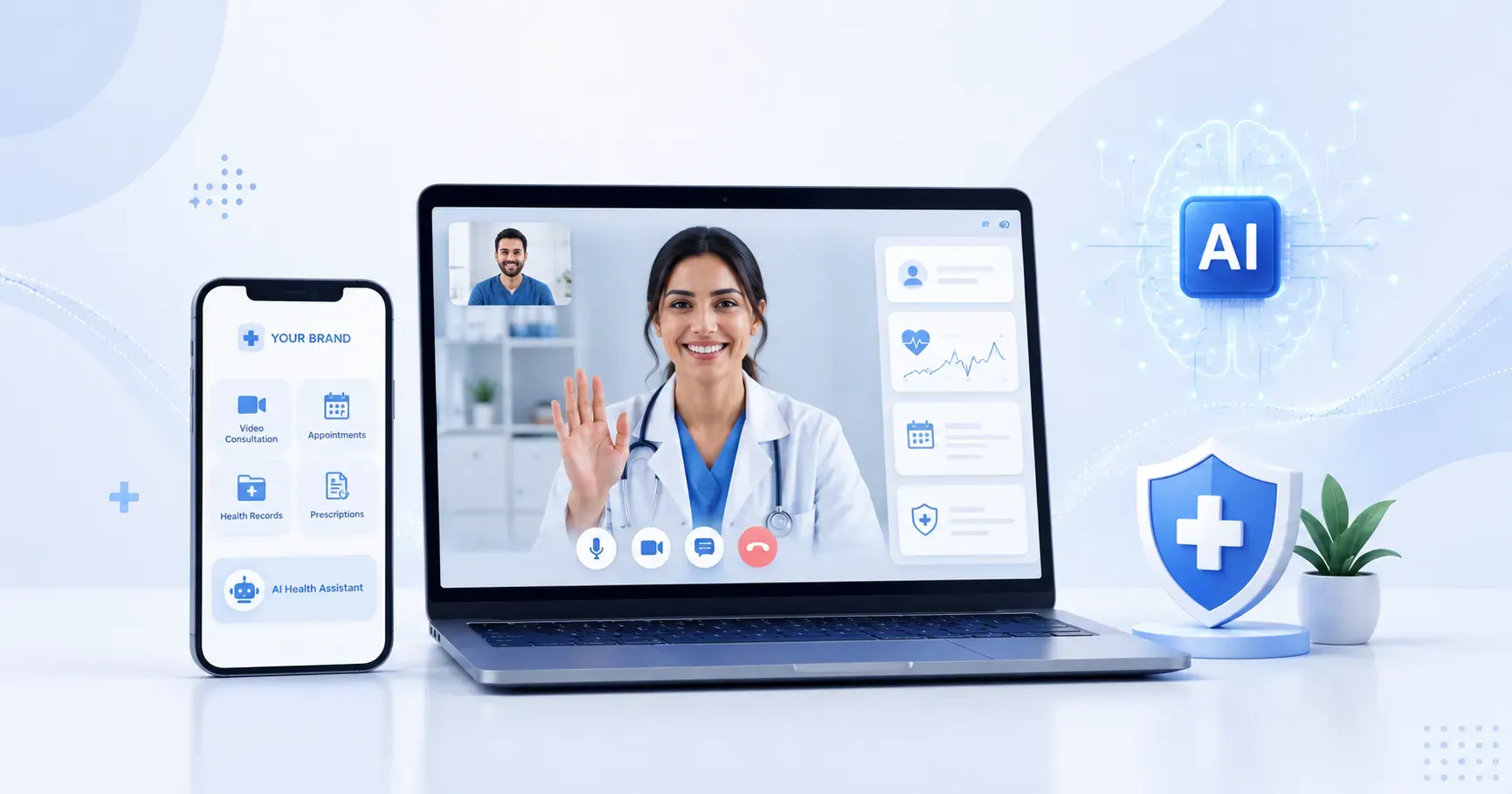
- Video consultation and chat
- E-prescriptions and notifications
- Admin dashboard and analytics
AI has the ability to write logic, create UI, and even optimize workflows. This accelerates the development of AI healthcare apps in the past. It also assists in making patients and providers experience smoother transitions.
Step 4: Pick a Stack AI Can Support Well
When creating a healthcare app, it is highly important to choose the appropriate stack. AI will be able to recommend scalable, secure, and easy-to-maintain technologies. It is also able to make comparisons of options in terms of performance, flexibility and compliance requirements.
A realistic AI-friendly stack has the following appearance
- Modern frontend framework
- Secure backend APIs
- HIPAA-ready cloud storage
- Strong authentication systems
- Monitoring and logging tools
AI helps keep your telemedicine app development stack consistent and optimized. This will minimise technical debt and future updates will be far easier to handle.
Step 5: Test, Monitor, and Keep Improving
A HIPAA-compliant telehealth application will never be complete. It should be constantly monitored. This can be fully automated by AI. It continues to monitor threats, mistakes, and non-compliance even after launch.
Let AI watch the app after launch
AI helps with:
- Automated security testing
- Real-time monitoring
- Log analysis
- Threat detection
- Compliance reporting
This is where AI in healthcare software development really comes in. It maintains your app safe without manual work. It also aids your team to react quicker to a change.
The Mistakes That Break Compliance
Even the most competent teams commit errors when creating telehealth apps. The distinction is getting them at an early age. AI will provide you with a greater opportunity to identify those errors before they turn into a major problem.
Common mistakes to avoid
- Skipping risk assessments
- Using non-compliant vendors
- Over-collecting patient data
- Ignoring software updates
- Poor access controls
These problems can be detected by AI in the early stage of your healthcare application development service. It will imply fewer surprises and a significantly reduced possibility of compliance issues down the line.
Final Thoughts
In 2026, building a HIPAA-compliant telehealth app is no longer overwhelming. With AI-powered telemedicine app development, most of the work becomes faster, smarter, and more structured. It gives teams a practical way to build with confidence instead of guesswork.
The complexity is dealt with by AI. Your attention is on patient experience and development. That is the actual merit. It is a simple change, but alters the entire process of development.
FAQs
1. Does AI have the capability to develop a HIPAA-compliant telehealth application?
Yes, most of the development, testing and documentation can be done with AI. However, human judgment is still needed in terms of compliance choices.
2. How much does it cost to construct a telehealth app?
The price is subject to features, although AI in the development of telehealth apps can greatly cut the time and expenses of development.
3. How long does telehealth app development take?
Using AI, a simple one can be developed much more quickly than the traditional process, in weeks rather than months.
4. What does a telemedicine app have to have?
A telemedicine app should include video consultation for real-time care and secure messaging for safe communication. It also needs appointment booking to manage schedules efficiently. In addition, features like e-prescriptions and patient records are essential to ensure smooth treatment and better continuity of care.
5. Why is HIPAA compliance important in healthcare apps?
It provides a high level of protection of patient data, legal safety, and confidence, particularly when it comes to sensitive health data.