contact@synergytop.com
 +1 619-349-4911




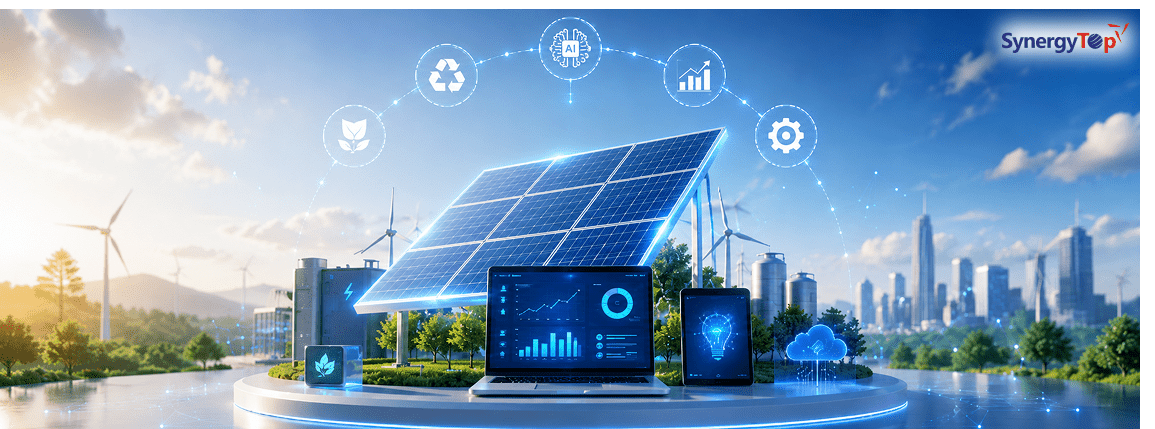


Renewable energy is no longer simply an alternative to traditional power generation. It is becoming a central part of how countries, businesses and communities plan for a cleaner, more secure and technologically advanced future.
Solar, wind, hydropower, geothermal energy and bioenergy are expanding rapidly. At the same time, artificial intelligence, energy storage, smart grids, connected devices and advanced analytics are making renewable power systems more reliable and easier to manage.
What Is the Future of Renewable Energy?
The future of renewable energy will be driven by the continued expansion of solar and wind power, supported by energy storage, smart grids, green hydrogen and AI-powered energy management. Together, these technologies will help energy providers balance supply and demand, improve asset performance, reduce operating costs and build more resilient power systems.
What Is Renewable Energy?
Renewable energy is produced from naturally replenished sources such as sunlight, wind, flowing water, organic matter and heat from within the Earth.
Unlike coal, oil and natural gas, renewable energy sources are not dependent on fuels that require millions of years to form. They can be used repeatedly without exhausting the underlying natural resource.
The main types of renewable energy include:
- Solar energy: Solar photovoltaic panels convert sunlight into electricity.
- Wind energy: Wind turbines use moving air to generate power.
- Hydropower: Flowing or falling water drives turbines to produce electricity.
- Geothermal energy: Heat beneath the Earth’s surface is used for electricity and heating.
- Bioenergy: Organic materials are converted into electricity, heat or fuel.
- Marine energy: Tides, waves and ocean currents are used to generate power.
Each technology has different geographic, financial and operational requirements. A balanced energy system may use several renewable sources together with battery storage and digital grid-management technologies.
Why Is Renewable Energy Important?
Renewable energy is important because it helps address several interconnected global challenges: climate change, air pollution, energy security, increasing electricity demand and the limited availability of fossil fuels.
Its importance extends across environmental, economic and social development.
Environmental Benefits
Generating electricity from solar and wind does not require the direct combustion of carbon-based fuels. This can reduce greenhouse-gas emissions and local air pollution compared with conventional fossil-fuel power generation.
Renewables can also reduce the need for continuous fuel extraction, transportation and processing. Although renewable infrastructure still requires land, materials and responsible lifecycle management, its long-term environmental impact can be considerably lower when projects are carefully designed and managed.
Economic Benefits
Renewable energy creates opportunities across manufacturing, construction, engineering, maintenance, software development, research and project operations.
Solar and wind systems also have minimal fuel costs after installation. This can reduce exposure to long-term fossil-fuel price volatility, although project economics still depend on financing, infrastructure, maintenance and market conditions.
Renewable energy development can also stimulate local investment and employment, particularly in areas where utility-scale projects are constructed.
Energy Security
Countries that rely heavily on imported fuels may be vulnerable to geopolitical disruption and rapidly changing energy prices.
Developing domestic renewable resources can diversify the energy supply and reduce dependence on imported fuel. Distributed solar, storage and microgrids can also improve resilience by reducing reliance on a small number of centralized power facilities.
Social Benefits
Cleaner power generation can support healthier communities by reducing air pollution.
Off-grid solar systems, renewable microgrids and distributed energy resources can also improve electricity access in remote or underserved areas where extending a traditional centralized grid may be expensive or impractical.
How Renewable Energy Is Shaping the Future
Renewable energy is transforming how power is generated, distributed, stored and consumed.
Traditional electricity systems were primarily designed around a limited number of large power plants. Modern energy systems are becoming increasingly distributed, with electricity generated through utility-scale solar farms, offshore wind projects, commercial installations, rooftop systems, microgrids and community energy projects.
This transition is influencing several major sectors.
Cleaner Electricity Generation
Utilities are adding more solar, wind and storage capacity to their energy portfolios. These technologies help meet increasing electricity demand without requiring a proportional increase in fossil-fuel generation.
However, the variable nature of solar and wind means that grids must become more flexible. Storage, forecasting, demand-response systems and intelligent grid controls are therefore becoming essential parts of renewable integration.
Electrification of Transportation
Electric vehicles can reduce direct transportation emissions, but their overall environmental impact depends partly on how the electricity used to charge them is generated.
As renewable electricity becomes more widely available, electric transportation can make a greater contribution to decarbonization. Smart charging systems may also help utilities manage demand and use periods of high renewable generation more effectively.
Smarter Buildings and Cities
Renewable energy will be increasingly integrated into buildings through rooftop solar, building-integrated photovoltaic materials, battery storage and intelligent energy-management systems.
Smart cities can combine renewable generation with connected transportation, public infrastructure, energy-efficient buildings and data-driven utility operations.
Decentralized Energy Systems
The future grid will not depend only on large centralized power plants. Homes, businesses and communities will increasingly produce, store and sometimes sell electricity.
Managing these distributed resources requires secure digital platforms, real-time data and automated coordination between generation, demand and storage systems.
Renewable Energy Statistics and Market Trends
The scale of global renewable energy growth demonstrates that the transition is already well underway.
According to the International Renewable Energy Agency, global renewable power capacity reached 5,149 gigawatts by the end of 2025 after a record addition of 692 gigawatts during the year. This represented annual growth of 15.5%, while renewable sources accounted for 85.6% of total power-capacity expansion.
Solar remained the main driver of capacity expansion. This reflects its improving economics, flexible deployment options and suitability for projects ranging from individual rooftops to utility-scale power plants.
Renewable electricity generation also virtually matched global coal-fired generation in 2025. Renewables accounted for approximately 34% of global electricity generation, increasing from 32% in 2024. Coal remained the largest individual source, also supplying approximately 34% of global generation.
The International Energy Agency expects renewable generation to continue expanding rapidly through 2030. Solar photovoltaic generation alone is expected to overtake wind and nuclear power in 2026 and hydropower by 2029.
These developments show that the renewable transition is moving from early adoption towards large-scale integration.
Renewable Energy Technologies Shaping the Future
Several technologies will determine how quickly and reliably renewable power can expand.
Advanced Solar Energy
Solar technology continues to improve through more efficient photovoltaic cells, better manufacturing techniques and new installation models.
Building-integrated solar can place photovoltaic materials within roofs, façades and windows. Floating solar projects can use reservoirs and other suitable water surfaces, reducing pressure on land while generating clean electricity.
Solar tracking systems, automated inspection tools and AI-based production forecasting can further improve project performance.
Next-Generation Wind Energy
Wind energy is expanding beyond conventional onshore installations.
Offshore wind farms can access stronger and more consistent wind resources. Floating wind platforms may allow projects to operate in deeper waters where fixed-bottom turbines are not practical.
Digital monitoring systems can analyze turbine vibration, temperature, output and weather conditions. These insights can help operators identify performance issues and plan maintenance before failures occur.
Energy Storage
Storage is critical because solar and wind generation varies according to weather and time of day.
Battery energy storage systems can store excess electricity and release it when demand rises or generation falls. Storage can also support frequency regulation, peak management, backup power and grid stabilization.
Future storage systems may include advanced lithium-ion batteries, solid-state batteries, flow batteries, thermal storage, compressed-air storage and green hydrogen.
Smart Grids
A smart grid uses sensors, communication networks, software and automated control systems to manage electricity more intelligently.
It can help utilities:
- Monitor supply and demand in real time
- Detect outages and equipment problems
- Coordinate distributed energy resources
- Redirect electricity during changing grid conditions
- Integrate renewable generation and storage
- Improve demand forecasting
- Automate operational responses
As renewable penetration increases, smart-grid technologies will become essential for maintaining reliability.
Green Hydrogen
Green hydrogen is produced by using renewable electricity to separate hydrogen from water.
It may support sectors that are difficult to electrify directly, including heavy industry, long-distance shipping and some forms of aviation. It can also provide long-duration energy storage, although costs, infrastructure and efficiency remain important challenges.
AI and the Future of Renewable Energy
Artificial intelligence is becoming an important part of renewable energy operations because modern energy systems produce enormous quantities of data.
AI can analyze information from weather services, smart meters, solar installations, turbines, battery systems and grid equipment. It can then identify patterns that would be difficult to detect through manual analysis alone.
Businesses exploring these capabilities can use AI development services to build models and automation systems around their specific operational requirements. SynergyTop’s AI services include predictive systems, machine learning, data-driven decision support and integration with existing business platforms.
Renewable Generation Forecasting
AI models can combine historical output with weather forecasts to estimate how much electricity solar and wind assets are likely to generate.
Better forecasting helps grid operators schedule backup resources, manage storage and balance energy supply with expected demand.
Predictive Maintenance
Renewable assets contain numerous components that can deteriorate over time.
AI-powered predictive maintenance systems can monitor sensor data for unusual vibration, temperature, pressure or output patterns. Detecting these changes early may help operators schedule maintenance before equipment fails.
Grid Optimization
AI can help energy operators evaluate generation, demand, storage availability and market conditions in real time.
Automated systems can recommend or execute actions such as charging batteries, discharging stored energy, redirecting power or adjusting controllable resources.
Anomaly Detection
Unexpected changes in energy production can indicate equipment degradation, communication problems, sensor errors or cybersecurity issues.
AI-based anomaly detection can notify teams when system behaviour moves outside expected operating patterns.
Renewable Energy vs Fossil Fuels
| Feature | Renewable Energy | Fossil Fuels |
| Primary sources | Sunlight, wind, water, biomass and geothermal heat | Coal, oil and natural gas |
| Resource availability | Naturally replenished | Finite |
| Operational emissions | Generally lower | Generally higher |
| Fuel costs | Minimal for solar and wind | Continuous fuel expense |
| Output characteristics | Some sources are variable | Often dispatchable |
| Infrastructure need | Storage, transmission and smart-grid investment | Extraction, transportation and combustion infrastructure |
| Long-term energy security | Can strengthen domestic supply | May create exposure to fuel-market volatility |
| Environmental impact | Lower when responsibly developed | Higher emissions and extraction-related impacts |
Renewable energy and fossil fuels cannot be compared on one factor alone. Reliability, storage, grid flexibility, location, cost, environmental impact and energy security must all be considered.
However, as storage, forecasting and grid-management technologies improve, renewable energy can supply a progressively larger share of global electricity demand.
Challenges Facing Renewable Energy Adoption
Despite rapid growth, renewable energy still faces several technical, financial and regulatory challenges.
Grid Infrastructure
Many existing power grids were designed for predictable electricity flows from centralized power plants. They may require significant modernization to support variable and distributed generation.
New transmission lines, substations, digital controls and interconnection capacity are needed to move renewable electricity from resource-rich areas to demand centres.
Intermittency and Storage
Solar generation falls at night, while wind output changes according to weather conditions.
Storage, demand response, interconnected grids and flexible generation can help manage these variations, but these solutions require investment and coordinated planning.
Permitting and Regulation
Renewable projects may face lengthy approval, land-use, environmental-review and grid-interconnection processes.
Unclear or changing policies can delay construction and increase financial risk.
Financing
Large renewable and grid-modernization projects require significant upfront investment.
Financing can be particularly challenging in developing markets where borrowing costs are high or investors perceive greater regulatory and commercial risk.
Data Fragmentation
Renewable energy businesses may use separate systems for asset monitoring, customer management, maintenance, billing, reporting and regulatory compliance.
When these systems do not communicate effectively, teams may lack a complete view of their operations. This is where integrated digital platforms become valuable.
How Technology Is Accelerating Green Energy for the Future
The physical development of renewable energy infrastructure must be supported by an equally strong digital foundation.
IoT sensors can gather performance data from panels, turbines, batteries, meters and substations. Cloud platforms can centralize that information. Analytics can transform raw data into operational insights, while AI can support forecasting, optimization and automation.
Digital twins can create virtual representations of physical assets. Engineers can use these models to analyze performance, simulate changes and evaluate potential issues without directly interfering with live equipment.
Companies can learn more about these capabilities through SynergyTop’s guide to energy management software, which explains real-time monitoring, smart-meter integration, energy analytics, automated alerts and cloud-based energy-management platforms.
How Digital Platforms Help Renewable Energy Companies Scale
Renewable energy companies often begin with a small number of projects, assets or operating locations. As their portfolio grows, spreadsheets and disconnected systems can become difficult to maintain.
A modern renewable energy platform can create one operational environment for monitoring, analytics, automation, reporting and decision-making.
Important capabilities may include:
- Real-time solar, wind and storage monitoring
- Energy-production dashboards
- Weather and generation forecasting
- Asset-performance tracking
- Predictive maintenance alerts
- Smart-meter and IoT integration
- Battery charge and discharge monitoring
- Customer and project management
- Automated compliance reporting
- ESG and sustainability reporting
- Work-order and maintenance workflows
- Role-based access and security
- Mobile access for field teams
- API integrations with external systems
SynergyTop offers AI-based renewable energy software solutions designed to help organizations improve forecasting, automate repetitive processes, monitor distributed assets and manage multiple energy sources from a unified platform.
SynergyTop Insight
The challenge for many renewable energy businesses is not simply collecting more data. The greater challenge is bringing operational, asset, customer and market data together in a form that helps teams make timely decisions.
A well-designed energy platform should not only display information. It should highlight exceptions, identify risks, automate routine work and guide teams towards the next appropriate action.
When Is Custom Renewable Energy Software Required?
Off-the-shelf platforms may work for standard monitoring and reporting requirements. However, they may become restrictive when an energy company has unique assets, business processes, data sources or integration requirements.
Custom software may be appropriate when a company needs:
- Proprietary forecasting or optimization models
- Integration with specialized hardware
- Unique compliance and reporting workflows
- Multi-site or multi-asset management
- Customer portals and mobile applications
- Advanced security requirements
- Integration with CRM, ERP or billing systems
- A scalable platform supporting future products
- Complete control over data and functionality
SynergyTop’s custom software development services support consulting, web development, mobile development, API integration, modernization, MVP development and scalable enterprise platforms.
For businesses developing a new commercial technology product, software product engineering services can support the complete lifecycle from product planning and architecture to development, testing, deployment and future improvement.
Why Renewable Energy Will Define the Coming Decades
Renewable energy combines three priorities that are shaping modern economies: sustainability, resilience and technological innovation.
The continuing expansion of solar and wind, combined with storage, smart grids and AI, will make renewable systems more flexible and capable. Digital platforms will help operators manage increasingly complex portfolios while improving reliability and visibility.
The transition will not happen without challenges. Grid expansion, financing, regulation, storage and responsible project development all require continued attention.
Nevertheless, renewable energy is no longer a distant possibility. It is becoming a foundational part of the global electricity system and an important source of business and technological innovation.
FAQs
Why is renewable energy important?
Renewable energy is important because it can reduce greenhouse-gas emissions, diversify energy supplies and decrease dependence on finite fossil fuels. It can also support local employment, improve electricity access and protect economies from some forms of fuel-price volatility.
What is the future of renewable energy?
The future of renewable energy will involve greater solar and wind capacity, advanced battery storage, smarter electricity grids, distributed generation and green hydrogen. AI and digital energy platforms will help operators forecast production, monitor assets and coordinate energy supply more efficiently.
How will renewable energy shape the future?
Renewable energy will influence electricity generation, transportation, buildings, industry and urban infrastructure. It will support electric mobility, distributed power generation, smart cities and cleaner industrial processes while creating new opportunities for technology providers and energy businesses.
What role does AI play in renewable energy?
AI helps renewable energy operators forecast solar and wind generation, identify equipment anomalies, predict maintenance needs and optimize the use of storage. It can also support grid balancing, market analysis and automated decision-making across complex energy networks.
What is renewable energy management software?
Renewable energy management software is a digital platform used to monitor, analyze and optimize solar, wind, hydro, storage or hybrid energy systems. It can combine asset data, operational workflows, alerts, reporting and forecasting within one interface.
How can renewable energy companies monitor distributed assets?
Companies can connect meters, sensors, inverters, turbines, battery systems and other equipment to a centralized cloud platform. Dashboards can then show real-time production, equipment condition, energy flow, alerts and performance across multiple sites.
Conclusion
Renewable energy is essential to building a cleaner, more secure and resilient future.
Solar, wind, hydropower, geothermal energy and bioenergy will continue to expand, while storage, AI and smart-grid technologies will make these resources easier to integrate and operate.
For renewable energy companies, future growth will depend on both physical and digital infrastructure. Organizations that invest in intelligent monitoring, connected assets, automated workflows and data-driven operations will be better prepared to manage complexity and scale sustainably.
SynergyTop helps renewable energy businesses design and develop secure, scalable and AI-enabled digital solutions. From asset-monitoring applications and energy analytics dashboards to custom operational platforms and system integrations, our team can help transform renewable energy data into practical business value.
Ready to modernize your renewable energy operations?
Book a Renewable Energy Software Consultation with SynergyTop