contact@synergytop.com
 +1 619-349-4911






Estimates suggest that each patient generates approximately 80MB of data annually. Not much, right? Easy to store and manage.
But imagine a clinic that sees multiple patients every day. A hospital that manages thousands of patients. The volume of data that these organizations generate and deal with is huge. Large hospitals, for example, annually produce an average of 50 petabytes of data.
Despite this wealth of information, many practices struggle to provide seamless patient care. Why? Because most of this data is trapped in data silos.
Data silos, which are isolated pockets of information, don’t communicate with each other. This makes them practically useless.
At SynergyTop, we’ve helped over 25+ clinics, hospitals, and private practices overcome the challenges of data silos.
How? By building and integrating their healthcare systems. With that, we’ve seen firsthand how breaking down silos can transform efficiency. And improve patient outcomes. In this blog, we’ll help you explore:
- What are healthcare data silos?
- Why do healthcare data silos exist?
- How data silos hurt healthcare businesses?
- How to fix healthcare data silos?
- The business benefits of breaking down healthcare data silos
- Getting started towards a unified, silo-less healthcare system
Let’s dive right in.
What Are Healthcare Data Silos?
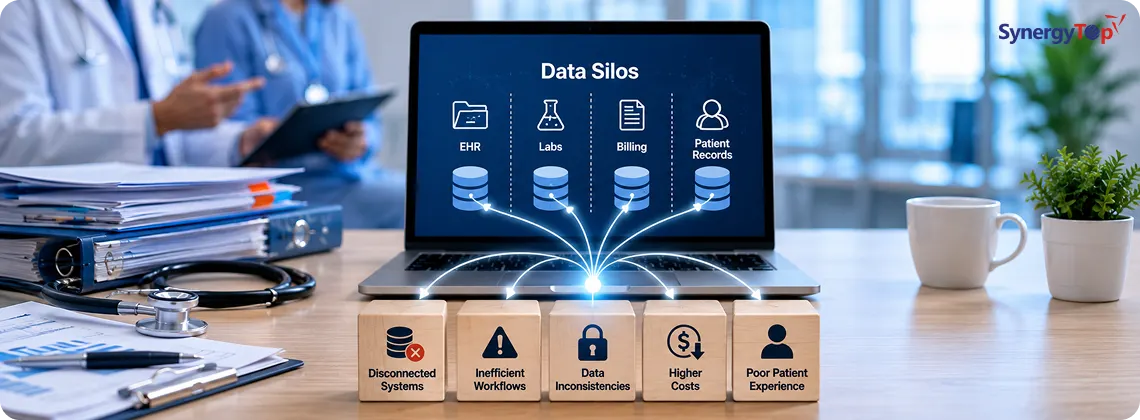
A data silo happens when data is stored in separate systems that don’t “talk” to each other. In healthcare, this could mean that patient records are stored in one system, billing information in another, and diagnostic reports in yet another.
For example, a hospital might use:
- An EHR (Electronic Health Record) system for patient data
- A billing system for payments and insurance claims
- A lab software for diagnostic reports
- A scheduling tool for patient appointments
If these systems aren’t integrated, staff end up manually transferring information or working with incomplete data. This creates delays, errors, and missed opportunities. Not to mention frustration for both staff and patients.
We’ve seen this scenario play out in multiple healthcare settings, from large hospitals to independent clinics. And the impact is more serious than most realize.
Also Read: Types of Healthcare Software
Why Healthcare Data Silos Exist
1. Legacy Systems and Outdated Infrastructure
Many healthcare facilities still rely on outdated legacy systems. These systems weren’t designed to integrate with modern platforms. Upgrading these systems is often seen as expensive and complex. But sticking with them comes at an even higher cost.
2. Lack of Interoperability Standards
Different healthcare systems use different data formats and communication protocols. Without a unified standard, data exchange becomes difficult and unreliable.
3. Data Privacy and Security Concerns
Healthcare data is sensitive, and organizations are rightfully cautious about sharing it across platforms. However, excessive security barriers can lead to restricted access and fragmented data.
4. Organizational Resistance to Change
Healthcare staff are often resistant to adopting new systems due to complexity or lack of training. This slows down integration efforts and prolongs inefficiencies.
How Data Silos Are Hurting Healthcare Businesses
1. Poor Patient Outcomes
When patient information is scattered across different systems, doctors and nurses don’t have a complete picture of the patient’s medical history. This increases the risk of misdiagnosis, conflicting treatments, and poor patient care.
For example, if a doctor can’t see a patient’s allergy record because it’s stored in a separate system, it could lead to prescribing the wrong medication.
2. Increased Operational Costs
Data silos create inefficiencies that increase administrative workload and costs:
- Staff manually entering the same data into multiple systems.
- Wasting time searching for patient information across platforms.
- Increased paperwork and billing errors.
3. Regulatory and Compliance Risks
Incomplete or inconsistent data makes it harder to comply with healthcare regulations like HIPAA and GDPR. Missing records or discrepancies in patient data can lead to failed audits, fines, and legal trouble.
4. Reduced Staff Efficiency and Burnout
Healthcare workers are under immense pressure. When they spend more time searching for patient data or dealing with system mismatches than providing care, it leads to stress and burnout.
5. Missed Opportunities for Better Care
Without a clear view of patient data, healthcare providers can’t identify opportunities for preventive care or personalized treatment. This means lost opportunities for increasing patient engagement and revenue.
How to Fix Healthcare Data Silos
1. Implement Interoperable Systems
Adopting industry standards like FHIR (Fast Healthcare Interoperability Resources) allows different systems to “talk” to each other.
- Choose platforms that support open APIs and data exchange.
- Ensure your EHR, billing, lab, and scheduling systems are integrated.
At SynergyTop, we’ve successfully integrated complex systems for hospitals using FHIR, reducing data transfer time by over 40%.
2. Centralize Data Storage and Access
Use a cloud-based platform to store and access patient data in one place.
- Ensure real-time synchronization across systems.
- Allow secure access for authorized staff from any location.
One of our clients, a multi-location hospital, increased patient data accessibility by 60% after switching to a centralized cloud-based system.
3. Introduce AI and Automation
AI can automate data extraction and analysis, reducing manual workload and improving accuracy.
- Automate appointment scheduling and follow-ups.
- Use AI for predictive analysis and care recommendations.
We integrated an AI-based patient care system for a hospital, which improved early diagnosis rates by 18% within six months.
4. Improve Data Governance and Compliance
Establish clear guidelines for data handling and access.
- Ensure systems are HIPAA and GDPR compliant.
- Regularly audit data processes and security protocols.
5. Educate and Train Staff
Resistance to change often stems from a lack of confidence in using new systems.
- Provide hands-on training for staff.
- Create a support system to address staff concerns quickly.
The Business Benefits of Breaking Down Data Silos
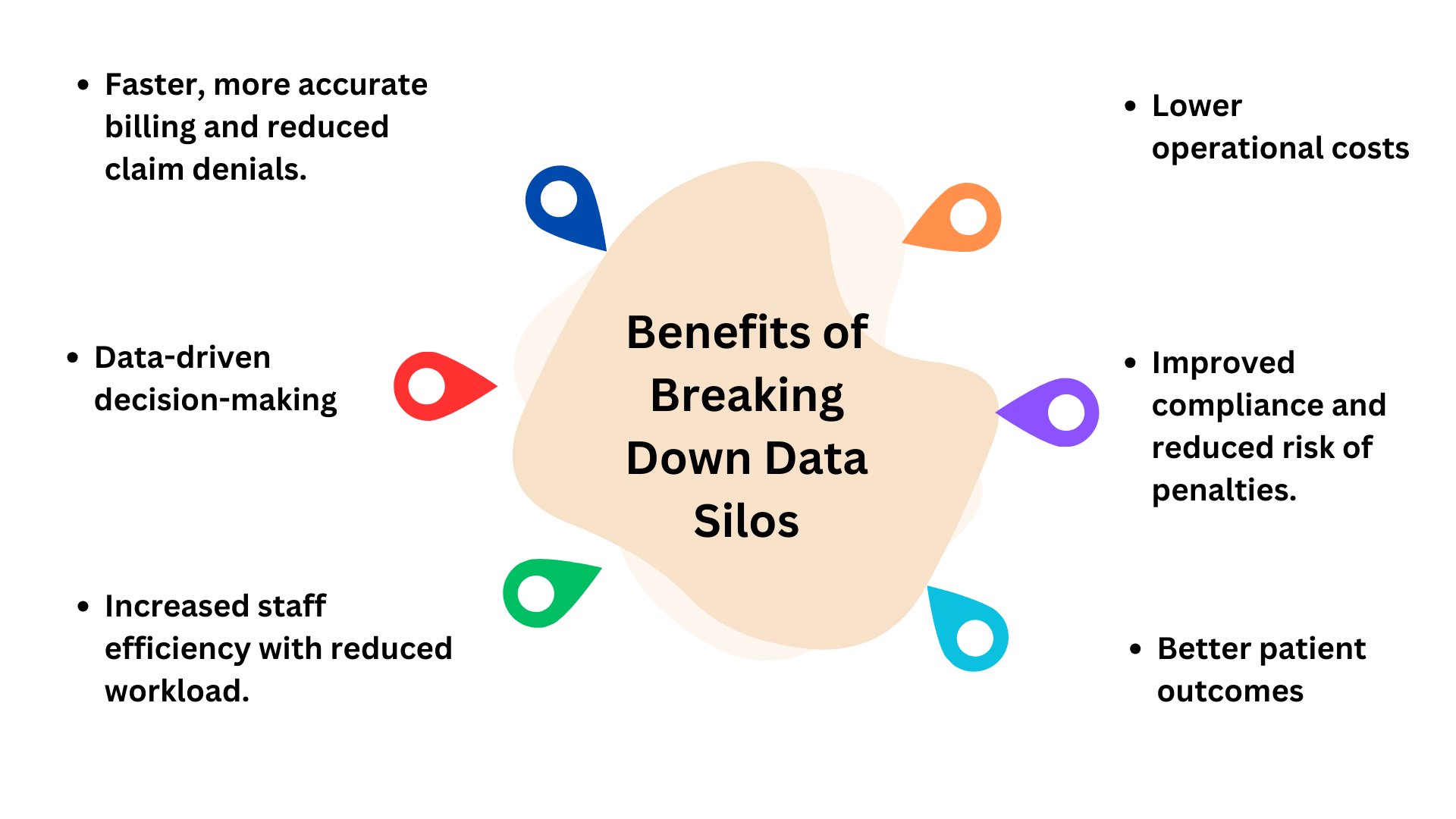
When data flows seamlessly across systems, healthcare businesses experience many benefits, like:
Gearing Towards Silo-Less Healthcare Systems
Healthcare data silos are not just an operational challenge. They directly impact patient care, business efficiency, and revenue. Breaking down these silos requires the right technology and strategy.
At SynergyTop, we’ve helped over 25 healthcare businesses unlock the power of connected data. We make it possible with:
- System integrations
- AI automation, and
- Custom healthcare software development.
If you’re struggling with fragmented data, it’s time to take action. Schedule a no-cost consultation with our team of healthcare development experts today!
FAQs
1. What are data silos in healthcare?
Data silos in healthcare occur when patient, clinical, billing, laboratory, or operational data is stored in separate systems that cannot easily communicate or exchange information. This fragmentation prevents healthcare providers from getting a complete view of patient information and can lead to inefficient workflows, duplicate data entry, and delays in care.
2. What causes data silos in healthcare?
Healthcare data silos are commonly caused by legacy systems, incompatible software, separate departmental applications, lack of interoperability standards, poor data governance, and limited system integration. EHRs, billing platforms, laboratory systems, scheduling tools, and other healthcare applications may all store data independently when they are not properly connected.
3. How do data silos affect patient care?
Data silos can prevent doctors and healthcare staff from accessing complete and up-to-date patient information. This may contribute to duplicated tests, delayed diagnoses, medication errors, inconsistent treatment decisions, and poor care coordination between providers.
4. How do healthcare data silos increase operational costs?
Disconnected healthcare systems often require staff to manually enter, transfer, verify, and reconcile information across multiple platforms. This increases administrative workload, creates billing errors, slows down workflows, and makes it more expensive for hospitals and clinics to manage patient information.
5. What is the difference between healthcare data silos and interoperability?
Healthcare data silos occur when information remains isolated within individual applications or departments. Healthcare interoperability is the ability of different systems, such as EHRs, laboratories, pharmacies, billing platforms, and patient portals, to securely exchange and use healthcare data.
6. How can healthcare organizations break down data silos?
Healthcare organizations can reduce data silos by integrating existing systems, adopting interoperability standards such as HL7 and FHIR, using APIs, centralizing data where appropriate, implementing cloud-based platforms, improving data governance, and automating data exchange between clinical and administrative applications.
7. How does FHIR help eliminate healthcare data silos?
FHIR (Fast Healthcare Interoperability Resources) provides a standardized approach for healthcare applications to exchange electronic health information. FHIR-based APIs can help EHRs, patient portals, mobile applications, laboratories, and other healthcare systems securely share data instead of keeping information trapped in separate platforms.
8. What role does EHR integration play in reducing data silos?
EHR integration connects electronic health records with systems such as laboratory software, billing platforms, pharmacies, scheduling applications, medical devices, and patient portals. This allows information to move between systems automatically and gives authorized healthcare professionals more complete access to patient information.