contact@synergytop.com
 +1 619-349-4911




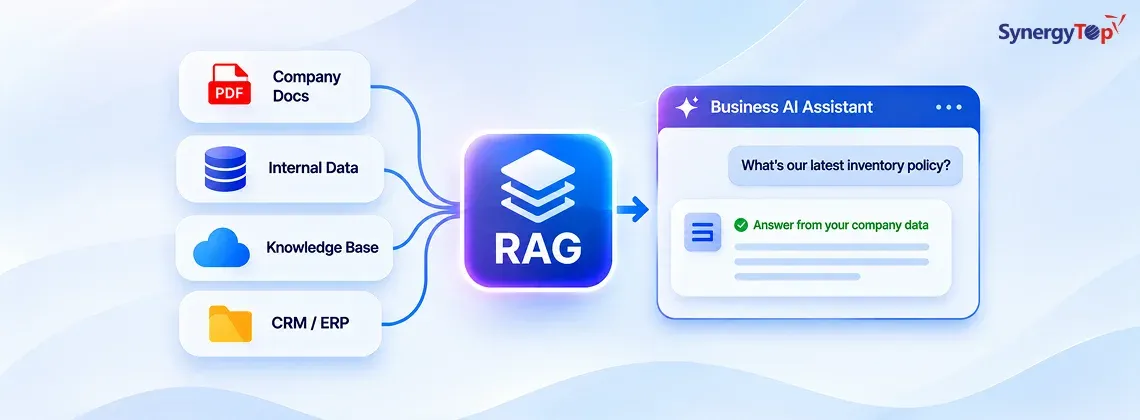


Your company already has the answers.
They are just buried across PDFs, SharePoint, Google Drive, CRM records, ERP systems, support tickets, databases, and internal applications.
Your employees still spend time searching for information, asking colleagues, or working from outdated documents.
This is why many businesses are considering Retrieval-Augmented Generation (RAG): an AI application that can search approved company data and provide grounded answers.
But before investing, there is one practical question:
How much does a RAG application actually cost in 2026?
A focused proof of concept may start around $10,000, while an enterprise RAG platform integrated with multiple business systems can exceed $100,000.
The expensive part is usually not adding a chat box.
It is making sure the AI retrieves the right information, from the right system, for the right user, with enough accuracy and security to trust the answer.
How Much Does RAG Application Development Cost?
A practical 2026 planning range looks like this:
| RAG Solution | Typical Budget |
| RAG Proof of Concept | 10,000–20,000 |
| Private Knowledge RAG Application | 20,000–40,000 |
| Business RAG With Multiple Data Sources | 30,000–60,000 |
| RAG + CRM/ERP/Database Integration | 60,000–120,000+ |
| Enterprise RAG / Agentic AI Platform | 100,000–150,000+ |
These are planning ranges, not fixed quotations.
The actual cost depends on your data, integrations, number of users, security requirements, retrieval complexity, and what you expect the AI to do.
Microsoft describes RAG as combining retrieval with an LLM so responses can be grounded in private or frequently changing information rather than relying only on the model’s training data. Microsoft’s RAG architecture guidance
That sounds straightforward.
In production, it rarely is.
Why Does RAG Development Become Expensive?
Imagine that you want employees to ask:
“Which customer contracts expire in the next 90 days?”
If the answer exists in one clean database, the problem may be relatively simple.
But what if contract information is spread across Salesforce, PDFs, SharePoint, email attachments, and an internal ERP?
Now the RAG system must:
Connect → Extract → Clean → Index → Retrieve → Filter → Generate → Cite
Each additional system adds development and testing effort.
The same applies to document quality.
Five thousand clean documents may be easier to work with than 500 poorly structured PDFs containing tables, scanned pages, duplicates, and outdated versions.
The first cost question therefore should not be:
“How many documents do we have?”
It should be:
“Where does our business knowledge live, and how difficult is it to retrieve reliably?”
The Biggest Cost Is Often Retrieval Quality
A RAG application can technically work and still fail your business.
Suppose an employee asks:
What is our cancellation policy for enterprise customers?
The application retrieves your general customer policy instead of the enterprise contract terms.
The AI produces a professional, confident answer.
But it is wrong.
This is where production RAG requires more than a vector database.
Depending on the application, you may need:
- semantic and keyword search
- hybrid retrieval
- metadata filtering
- query rewriting
- reranking
- source citations
- relevance testing
- permission-aware retrieval
The goal is not simply to make the model answer.
The goal is to make it retrieve the right evidence before answering.
Your Existing Software Can Double the Complexity
A simple knowledge assistant may only search documents.
A business-grade application may need live access to:
- Salesforce
- HubSpot
- SAP
- Microsoft Dynamics
- NetSuite
- SQL databases
- support platforms
- internal APIs
- custom applications
For example, a salesperson could ask:
“Summarize this customer’s last six months of activity and tell me what we should discuss on the next call.”
The RAG application may need CRM activity, invoices, support tickets, meeting notes, contracts, and product documentation.
At that point, you are building more than document search.
You are integrating AI into your existing business software.
SynergyTop explains this architecture in more detail in its guide on integrating AI into existing software without rebuilding everything.
Security and Permissions Can Change the Budget
This is another cost businesses often underestimate.
Your RAG system may find the right information—but should the current user be allowed to see it?
HR documents should not automatically appear for sales employees.
One customer should not retrieve another customer’s information.
Confidential finance data should not become searchable across the company.
Production RAG may therefore require:
- authentication
- role-based access
- document permissions
- SSO
- encryption
- audit logging
- user-level filtering
The more sensitive your data, the more important this layer becomes.
This is particularly relevant for healthcare, finance, legal, SaaS, and enterprise applications.
Are AI API Costs the Biggest Expense?
Usually, no.
Embedding itself can be inexpensive. OpenAI currently lists text-embedding-3-small at $0.02 per million tokens and text-embedding-3-large at $0.13 per million tokens.
Infrastructure can also remain manageable for focused applications.
AWS recently published a RAG proof-of-concept example using approximately 5 GB of documents and 2,000 queries per month, estimating monthly infrastructure and model costs of roughly 78–191.
Your production cost may be considerably different, but this illustrates an important point:
The main investment is often engineering—not one AI query.
Data preparation, integrations, permissions, retrieval testing, user experience, monitoring, and deployment usually determine the project budget.
What Does a Real Business RAG Project Look Like?
Consider a 100-person company with:
- SharePoint
- 10,000 internal documents
- CRM
- product documentation
- policies and SOPs
Employees want to ask:
“What process should I follow for this customer issue?”
A focused RAG solution may retrieve the correct approved documents and return an answer with source references.
Now add:
“Also check this customer’s account, previous support issues, and contract.”
The system now requires CRM integration, structured data retrieval, access controls, and business logic.
That is why two projects both called “RAG assistants” can have completely different budgets.
If your requirement is closer to an internal knowledge assistant, see SynergyTop’s detailed breakdown of private AI assistant development costs.
How Can You Reduce RAG Development Cost?
Do not start with:
Build an AI assistant for our entire company.
Start with one expensive knowledge problem.
For example:
Help our support team answer technical questions using product documentation and approved support knowledge.
Now you can measure:
- answer accuracy
- employee adoption
- time saved
- cost per query
- reduced manual searching
If the business case works, expand into CRM, ERP, additional departments, automation, or AI agents.
This is much safer than spending six figures before proving employees will actually use the system.
What Should You Budget for Your RAG Application?
Before requesting a quotation, answer these five questions:
- What should the RAG application help users do?
- Where does the required data currently live?
- Which systems must be integrated?
- Who should have access to which information?
- How many users and queries do you expect?
You do not need a complete technical specification.
These answers are usually enough to start estimating architecture, integrations, timeline, and development effort.
Get a RAG Development Cost Estimate
The most expensive RAG application is not necessarily the one with the highest development budget.
It is the one your employees stop using because the answers are unreliable.
A successful RAG system should reduce searching, shorten decision time, make company knowledge easier to access, and give users enough source evidence to trust the response.
SynergyTop builds AI-powered custom software solutions and helps businesses integrate AI, RAG, private AI assistants, and intelligent workflows into existing applications.
Planning a RAG application?
Tell us:
What you want the AI to do • Where your data lives • Which systems need integration • Approximate number of users
We can help you determine the likely architecture, development range, integrations, timeline, and implementation approach before you commit to the build.
Get Your RAG Application Cost Estimate
Share your requirements with SynergyTop and get a project-specific quotation.