contact@synergytop.com
 +1 619-349-4911




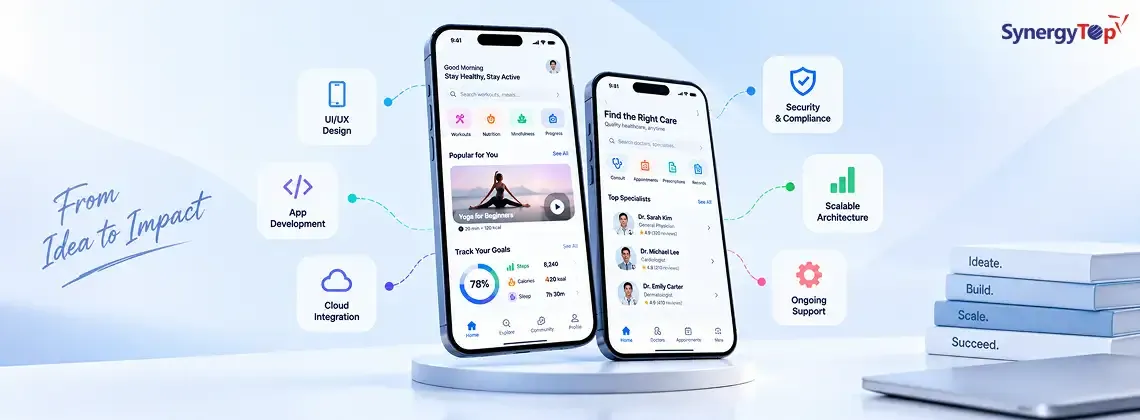


A mobile app development company is a firm that designs, builds, tests, and maintains iOS, Android, and cross-platform apps for businesses. The right one for you is defined less by its portfolio size and more by how it handles discovery, communication, and post-launch support. In 2026, the smartest way to choose is to evaluate a shortlist against five signals verified reviews, a fixed discovery phase, a named team, a realistic budget range, and a maintenance plan before you sign anything.
If you searched “mobile app development company,” you almost certainly did not wake up curious about software vendors. Something pushed you here. Let’s talk about what that something usually is because naming the real pain is the fastest route to hiring the right partner.
Why people actually search for a mobile app development company
Nobody types “mobile app development company” for fun. Behind that query is almost always one of four situations:
- “I have an idea but no technical team.” A founder or business owner has validated demand and needs someone to turn a concept into a shippable product without hiring a full in-house engineering department.
- “My last developer disappeared.” A freelancer went dark, or an offshore shop delivered buggy code, missed deadlines, and stopped answering messages. Now there’s a half-finished app and a trust deficit.
- “My app launched and nobody stayed.” The product shipped but users churned. Industry data repeatedly shows that roughly one in four apps is used only once and then abandoned, and a large share are uninstalled within the first week usually because they load slowly, drain the battery, feel clunky, or solve the wrong problem. This person doesn’t need an app; they need one people keep.
- “Leadership approved the budget and it’s on me to pick a vendor.” A product manager or ops lead has been handed procurement and is terrified of choosing wrong on a five- or six-figure decision.
Notice that only one of these is really about “building an app.” The other three are about risk, trust, and outcomes. A good mobile app development company understands that the buyer’s core fear is wasting money on something that never ships or never gets used and it addresses that fear directly, in plain language, before talking about tech stacks.
The exact queries buyers type (and what each one signals)
Search behavior maps almost perfectly to where someone is in the decision. Here is how the intent shifts across the most common phrases:
| What they search | Where they are | What they actually need |
| “mobile app development company” | Just starting, gathering options | Reassurance and a shortlist |
| “how to choose a mobile app development company” | Comparing, nervous about mistakes | A vetting framework |
| “top rated mobile app development company” | Trust-seeking | Proof: reviews, ratings, awards |
| “mobile app development company in usa” | Wants accountability, time-zone overlap | Onshore or hybrid delivery |
| “top mobile software development companies” | Building a comparison list | A credible, rankable set of names |
| “how much does it cost to build an app” | Budget anxiety | Honest, ranged pricing |
| “mobile app development company near me” | Prefers local, in-person option | Regional presence |
If you’re the buyer, the takeaway is this: match your search to your real stage. If you’re anxious about choosing wrong, you don’t need more company names you need the framework below.
How to choose a mobile app development company: a 7-point framework
Here is the practical, no-fluff way to separate a partner from a liability. Run every candidate through these seven checks.
1. Verified, third-party reviews not testimonials on their own site
Anyone can publish glowing quotes on their homepage. Look for independent proof: Clutch, GoodFirms, G2, and Google reviews, plus named case studies with measurable results. A top rated mobile app development company will have dozens of reviews clustered at 4.5–5.0 stars, with recurring themes like on-time delivery, proactive communication, and responsiveness the three things that actually predict a smooth project.
2. A real discovery phase before any code
Reputable firms insist on a paid discovery or scoping phase a short engagement that produces a technical blueprint, wireframes, a feature list, and a fixed estimate. If a company gives you a firm price and timeline after one call without understanding your users, that’s a red flag, not efficiency.
3. A named team, not a faceless queue
Ask who will work on your project and whether you’ll speak with them directly. The best engagements have a dedicated project manager and named developers you can reach not an anonymous ticket system where your app is one of two hundred.
4. The right technology for your project, not their favorite
There is no single “best” technology for every app. Native (Swift for iOS, Kotlin for Android) delivers maximum performance; cross-platform frameworks like Flutter and React Native let you ship to both platforms from one codebase, saving time and money. A strong partner recommends the stack that fits your budget, audience, and timeline and can explain why in one sentence you understand.
5. Transparent, ranged pricing
Good companies talk about money early and honestly. In 2026, a simple app typically runs $25,000–$60,000, a mid-complexity app $60,000–$150,000, and a complex, multi-integration platform $150,000+. Anyone quoting a flat “we build apps for $5,000” is either scoping something trivial or setting up a change-order trap.
6. A written maintenance and support plan
Launch is the midpoint, not the finish line. Apps need OS updates, security patches, and iteration based on real usage. Confirm what post-launch support costs and what it covers before you sign. This single question filters out a surprising number of vendors.
7. Communication cadence and time-zone reality
Ask how often you’ll get updates and in what form. This is exactly why so many buyers search “mobile app development company in usa” they want overlapping business hours, clear English communication, and legal accountability. Many of the strongest firms now run a hybrid model: US-based strategy, project management, and QA, paired with a global engineering bench that keeps costs sane without sacrificing communication.
USA vs. offshore: what “mobile app development company in usa” really buys you
This is one of the most searched trade-offs, so let’s be direct.
| Factor | US-based | Pure offshore | Hybrid (US + global team) |
| Communication overlap | High | Low | High |
| Hourly cost | $$$–$$$$ | $ | $$ |
| Accountability & legal recourse | Strong | Weak | Strong |
| Time-to-response | Fast | Variable | Fast |
| Best for | Regulated, complex, or fast-moving products | Tight budgets, simple scope | Most SMBs wanting balance |
The honest answer: a fully US team is the safest but priciest option; pure offshore is the cheapest but riskiest; and a hybrid model is where most small and mid-size businesses land in 2026. If a vendor operates from the US and maintains a delivery team abroad, you often get the best of both accountability and time-zone overlap on the front end, cost efficiency on the build.
What separates the top mobile software development companies from the rest
When people build a list of “top mobile software development companies,” they tend to assume it’s about size. It isn’t. The differentiators that actually matter are:
- Domain experience in your industry. A team that has shipped healthcare, retail, solar, or construction apps understands your compliance and workflow quirks before you explain them.
- A full lifecycle, not just coding. UX/UI design, QA automation, cloud/DevOps, and analytics under one roof beats stitching together five vendors.
- Original, provable outcomes. Case studies with real numbers traffic lifted, tasks automated, hours saved signal a primary source, not a portfolio filler.
- Longevity. A firm that has operated for a decade has survived platform shifts, framework churn, and economic cycles. That stability is worth a lot when your app needs support in year three.
Where SynergyTop fits into this picture
Full disclosure: this guide is published by SynergyTop, so here’s the honest positioning rather than a sales pitch.
SynergyTop is a San Diego–headquartered software and mobile app development company founded in 2014, operating a hybrid US-and-India model exactly the structure described above. Over that time the team has delivered 200+ websites, 50+ mobile applications, and 100+ eCommerce platforms for small and mid-size businesses across retail, healthcare, solar and energy, construction, and manufacturing.
On the trust signals that matter to buyers: SynergyTop holds strong, consistent ratings across independent review platforms with the large majority of reviews at 5.0 and recurring praise for proactive communication and on-time delivery and was named a Top Mobile App Development Company in San Diego by Digital.com. On technology, the team ships native iOS (Swift, Objective-C), Android, and cross-platform apps using Flutter, React Native, Ionic, and Xamarin, and pairs development with UX/UI design, QA, and managed cloud services.
That combination a US base for accountability, a global bench for cost efficiency, a decade of longevity, and verified reviews is what most buyers searching this exact term are actually looking for. Whether SynergyTop is your right fit depends on your industry, budget, and timeline, which is precisely what a discovery conversation exists to determine.
Your next step
If you’re at the “gathering options” stage, build a shortlist of three to five firms and run each through the 7-point framework above. If you’re closer to deciding, ask your top candidate for a scoping call and a written estimate and pay attention to how they communicate during it, because that is the preview of your whole project.
The goal was never to hire “a mobile app development company.” It was to ship an app your users actually keep. Choose for that.
FAQs
1. What does a mobile app development company do?
A mobile app development company handles the full lifecycle of an app strategy, UX/UI design, coding for iOS and Android, quality assurance, deployment to the app stores, and ongoing maintenance. The stronger firms also advise on which platform and technology fit your goals, so you don’t overbuild or underbuild.
2. How do I choose a mobile app development company?
Vet each candidate on seven signals: independent reviews, a real discovery phase, a named and reachable team, a technology recommendation matched to your project, transparent ranged pricing, a written post-launch support plan, and a clear communication cadence. If a vendor gives a firm price after one call without scoping, treat that as a warning sign.
3. How much does it cost to hire a mobile app development company in 2026?
As a working range, a simple app typically costs $25,000–$60,000, a mid-complexity app $60,000–$150,000, and a complex platform with multiple integrations $150,000 and up. Exact cost depends on features, platforms, and design complexity, which is why a scoping phase produces a far more accurate number than a phone quote.
4. Is a US-based mobile app development company better than offshore?
A US-based company offers the strongest communication overlap and legal accountability but at a higher hourly rate; pure offshore is cheaper but riskier on communication and recourse. For most small and mid-size businesses, a hybrid model US-based strategy, project management, and QA with a global engineering team delivers the best balance of cost, quality, and accountability.
5. What makes a mobile app development company “top rated”?
Top-rated firms have dozens of verified reviews on independent platforms like Clutch, GoodFirms, and G2 clustered at 4.5–5.0 stars, recurring praise for on-time delivery and communication, named case studies with measurable outcomes, industry awards, and a track record spanning several years.
6. Should I choose native or cross-platform app development?
Choose native (Swift, Kotlin) when you need maximum performance or deep device-hardware features. Choose cross-platform (Flutter, React Native) when you want to launch on both iOS and Android from one codebase to save time and budget. There is no universal best the right choice depends on your users, timeline, and budget, and a good partner will recommend based on those.