contact@synergytop.com
 +1 619-349-4911




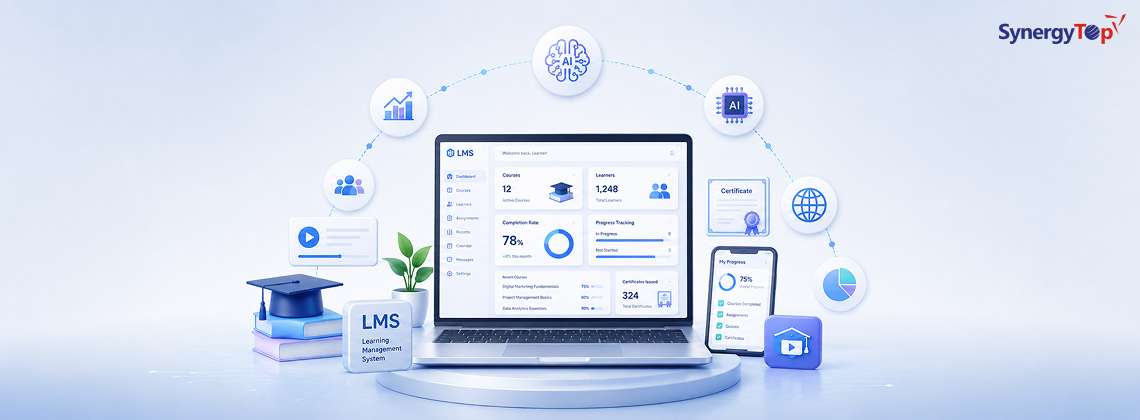


The learning management system industry is entering a new phase of growth in 2026. Organizations are no longer using LMS platforms only to upload courses and track completion rates. Modern learning management systems are becoming intelligent, connected platforms that help businesses develop workforce skills, improve compliance, personalize training and measure learning outcomes.
The most important LMS industry trends in 2026 include artificial intelligence, personalized learning, cloud-based deployment, mobile-first experiences, skills-based training, learning analytics, enterprise integrations, accessibility and stronger data governance.
These developments matter to corporate training teams, educational institutions, professional training providers and businesses investing in modern education technology solutions.
LMS Industry Trends 2026: Key Takeaways
The most important developments shaping the LMS market include:
- The global LMS market is expected to continue experiencing double-digit growth.
- AI is enabling personalized recommendations, automated support and faster content creation.
- Businesses are connecting learning programs with skills development and career mobility.
- Cloud-based LMS platforms are becoming increasingly important for scalability and distributed access.
- Mobile learning and shorter, role-specific training experiences are influencing platform design.
- Organizations are demanding better reporting on engagement, skills and business outcomes.
- LMS integrations with HR, CRM, ERP and collaboration platforms are becoming standard requirements.
- Accessibility, privacy, responsible AI and data security are becoming core buying considerations.
Together, these trends show that an LMS is becoming more than a course-delivery tool. It is developing into a central component of workforce development and digital-learning infrastructure.
How Large Is the LMS Market in 2026?
The global learning management system market was valued at approximately $24.09 billion in 2025 and is projected to reach $31.61 billion in 2026, according to Fortune Business Insights.
The same research forecasts that the market could reach $104.04 billion by 2034, representing a compound annual growth rate of approximately 16.1% from 2026 to 2034.
North America accounted for approximately 42.7% of the global LMS market in 2025, making it an important region for corporate learning, higher education, professional certification and workforce-development platforms.
LMS Market Snapshot
| Market indicator | Latest estimate |
| Global LMS market size in 2025 | $24.09 billion |
| Projected market size in 2026 | $31.61 billion |
| Projected market size by 2034 | $104.04 billion |
| Projected CAGR, 2026–2034 | 16.1% |
| North American market share in 2025 | 42.7% |
Source: Fortune Business Insights. Market projections should be reviewed periodically as research organizations update their forecasts.
Market estimates differ between research companies because they use different definitions, methodologies and market segments. However, major forecasts consistently point toward substantial long-term growth in cloud learning, corporate training and AI-enabled education technology.
Businesses and investors can also review the latest EdTech funding news and market trends to understand how investment activity is influencing digital-learning platforms.
What Is Driving LMS Market Growth?
LMS market growth is being driven by a combination of workforce, technology and operational changes.
Organizations need faster ways to onboard employees, maintain compliance, introduce new technologies and close skills gaps. Educational institutions need flexible systems for delivering courses, managing assessments and supporting blended-learning models.
Professional training businesses also need scalable platforms through which they can sell courses, issue certifications and manage learners.
The World Economic Forum reported that nearly 40% of skills required on the job are expected to change by 2030, while 63% of employers identify skills gaps as a major barrier to business transformation.
These pressures are encouraging organizations to treat learning technology as strategic infrastructure rather than an optional employee benefit.
1. AI-Powered LMS Platforms and Personalized Learning
Artificial intelligence is one of the most significant LMS trends in 2026.
Traditional learning systems typically provide the same content sequence to every learner. AI-enabled systems can use information such as role, assessment results, course history, engagement and skills data to recommend more relevant learning resources.
Depending on the platform and available data, AI-powered LMS features may include:
- Personalized course recommendations
- Adaptive learning paths
- AI-generated quizzes and assessments
- Course-content summaries
- Intelligent search
- Virtual learning assistants
- Automated translations and captions
- Skills-gap recommendations
- Instructor and administrator support
LinkedIn’s 2025 Workplace Learning Report found that 71% of learning and development professionals were exploring, experimenting with or integrating AI into their work.
Organizations planning intelligent learning features can use specialized artificial intelligence development services to integrate recommendation systems, virtual assistants, automation and analytics into an existing or custom LMS.
AI should not, however, be added simply because it is popular. Its use should solve a measurable learning problem, such as helping learners find relevant content, reducing administrative work or identifying skills gaps.
Organizations should also establish clear rules for:
- Data privacy
- Human review
- AI-generated content
- Model accuracy
- Transparency
- Data retention
- Responsible AI use
2. Skills-Based Learning and Career Development
Modern organizations are moving from course-based training toward skills-based learning.
Instead of measuring success only through enrollment and completion, a skills-based LMS connects learning activities to:
- Job roles
- Required competencies
- Career pathways
- Performance goals
- Internal mobility
- Certifications
- Future workforce requirements
This approach helps organizations understand which capabilities they already have, where gaps exist and which learning programs should receive priority.
LinkedIn reports that 49% of learning and talent-development professionals believe their executives are concerned that employees do not have the skills required to execute business strategy.
For businesses, this means LMS platforms will increasingly need:
- Skills-taxonomy support
- Competency assessments
- Role-based learning journeys
- Personalized development plans
- Career-path recommendations
- Integration with talent-management systems
3. Cloud-Based LMS Adoption
Cloud deployment remains a major direction in the learning management system industry.
A cloud-based LMS is hosted and managed through internet-based infrastructure rather than installed entirely on an organization’s internal servers. This model can make it easier to support remote teams, multiple locations and growing learner populations.
Common benefits include:
- Faster deployment
- Remote accessibility
- Easier software updates
- Flexible infrastructure
- Reduced dependency on internal hardware
- Support for geographically distributed learners
- Easier integration with other cloud applications
Grand View Research estimated that the cloud LMS segment generated approximately $15.65 billion in 2025 and forecast strong growth through 2033.
Cloud deployment is not automatically the correct choice for every organization. Businesses with specialized security, data-residency or infrastructure requirements should compare cloud, private-cloud and on-premise options before selecting an architecture.
4. Mobile-First Learning Experiences
Learners increasingly expect training to be available across desktops, smartphones and tablets.
A mobile-friendly LMS should do more than resize a desktop interface. It should allow learners to complete important tasks comfortably on smaller screens, including:
- Watching training videos
- Reading course material
- Completing quizzes
- Receiving reminders
- Downloading permitted resources
- Checking progress
- Participating in discussions
- Accessing certificates
Mobile access is particularly valuable for frontline employees, field teams, sales representatives, healthcare workers, contractors and learners who do not spend their day at a desk.
Organizations that need a dedicated learner application can consider professional mobile application development services for native or cross-platform LMS experiences.
Businesses that want an app-like experience without maintaining separate native applications may also evaluate progressive web application development.
Businesses evaluating an LMS should test actual learner workflows on different devices instead of relying only on a vendor’s “mobile responsive” claim.
5. Microlearning and Learning in the Flow of Work
Long courses are not always the best answer to an immediate workplace need.
Microlearning divides training into focused learning experiences that can be completed in a shorter period. Examples include:
- A five-minute compliance refresher
- A short product demonstration
- A process checklist
- A role-specific quiz
- A safety reminder
- A short troubleshooting guide
Microlearning can be useful when:
- Employees need information at the point of need.
- A procedure changes frequently.
- Training must fit around operational responsibilities.
- Learners need reinforcement after a longer course.
- Organizations want to reduce cognitive overload.
The strongest LMS strategies combine microlearning with structured courses, instructor support, practical exercises and assessments.
Shorter content should support a learning objective rather than simply make every course smaller.
6. Learning Analytics and Measurable Business Outcomes
Basic LMS reporting usually focuses on enrollments, completion rates and assessment scores. In 2026, organizations increasingly need to understand whether training is affecting job performance and business outcomes.
Modern learning analytics may include:
- Learner engagement
- Assessment improvement
- Skills-gap progress
- Time to competency
- Certification status
- Course drop-off points
- Compliance risk
- Learning-path effectiveness
- Department-level performance
- Content usage
- Employee-retention indicators
- Training cost per learner
An effective dashboard should answer business questions, not simply display more charts.
For example:
- Are new employees becoming productive faster?
- Which departments have overdue compliance training?
- Where do learners abandon a course?
- Which skills are missing from a particular team?
- Is a training program reducing support incidents?
- Which content should be updated or retired?
Before implementing advanced analytics, organizations should define what success means and ensure that the required data can be collected accurately and responsibly.
7. LMS Integration With Business Systems
Learning platforms rarely operate in isolation.
A corporate LMS may need to connect with:
- Human resource information systems
- Customer relationship management software
- Enterprise resource planning platforms
- Identity and access-management systems
- Video-conferencing tools
- Collaboration platforms
- Payment gateways
- Business-intelligence tools
- Content libraries
- E-commerce platforms
- Student information systems
Integrations can automate user provisioning, synchronize employee or student information, share completion data and reduce duplicate administrative work.
For education technology environments, Learning Tools Interoperability, or LTI, provides a standard way for an LMS to connect with external learning tools and content. LTI Advantage also supports functions such as role provisioning, assignment and grade exchange and deep linking.
Organizations should identify required integrations during LMS planning rather than treating them as a post-launch task. Integration complexity can significantly affect architecture, budget, security and implementation time.
8. Accessibility and Inclusive Learning
Accessibility is becoming an essential LMS requirement.
An accessible LMS helps people with visual, auditory, physical, speech, neurological and cognitive disabilities use learning content and platform features more effectively.
Accessibility considerations include:
- Keyboard navigation
- Visible focus states
- Screen-reader compatibility
- Captions and transcripts
- Sufficient color contrast
- Accessible forms
- Descriptive link text
- Alternative text for meaningful images
- Clear error messages
- Adequate touch-target sizes
- Accessible authentication
- Consistent navigation and help
W3C recommends using WCAG 2.2 as the current accessibility target when developing or updating web content.
Accessibility should be considered during UX design, development, content creation and quality assurance. Retrofitting it after launch can be more complicated and expensive.
9. Data Security, Privacy and Responsible AI
Learning platforms may contain employee records, student information, assessment results, certifications, performance data and other sensitive information.
Security requirements should therefore be considered throughout the LMS lifecycle.
Important controls may include:
- Role-based access
- Multi-factor authentication
- Encryption
- Secure APIs
- Audit logs
- Data-retention rules
- Backup and recovery
- Vulnerability management
- Vendor-access controls
- Privacy-consent management
- Incident-response procedures
- AI-data governance
The exact compliance requirements will depend on the organization, location, users and type of information processed. A school, healthcare training provider and multinational employer may each face different regulatory and contractual obligations.
When AI is included, organizations should also determine:
- Which data can be processed
- Whether data is shared with external AI providers
- How long data is retained
- Where human approval is required
- How inaccurate AI results will be reported
- Who is responsible for model governance
10. Blended and Hybrid Learning
Digital learning has not eliminated instructor-led education. Instead, many organizations are combining self-paced courses with live sessions, coaching, workshops, assignments and practical assessments.
A blended-learning LMS may need to support:
- Virtual and in-person sessions
- Attendance tracking
- Session scheduling
- Recorded classes
- Instructor feedback
- Discussion forums
- Group assignments
- Practical assessments
- Course prerequisites
- Certificates and continuing-education credits
This model gives organizations the scalability of digital learning while preserving human support where discussion, mentoring or hands-on practice is important.
For example, SynergyTop designed and developed the e-INSCRIPTIONS e-learning platform with live video streaming, video conferencing, online classes, course materials, assignments, quizzes, exams and student-progress management.
11. Custom LMS Development Versus Off-the-Shelf Platforms
One of the most important decisions is whether to purchase an existing LMS or develop a custom platform.
Choose an Off-the-Shelf LMS When:
- Your training process follows common workflows.
- You need to launch relatively quickly.
- Standard reporting is sufficient.
- Your integration requirements are limited.
- Subscription pricing fits your long-term budget.
- The available platform can support your users and content.
Consider a Custom LMS When:
- Your learning process is a competitive differentiator.
- You need unique roles, workflows or approval processes.
- Complex integrations are required.
- You plan to sell courses using a specialized business model.
- You require full control over the user experience.
- Existing platforms require extensive workarounds.
- You need industry-specific compliance features.
- Your learner or administrator journey is substantially different from standard LMS workflows.
Organizations with specialized requirements can use custom software development services to create an LMS around their workflows instead of adapting their operations to a fixed platform.
LMS Selection Comparison
| Requirement | Off-the-shelf LMS | Custom LMS |
| Initial launch | Usually faster | Usually requires more planning |
| Upfront investment | Often lower | Usually higher |
| Custom workflows | Limited by platform | Designed around requirements |
| Product control | Vendor-controlled | Organization-controlled |
| Integrations | Based on available connectors | Can be developed as required |
| Recurring fees | Usually subscription-based | Depends on hosting and support |
| Scalability | Based on vendor plan | Based on selected architecture |
| User experience | Standardized | Can be tailored to users |
| Product roadmap | Controlled by vendor | Controlled by organization |
The correct decision should be based on:
- Total cost of ownership
- Implementation risk
- Business goals
- Integration requirements
- Expected user growth
- Security and compliance
- Long-term platform control
What Should Businesses Look for in an LMS in 2026?
Before choosing or developing an LMS, businesses should assess the following areas.
Business Requirements
Define who will use the platform, what they need to learn and which business outcomes the LMS should support.
Learner Experience
Review navigation, search, mobile usability, accessibility, course discovery and the number of steps required to complete common tasks.
Administrative Experience
Assess how easily administrators can create users, assign courses, monitor progress, update content and generate reports.
Integrations
Document required connections with HR, CRM, ERP, payment, identity, communication and analytics systems.
Reporting
Confirm whether the platform can answer the organization’s most important compliance, engagement, skills and performance questions.
Security and Compliance
Review data ownership, permissions, hosting, encryption, backups, privacy, incident response and vendor-security practices.
Scalability
Determine whether the architecture can support future users, locations, courses, languages and business models.
Support and Maintenance
Clarify who will manage upgrades, integrations, security patches, content changes and technical support after launch.
Organizations that need ongoing technical support can use application management services to monitor, maintain, secure and improve their learning platform after deployment.
How to Prepare for an LMS Development or Modernization Project
A successful LMS project starts with discovery rather than development.
Organizations should prepare the following information:
- User groups and roles: Learners, instructors, managers, administrators, customers or partners.
- Learning workflows: Enrollment, payment, approval, assessment, certification and renewal processes.
- Content types: Video, documents, quizzes, assignments, live sessions and interactive modules.
- Integration requirements: HR, CRM, ERP, SSO, payment, analytics and communication systems.
- Reporting goals: Compliance, engagement, skills, revenue or performance metrics.
- Security requirements: Permissions, data retention, hosting and regulatory considerations.
- Growth expectations: Projected users, courses, locations and languages.
- Success metrics: What the organization expects to improve after launch.
This information allows a development team to recommend an appropriate architecture, feature roadmap, timeline and budget.
Businesses at an earlier planning stage may also review this educational app development guide to understand common application types, important features and monetization options.
Build a Learning Platform That Supports Your Business Goals
The future of LMS technology is not about adding the largest possible number of features. It is about building a learning experience that helps users find relevant knowledge, develop useful skills and complete important training without unnecessary friction.
SynergyTop provides full-lifecycle software services covering:
- Product planning
- UX and UI design
- Web and mobile development
- Third-party integrations
- Quality assurance
- Cloud deployment
- Application maintenance
- Platform modernization
Its education technology experience includes digital-learning platforms, student-management systems, online classes, assessments, video conferencing, payment integration and administrative-management capabilities.
Planning a New LMS or Modernizing an Existing Platform?
SynergyTop can help you evaluate your users, workflows, integrations, security requirements and growth plans before recommending an off-the-shelf implementation, platform modernization or custom LMS.
Contact SynergyTop to discuss your LMS requirements and receive a practical development roadmap.
FAQs
The biggest LMS trends in 2026 include AI-powered personalization, skills-based learning, cloud deployment, mobile-first experiences, learning analytics, microlearning, enterprise integrations, accessibility and stronger data governance.
Organizations are also focusing more on connecting training activity with measurable workforce and business outcomes.
Fortune Business Insights estimates that the global LMS market will grow from approximately $31.61 billion in 2026 to $104.04 billion by 2034, representing a compound annual growth rate of approximately 16.1%.
Forecasts vary by research methodology, but major market studies consistently project continued expansion.
AI can help LMS platforms recommend content, personalize learning paths, generate assessments, summarize material, improve search and provide automated learner support.
Organizations must combine these capabilities with privacy controls, responsible-AI policies, accurate data and human oversight.
Businesses use cloud LMS platforms to support distributed learners, simplify updates, reduce dependence on internal infrastructure and scale more flexibly.
The suitability of cloud deployment still depends on the organization’s security, customization, integration and data-residency requirements.
A corporate LMS is a learning platform used by an organization to manage employee onboarding, compliance training, product education, leadership development, skills improvement, certification and partner training.
It may also integrate with HR, CRM and workforce-management systems.
Neither option is automatically better.
An off-the-shelf platform is usually suitable for common training workflows and faster implementation. A custom LMS may be a better choice when an organization needs specialized workflows, complex integrations, unique business models or greater control over its product roadmap.
A modern LMS should provide intuitive course management, learner tracking, assessments, mobile access, accessibility, reporting, role-based permissions, integrations and appropriate security controls.
Additional features may include e-commerce, live learning, AI recommendations, skills management, certification and multilingual content.
LMS development costs depend on the number of user roles, course formats, integrations, reports, payment features, mobile requirements, AI capabilities, compliance needs and expected scale.
A discovery phase is usually required before a reliable timeline and budget can be prepared.
Conclusion
The LMS industry trends shaping 2026 show that learning platforms are becoming more intelligent, measurable and connected.
AI-powered personalization, cloud infrastructure, mobile learning, skills-based development, analytics and enterprise integrations are expanding what an LMS can do.
At the same time, accessibility, security, privacy and responsible AI are becoming essential requirements rather than optional additions.
Organizations planning an LMS initiative should begin with their users and business objectives. The best platform is not necessarily the one with the longest feature list. It is the platform that:
- Fits the organization’s learning workflows
- Integrates with its existing technology
- Protects sensitive information
- Supports learners across devices
- Produces meaningful performance data
- Scales with its long-term strategy
Ready to plan or modernize your learning management system? Speak with SynergyTop to turn your LMS requirements into a practical product roadmap.