contact@synergytop.com
 +1 619-349-4911




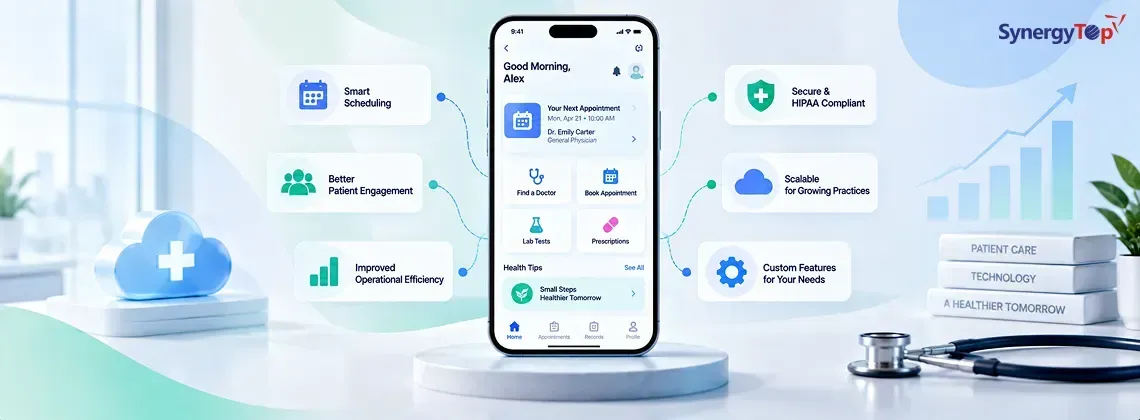


Healthcare apps have moved well beyond appointment booking.
A patient can now check a medical record from a smartphone, attend a video consultation, share readings from a connected device, receive medication reminders, or submit health data directly to a provider. On the provider side, the same application can reduce administrative work, connect with an EHR, support remote monitoring, and give clinicians a clearer view of what is happening between appointments.
The numbers reflect that shift. In 2024, 65% of people in the US reported being offered and accessing an online medical record or patient portal, while app-based access to medical records increased from 38% in 2020 to 57% in 2024.
But there is an important distinction here.
A healthcare app is not simply a regular mobile application with a medical-looking interface. Once an app handles protected health information, connects to an EHR, supports telehealth, or performs functions that could affect clinical decisions, the technical and regulatory requirements change.
That is where good healthcare app development starts to separate itself from ordinary app development.
This guide covers what healthcare mobile apps actually include, the features that matter, the benefits they can deliver, how custom healthcare apps are built, what development costs, and the challenges teams need to plan for before writing the first line of code.
What Is Healthcare Mobile App Development?
Healthcare mobile app development is the process of designing, building, testing, deploying, and maintaining mobile software used to support healthcare delivery, patient engagement, clinical workflows, health monitoring, or wellness services.
The scope is broad.
A simple appointment app and an application that collects continuous glucose readings, connects to an EHR, and helps clinicians monitor patients are both healthcare apps. Their architecture, security model, integrations, testing requirements, and regulatory considerations are very different.
That distinction matters when planning healthcare application development.
A typical healthcare application may have three layers:
| Layer | What it handles |
| Patient-facing app | Appointments, records, medications, messaging, payments, telehealth and health tracking |
| Provider-facing app | Patient information, schedules, consultations, clinical workflows and monitoring |
| Backend/admin system | APIs, databases, authentication, integrations, analytics, permissions and administration |
Healthcare applications can also be divided by purpose:
- Telemedicine and virtual consultation
- Appointment and care scheduling
- Remote patient monitoring
- EHR/EMR access
- Medication and pharmacy management
- Fitness and wellness
- Chronic disease management
- Mental health support
- Patient engagement and education
- Clinical decision support
The important point is that the app type should follow the healthcare workflow, not the other way around.
If the problem is fragmented patient communication, building a sophisticated AI engine does not fix it. If the problem is remote monitoring, an appointment-booking workflow is not enough.
Medical application development works best when the product architecture starts with the clinical or operational problem.
And that brings us to the different types of healthcare apps.
Types of Healthcare Mobile Apps
Healthcare organizations rarely need a generic “healthcare app.” They need software designed around a specific interaction between patients, providers, administrators, devices, and health data.
Here are the most common categories.
1. Telemedicine Apps
Telemedicine applications connect patients with healthcare professionals remotely.
Core functionality can include:
- Video and audio consultations
- Secure messaging
- Appointment scheduling
- Provider availability
- Digital prescriptions
- Patient history
- Payments and billing
- Consultation notes
- Follow-up reminders
Telehealth is no longer an experimental channel. The AMA reports that 71.4% of physicians used telehealth in 2024, compared with 25.1% in 2018.
The key challenge with telemedicine system development is not simply adding a video SDK. The application needs to manage scheduling, identity, consent, clinical context, security, documentation, and what happens before and after the consultation.
2. Appointment Booking Apps
These applications focus on making care easier to schedule and manage.
Patients can search for providers, view availability, book appointments, cancel or reschedule, receive reminders, and manage upcoming visits.
For providers, the system may include:
- Calendar management
- Provider availability
- Appointment rules
- Waitlists
- Automated reminders
- Cancellation management
- No-show tracking
- Multiple locations
A well-designed appointment application should reduce administrative work rather than simply move the same work from a receptionist’s desk to a patient’s phone.
3. Remote Patient Monitoring Apps
Remote patient monitoring, or RPM, allows patients to submit health information from home.
Depending on the use case, this can include:
- Blood pressure
- Blood glucose
- Heart rate
- Oxygen saturation
- Weight
- Temperature
- Activity
- Sleep data
The data can come from manual entry, Bluetooth-enabled devices, wearables, or connected medical equipment.
The real value of getting a remote patient monitoring solution developed comes from what happens after collection. A useful RPM system needs rules for abnormal readings, clinician alerts, escalation, trend analysis, and follow-up.
4. Fitness and Wellness Apps
Not every healthcare application handles clinical data.
Fitness and wellness apps may focus on:
- Exercise
- Nutrition
- Sleep
- Weight management
- Meditation
- Habit tracking
- Preventive health
The regulatory requirements can differ significantly depending on what the app actually does. An app that records exercise is not automatically regulated as a medical device. An app that performs a medical function or controls a medical device can be a different story.
The FDA uses a risk-based approach to determine which software functions fall within its medical-device oversight.
5. EHR/EMR Apps
Getting custom EHR and EMR applications developed give authorized users mobile access to health records and clinical information.
They may support:
- Patient demographics
- Diagnoses
- Medications
- Allergies
- Lab results
- Clinical notes
- Documents
- Care plans
- Patient-generated data
Interoperability is the hard part.
FHIR, or Fast Healthcare Interoperability Resources, provides a standardized way to exchange clinical and administrative health data through APIs.
In 2024, approximately 9 in 10 US hospitals enabled patient electronic access to health information through an API, and seven in ten reported using standards-based APIs such as FHIR for that access.
6. Pharmacy and Medication Apps
These apps can support:
- Prescription management
- Medication reminders
- Refill requests
- Pharmacy search
- Drug information
- Dosage schedules
- Medication adherence tracking
- Notifications
For chronic-care applications, medication management can become part of a larger patient engagement workflow. A well-designed pharmacy and medication app should not simply remind someone to take a pill. It should fit into the way that patient, caregiver, pharmacy, and provider actually work.
That’s only part of the story. The feature set determines whether the application is useful, but the architecture determines whether it can safely operate at scale.
Key Features of Healthcare Mobile Apps
The right features depend on the application. Still, several capabilities appear repeatedly across successful healthcare products.
User-Friendly Interface
Healthcare interfaces need to be simple without becoming simplistic.
Patients may be using the application while sick, stressed, tired, or unfamiliar with medical terminology. Clinicians may be using it between appointments.
That means important actions should be obvious.
A patient should not need to hunt through four menus to find an upcoming appointment. A clinician should not need to open six screens to understand why an RPM alert was triggered.
Patient Dashboard
A patient dashboard can bring the most relevant information into one place:
- Upcoming appointments
- Medication reminders
- Recent test results
- Care tasks
- Messages
- Health metrics
- Treatment plans
- Notifications
The dashboard should be role-based. A patient, doctor, caregiver, and administrator should not see the same information.
Appointment Scheduling
Scheduling can include more than a calendar.
A production-grade system may need to account for provider availability, appointment duration, location, consultation type, holidays, cancellations, rescheduling, time zones, reminders, and overlapping bookings.
These rules should live in the backend rather than being hardcoded into the mobile interface.
Real-Time Chat and Video Consultation
Secure communication can include:
- Patient-provider messaging
- Attachments
- Video consultations
- Audio calls
- Consultation notes
- Notifications
- Session history
For telehealth applications, the communication layer also needs to be considered as part of the application’s security and risk model. HHS specifically notes that communication applications, VoIP systems, and technologies that record or transcribe telehealth sessions can involve ePHI and therefore need appropriate risk analysis and safeguards.
EHR/EMR Integration
This is often one of the largest technical components of a healthcare application.
Integration may involve:
- Patient demographics
- Clinical records
- Medications
- Lab results
- Allergies
- Appointments
- Documents
- Patient-generated health data
FHIR APIs can make interoperability more practical, but “FHIR integration” is not a complete integration strategy. The exact resources, authorization model, EHR capabilities, data mapping, error handling, and workflow still need to be designed.
Security, Privacy and Compliance
Security cannot be added at the end of development.
A healthcare application may need:
- Strong authentication
- Role-based access control
- Encryption
- Secure API communication
- Audit logging
- Session management
- Access monitoring
- Backup and recovery
- Vulnerability management
- Consent management
- Secure cloud configuration
Under the HIPAA Security Rule, regulated entities must assess risks to the confidentiality, integrity, and availability of ePHI and implement reasonable and appropriate safeguards. The Rule also includes requirements around access control, audit controls, authentication, and transmission security.
HHS’s January 2026 cybersecurity guidance also highlights the importance of addressing vulnerabilities such as unpatched software as part of ongoing risk analysis and risk management.
So when someone says, “We will make it HIPAA compliant after launch,” that is already a problem. Security architecture needs to be part of the product architecture.
Analytics and Reporting
Healthcare apps generate useful operational data. Depending on the product, analytics can track:
- Appointment completion
- No-shows
- Patient engagement
- Medication adherence
- Device readings
- Provider utilization
- Consultation volume
- Response times
- Care-plan completion
Analytics should be designed around decisions. Collecting 200 metrics because the database can store them is not analytics strategy.
Benefits of Healthcare Mobile App Development
The business case for app development healthcare is usually strongest when the application removes friction from an existing workflow.
The benefits are not limited to convenience.
Improved Patient Engagement
An app gives patients a direct channel for interacting with providers and managing their care.
Instead of waiting for a phone call, patients can receive reminders, complete forms, view information, communicate with their care team, or access records when needed.
The ONC found that patients who were encouraged by their healthcare provider to use a patient portal accessed and used it at higher rates than those who were not encouraged.
The lesson is simple: technology works better when it is connected to an actual care workflow.
Better Access to Care
Mobile apps can remove geographic and scheduling barriers for appropriate types of care.
Patients can:
- Book remotely
- Attend virtual consultations
- Receive follow-up communication
- Share health readings
- Access records
- Receive reminders
For some conditions and patient populations, that can make ongoing care easier to manage.
Reduced Administrative Workload
Automation can handle repetitive tasks such as:
- Appointment reminders
- Confirmation messages
- Form collection
- Payment notifications
- Basic patient communication
- Prescription reminders
- Data collection
That gives administrative and clinical teams more time for work that actually requires human judgment.
Real-Time Monitoring
A patient doesn’t stop having a chronic condition because their appointment ended.
Remote monitoring can give providers access to information between visits and help identify changes earlier.
The AMA’s research shows that remote monitoring has become a meaningful part of physician digital-health adoption, although implementation still varies widely by practice and specialty.
Cost Efficiency
Healthcare applications can reduce the cost of repetitive manual workflows, but this benefit should be measured rather than assumed.
A useful business case might compare:
Current workflow cost → automated workflow cost → implementation cost → ongoing operating cost
That is a much better calculation than simply saying an app will “save money.”
The benefits of an app ultimately depend on whether it improves a real workflow. That is why custom development becomes important for organizations whose processes don’t fit neatly into an off-the-shelf product.
Custom Healthcare App Development
Off-the-shelf healthcare software works well when your workflow matches the software.
The problem starts when it doesn’t.
You end up paying for features you do not use while creating workarounds for the features you actually need.
Custom healthcare app development takes a different approach. The software is designed around the organization’s workflows, users, data, integrations, and long-term product strategy.
Custom development makes particular sense when you need:
- A proprietary patient or provider workflow
- Complex EHR integration
- Remote monitoring
- Multiple user roles
- Custom billing or subscription logic
- AI-driven functionality
- Connected medical devices
- Multi-location support
- A healthcare marketplace
- A product intended for multiple healthcare organizations
The biggest advantage is not simply customization, but control. You control the architecture, integrations, roadmap, data flows, user experience, and future expansion. That matters because healthcare software rarely stays exactly as it was on day one. A clinic adds providers. A digital health company adds a new care program. An RPM platform adds another device. A telehealth company enters another market.
The application has to grow without requiring a complete rebuild.
Healthcare Mobile App Development Process
A healthcare application should not move directly from an idea to development.
The strongest projects spend time reducing uncertainty before increasing code volume.
1. Requirement Analysis
The first step is to define:
- Who will use the application?
- What problem does it solve?
- What data does it collect?
- Where does that data come from?
- Who can access it?
- What systems need to connect?
- What regulations apply?
- What happens when something goes wrong?
This is where the product scope is established.
2. UI/UX Design
The design phase translates workflows into actual user journeys.
For a patient, that could be:
Sign up → verify identity → select provider → book appointment → receive reminder → attend consultation → receive follow-up
For a clinician:
Log in → review schedule → open patient record → conduct consultation → document notes → create follow-up
The design should expose friction before development does.
3. Development
Development normally includes:
- Mobile application
- Backend services
- Database
- APIs
- Authentication
- Admin dashboard
- Third-party integrations
- Notifications
- Analytics
Depending on the project, teams may use native iOS/Android development or cross-platform frameworks such as Flutter or React Native.
The choice should follow the product requirements rather than fashion.
4. Testing and Compliance
Healthcare testing needs to cover more than whether buttons work.
Testing should include:
- Functional testing
- API testing
- Security testing
- Performance testing
- Device compatibility
- Role and permission testing
- Integration testing
- Data validation
- Failure scenarios
- Compliance requirements
If the software may fall under FDA medical-device oversight, regulatory classification needs to be addressed early. The FDA’s current digital-health guidance makes clear that oversight depends on the software function and the potential risk to patient safety, not simply on the fact that the software runs on a smartphone.
5. Deployment and Maintenance
Launch day is not the end of healthcare software development.
Post-launch work may include:
- Security updates
- OS compatibility
- Monitoring
- Bug fixes
- Performance optimization
- New integrations
- Compliance updates
- Feature improvements
- Infrastructure scaling
HHS describes HIPAA compliance as an ongoing process rather than a one-time destination.
The same principle applies to the software itself.
How to Choose the Right Healthcare App Developer
A healthcare app developer needs more than mobile development skills. The developer needs to understand the environment the software will operate in. Look for these capabilities.
Healthcare Domain Experience
Ask whether the team has actually built healthcare products.
There is a difference between saying “we can build a healthcare app” and having experience with EHR integrations, patient portals, telehealth, clinical workflows, medical data, and healthcare security.
Compliance Knowledge
The developer should understand requirements around HIPAA, GDPR where applicable, and other regulations relevant to the target market.
More importantly, they should understand that compliance affects architecture, infrastructure, access controls, logging, vendors, workflows, and documentation.
Technical Expertise
Evaluate experience with:
- iOS and Android
- Cross-platform development
- Cloud infrastructure
- APIs
- FHIR/HL7
- EHR integration
- Authentication
- Encryption
- Databases
- AI/ML where applicable
- IoT and wearable integrations
Portfolio and Case Studies
Ask for evidence. A strong portfolio should show what was actually built, what systems were integrated, what challenges existed, and what role the development team played. Do not evaluate a healthcare app developer only on screenshots. Ask about architecture.
Post-Launch Support
Healthcare software requires ongoing maintenance.
Ask:
- Who handles production issues?
- How are security vulnerabilities addressed?
- How quickly are critical bugs handled?
- How are third-party API changes managed?
- How are infrastructure and dependencies updated?
The right development partner should be able to discuss these questions without turning the conversation into a sales pitch.
Cost of Healthcare Mobile App Development
This is where many healthcare app estimates become misleading.
There is no meaningful single price for “a healthcare app.” An appointment-booking MVP and an AI-enabled remote-monitoring platform are not remotely the same project. For planning purposes, a custom healthcare application can fall into broad ranges such as:
| App Complexity | Typical scope | Indicative Development Range* |
| Basic MVP | Login, profiles, appointments, notifications, basic admin | $20,000–$40,000+ |
| Mid-complexity | Telehealth, chat, payments, dashboards, integrations | $40,000–$75,000+ |
| Advanced platform | EHR/FHIR, RPM, multiple roles, advanced backend, analytics | $75,000–$150,000+ |
| Enterprise/regulated product | Complex integrations, AI/ML, devices, multiple systems, extensive compliance requirements | $150,000+ |
*These are indicative planning ranges, not fixed market prices. Actual cost depends heavily on scope, geography, technology choices, integrations, compliance requirements, team structure, and post-launch support.
The largest cost drivers are usually:
Features
Every major workflow adds design, development, testing, and maintenance effort.
Platform
Building for iOS and Android can increase the scope compared with launching on one platform first.
Complexity
A simple patient app is much less complex than an application with several user roles, automated workflows, real-time communication, clinical logic, and connected devices.
Integrations
EHR/EMR systems, payment gateways, telehealth services, identity providers, pharmacies, laboratories, wearables, and medical devices can all add significant effort.
Security and Compliance
Security is not a separate checkbox at the end. It affects architecture, infrastructure, development practices, testing, monitoring, access management, and documentation.
Ongoing Maintenance
Budget for:
- Cloud infrastructure
- Monitoring
- Security updates
- OS updates
- Third-party services
- Bug fixes
- New features
- Compliance work
A useful cost estimate therefore looks like:
Development + integrations + security/compliance + infrastructure + testing + maintenance
Not simply:
Number of screens × development rate
That’s a much better way to budget for healthcare software.
Challenges in Medical Mobile App Development
The most difficult part of medical mobile app development is often not writing the mobile code. It is making everything around the code work correctly.
Data Privacy and Security
Healthcare data is sensitive by definition. A security incident can expose medical information, disrupt care, create regulatory consequences, and damage patient trust.
Security needs to cover the entire data lifecycle: collection, transmission, processing, storage, access, modification, backup, and deletion.
Regulatory Compliance
Compliance depends on the product, users, geography, data, and functionality.
A U.S. app handling ePHI may need to address HIPAA. A medical device function may bring FDA requirements into the picture. A product operating in Europe may need to account for GDPR and potentially other health-data requirements.
The exact regulatory path needs to be assessed for the product rather than assumed from the word “healthcare.”
Integration With Existing Systems
Healthcare organizations already have systems. The new application has to coexist with them. That can mean working with:
- EHRs
- EMRs
- Practice management systems
- Billing platforms
- Laboratories
- Pharmacies
- Identity systems
- Payment providers
- Medical devices
The integration layer can become one of the largest parts of the project.
User Adoption
A technically excellent healthcare app can still fail if nobody wants to use it. Patients may abandon complicated workflows. Clinicians may avoid tools that create additional documentation. Administrators may resist systems that increase operational overhead.
Adoption starts with product design. If the app makes an existing workflow harder, people will notice.
Future Trends in Healthcare App Development
Healthcare applications are becoming more connected, intelligent, and data-driven. But not every new technology belongs in every healthcare product.
AI and Machine Learning
AI is moving from demonstrations toward operational use. McKinsey’s 2024 survey of 150 healthcare leaders found that 85% were exploring or had already adopted generative AI capabilities. Healthcare applications can use AI for:
- Clinical documentation support
- Patient communication
- Triage assistance
- Personalization
- Risk prediction
- Image analysis
- Summarization
- Administrative automation
The important question is not “Where can we add AI?”
It is: Where does AI improve a measurable healthcare workflow without creating unacceptable risk?
That distinction will become more important as AI moves deeper into clinical environments.
Wearables and IoT
Wearables and connected devices can turn an app into a continuous data-collection layer. Heart rate, activity, sleep, glucose, blood pressure, oxygen saturation, and other measurements can feed into monitoring systems. The challenge is not collecting more data. It is deciding which data matters, how it should be validated, when someone should act on it, and how false alerts are handled.
Telehealth and Hybrid Care
Telehealth is increasingly becoming part of a broader care model rather than a standalone video call. A mature platform may combine:
In-person care + virtual consultations + messaging + remote monitoring + digital records
The AMA’s 2024 data shows that telehealth remains embedded in physician practice, although adoption differs by specialty and practice setting.
Cloud-Based Healthcare Solutions
Cloud infrastructure makes it easier to scale healthcare applications, support distributed users, manage APIs, and integrate services. But moving healthcare data to the cloud does not automatically make an application secure or compliant.
Architecture, configuration, identity management, logging, backups, encryption, vendor agreements, and ongoing risk management still matter.
Interoperability as a Product Requirement
Interoperability will continue to shape healthcare applications. FHIR-based APIs are already a significant part of the U.S. health IT ecosystem, and ONC continues to advance standards for patient and population access.
For product teams, that means interoperability should be considered during architecture planning rather than added as an integration project after launch.
The healthcare app of the future will not operate as an isolated island. It will be one part of a larger healthcare data ecosystem.
Getting Started with Healthcare App Development
Healthcare apps have become part of how patients access care, how providers communicate, and how organizations manage health data. But building one successfully takes more than a good mobile interface. The application needs the right workflow, secure architecture, reliable integrations, thoughtful UX, appropriate compliance controls, and a roadmap that accounts for what happens after launch.
The most important decisions usually happen before development begins:
Who is the user? What problem are we solving? What data are we handling? Which systems must we integrate? What regulations apply? What needs to scale?
Answer those questions properly and the technology becomes much easier to design.
At SynergyTop, we approach healthcare app development around those practical questions rather than starting with a list of features. With experience across healthcare software, patient-facing applications, integrations, and secure digital products, our focus is on building software that fits the way healthcare organizations actually operate.
If you are planning a new healthcare application or replacing an outdated system, schedule a consultation call with our experts to start planning the workflow and architecture. The feature list can come next.
FAQs
What is healthcare mobile app development?
Healthcare mobile app development is the process of designing and building mobile applications that support healthcare delivery, patient engagement, health monitoring, clinical workflows, wellness, or healthcare administration. Depending on the product, the application may include telehealth, appointment scheduling, EHR integration, remote monitoring, medication management, secure messaging, and analytics.
How much does healthcare app development cost?
Healthcare app development can range from approximately $20,000 for a relatively simple MVP to $150,000+ for complex healthcare platforms. Advanced applications involving EHR integration, remote monitoring, AI, medical devices, multiple user roles, or extensive compliance requirements can cost significantly more. The final cost depends on features, platforms, integrations, complexity, security requirements, development team, and ongoing maintenance.
What features should a healthcare app have?
The features depend on the application’s purpose. Common healthcare app features include:
- Secure login and authentication
- Patient profiles
- Appointment scheduling
- Patient dashboards
- Secure messaging
- Video consultations
- EHR/EMR integration
- Medication reminders
- Remote monitoring
- Notifications
- Payments
- Analytics and reporting
- Role-based access
- Audit logs
- Security and privacy controls
The right feature set should be based on the healthcare workflow rather than a generic checklist.
How do I choose a healthcare app developer?
Look for a healthcare app developer with demonstrated experience in healthcare software, security, compliance, EHR/EMR integrations, APIs, cloud infrastructure, and mobile development. Ask potential developers for relevant case studies and ask how they approach architecture, data security, testing, regulatory requirements, integrations, and post-launch maintenance.